Showing posts with label novels. Show all posts

Tuesday, September 19, 2017

Stepping Heavenward by Elizabeth Prentiss

Stepping Heavenward


Stepping Heavenward by Elizabeth Prentiss is one of my favorite works of Christian fiction.  Written in the 1800s, it is still very interesting and relevant to people in our current day and very readable. Prentiss tells the story using the format of a diary written by a woman named Katherine, who records her life struggles, from young womanhood through much of her married life.  She gives the events of various days (sometimes skipping days, months or even years, but giving updates along the way), and writes down many of her inmost thoughts, questions and struggles with sin.  She has questions about her salvation and whether or not she is being sanctified.  God brings along many different people to teach her and to help her recognize that He really is working in her and making her more Christ like. God also brings along many different trials to grow her spiritually. 

There are several interesting dialogues with others that are recounted by Katy, I give a couple of samples here:

Here she is speaking to one of her spiritual mentors, Dr Cabot:

 "'There is one thing more that troubles me,' I said.  'Most persons know the exact moment when they begin real Christian lives.  But I do not know of any such time in my history.  This causes me many uneasy moments.' 
[Dr Cabot]'You are wrong in thinking that most persons have this advantage over you.  I believe that the children of Christian parents, who have been judiciously trained, rarely can point to any day or hour when they began to live this new life.  The question is not, do you remember, my child, when you entered this world, and how!  It is simply this, are you now alive and an inhabitant thereof?'"

In this next excerpt Katy has just had a former friend, Amelia, die, her husband, a doctor, attended her last moments on earth:

"'What do you think,'  I asked, 'about her last days on earth?  Was there really any preparation for death?'
'These scenes are very painful,' he returned.  'Of course there is but one real preparation for Christian dying, and that tis Christian living……..I do not now recall a single instance where a worldly Christian died a happy, joyful death, in all my practice.'
[Kate]…..'Well, in one sense it makes no difference whether they die happily or not.  The question is do they die in the Lord?'
'[her husband]It may make no vital difference to them, but we must not forget that God is honored or dishonored by the way a Christian dies, as well as by the way in which he lives…..I can tell you, my darling, that standing, as I so often do, by dying beds, this whole subject has become one of great magnitude to my mind.  And it gives me positive personal pain to see heirs of the eternal kingdom, made such by the ignominious death of their Lord, go shrinking and weeping to the full possession of their inheritance.'"

There are several thought provoking dialogues like the above. And many little statements that are intriguing as well, a few of which I give here:

"You can will to prefer a religion of principle to one of mere feeling; in other words, to obey the will of God when no comfortable glow of emotion accompanies your obedience."

"It is repining that dishonors God, not grief."

"People ask me how it happens that my children are all so promptly obedient and so happy.  As if it chanced that some parents have such children, or chanced that some have not! I am afraid it is only too true, as someone has remarked, that this is the age of obedient parents!' What then will be the future of their children? How can they yield to God who have never been taught to yield to human authority…?"

A year after her oldest child died she writes:
"It is a year ago this day that the brightest sunshine faded out of our lives, and our beautiful boy was taken from us.  I have been tempted to spend this anniversary in bitter tears and lamentations.  For oh, this sorrow is not healed by time!  I feel it more and more.  But I begged God when I first awoke this morning not to let me so dishonor and grieve Him.  I may suffer, I must suffer, He means it, He wills it, but let it be without repining, without gloomy despondency.  The world is full of sorrow; it is not I alone who taste its bitter draughts, nor have I the only right to a sad countenance.  Oh, for patience to bear on, cost what it may!"

Now, there were statements and things that I didn't agree with, such as Kate thinking that her little children do not need to learn that they are sinners until they get older, though they do need to learn about Christ.  That doesn't make a lot of biblical , or even common, sense to me.  Wasn't that one of the most important things about Christ? That he came to die for the sins of His people? Or when she indicates that when we die, we leave our bodies forever.  I don't know if she believed in the resurrection of  our physical bodies?  Things like that bothered me.

But overall, I still really liked the book and found it quite spiritually edifying.  Kate grows in the Faith, becomes more patient toward others, learns to not trust her own judgement, learns to trust God more and more, learns that whatever trials He ordains for her to face are lovingly ordained to make her more Christ like.  The book is very well written and really keeps the attention, or at least it kept mine! 

Now, I must say something about this particular edition that I am reviewing, published by Ichthus Publications. The cover is pretty, the format of the text inside the book is very nicely laid out and readable.  But….this edition needs to be proofread.  There are typos ALL OVER this edition, periods and commas out of place or missing, and sentences that were practically unintelligible.  Here's a sample:

"In the first place, Helen would be perfectly if she had the care of father in his present. She is too young to have such responsibility….She is one of those little tender, soft souls one could crush fingers."

I don't think I've ever had to rate a book based on numerous typos and missing words. But I'll have to do that with this one.  I feel really bad having to do this, but I need to rate this edition at only three stars.  Normally I would rate this book at five stars, but this is not a good edition of Stepping Heavenward.  I love the book, I just don't like this edition.  If they would fix the typos it would be great!


Thanks to the folks at Ichthus Publications for sending me a free review copy of this book (My review did not have to be favorable).

Rating of Prentiss' book: Five Stars *****
Rating of this edition:  Three Stars ***

Thursday, August 31, 2017

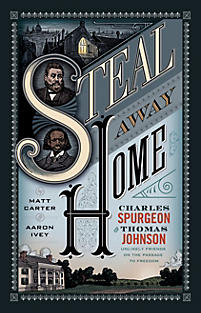
Steal Away Home - By Matt Carter and Aaron Ivey

Steal Away Home: Charles Spurgeon & Thomas Johnson - Unlikely Friends on the Passage to Freedom by Matt Carter and Aaron Ivey, is a novel that tells of a friendship between those two men.  One was a pastor who became quite famous, and yet had a lot of troubles in his life, and the other a former slave who became a preacher and then a Missionary to Africa.  This book is an attempt to imagine their lives leading up to their ultimate meeting and friendship.  Various chapters deal with either the perspective of Spurgeon or that of Thomas in a particular year.  The time advances through the chapters, showing the growing perspective of the men individually.

I really wanted to like this book, but sadly I didn't.  First, , as I was reading this book I kept running across parts where the thought kept nagging me that something about the depiction wasn't right.  I went and looked at some other books I have on Spurgeon and realized the thought was generally correct.  The authors don't seem very concerned about getting the history right. 

I'll give a couple of examples:  First, when Spurgeon's wife, Susannah, heard Spurgeon preach and  laid eyes on Spurgeon  for the first time, the book describes Susannah as struggling with conviction, focused upon a spiritual question provoked by Charles' sermon.  But in real life Susannah herself says, "Alas, for my vain and foolish heart! I was not spiritually minded enough to understand his earnest presentation of the Gospel and his powerful pleading with sinners", rather she remembers that his odd attire attracted most of her attention and caused her some amusement.  The portrayal afterward when they met at dinner seemed odd as well, Spurgeon and Susannah are depicted as flirting with each other, even though they were only just meeting each other! I never understood that to be the case.  Another inaccuracy in the book is that Susannah is present in the building at the time of the Surrey Gardens Music Hall disaster and Spurgeon runs to her immediately after attempting to conclude the message.  In reality Susannah was not there, she was at home having not yet recovered from childbirth.  I understand that this is a work of fiction, but I understood that it was going to be building around the historical facts, not changing them.  This just seemed like an attempt to make the events romantic, when they were not.

Second, I didn't like that Charles and Susannah are portrayed together in bed.  Nothing really indecent is described there but I feel really uncomfortable with that type of thing.  The conversations that this book depicts them having in bed could have been had in the living room during the day.  There was also at least one description of Spurgeon touching his wife that make me feel uncomfortable, it seemed slightly sensual.  Maybe I'm just too picky, but I don't need to picture them caressing each other in order to realize that they loved each other.  I don't understand why this needs to be depicted? 

And then, ironically, some  of Spurgeon's struggle with depression is depicted in a depressing way.  Spurgeon is shown to struggle with various fears,  fear about his wife dying, about himself dying with no one to mourn him, fearing that too many people need him, feeling that no one needs him, and he has struggles with the "why" of his and his wife's sufferings.  Things like that.  He finally finds peace late in the book when Thomas talks to him, but that doesn't make much sense. I don't understand that what Thomas told him was different from what he had already been contemplating himself, in real life and in the book.  And I really didn't think that Spurgeon's almost despairing "why?" was in keeping with his character.

I never thought that Spurgeon lived through a good portion of his life doubting the sanctifying purpose of God in suffering. From what I've read, he seemed to understand it most of his life as a Christian! And I always thought that good deal of his sadness and depression stemmed from his grief for others.  That he mourning for the souls of people and their not caring for God rather than fearing that they did not care about him.  That he mourned for the state of the church and the indifference of so called Christians to getting the Gospel right and Biblical doctrine right.  I also remember his grieving that he didn't preach adequately. In a way, a lot of Spurgeon's sorrows seemed to me to be godly sorrow, rather than worldly sorrow.  But perhaps I misunderstood Spurgeon's depression in my readings of biographies about him, or perhaps I just don't remember correctly.

But the way they have him deal with his depression (or not deal with it) also bothered me.  One spot talks about him using nature:  "Whether it was a starry night on the patio, a morning in the garden, an afternoon with bees, or a week in the countryside with a friend, Charles did his best to surround himself with things that felt natural, real, and truthful.  Because when a person wars against depression, and tries with all their might to push away the haunting darkness……that person pays very close attention to the things that illuminate truth.  Like sunshine after a weeklong shower, truth is wonderfully bright to a depressed heart."  That didn't make biblical sense to me.  That the things which are seen illuminate truth and, by implication, provoke faith?  Doesn't that contradict what Hebrews 11:1 says about faith? And other Biblical passages as well? Truth is found by hearing the Word of God, and faith comes by that Word, not by staring at nature or finding things to stir up one's emotions or feelings.

The portrayal of the two wives, Spurgeon's wife and Johnson's wife, gave me an impression that the wives were the spiritual leaders of the families.  I know in Spurgeon's family that wasn't the case in real life. Spurgeon was his "wifey's" spiritual leader.  That change grated at me, but maybe I just read it the wrong way.  And then Spurgeon seemed too, how shall I describe it?  Too flighty? Too mystical?  He didn't seem as grounded in the truth of God's Word as the real Spurgeon was.

The book didn't talk about the DownGrade controversy, or Susannah's book fund for pastors who were struggling financially. Facts like those would have been interesting to have delved into and contemplated. Showing Spurgeon's fight to keep to the truths of the Bible rather than give in and promote the doctrines of men. Instead the book just seemed to desperately be trying to interweave Johnson and Spurgeon's lives more than they probably actually were.  Even at the very end, they portray Susannah softly singing "Steal Away" to Spurgeon as he is dying.  Maybe she did, though I don't remember it.  I remember having read in a biography that the song that was sung close to the time Spurgeon died was "Emmanuel's Land", which, as nice as Steal Away is, has a lot more biblical concepts than the latter. 


 I have focused on the book's portrayal of Spurgeon and his wife because I don't know much about Thomas Johnson. But, knowing how they portrayed the Spurgeons, I'm not sure I'd completely trust the portrayal of Johnson or his wife either.  I am very disappointed.  The book was well written, I just didn't find this Spurgeon to be the Spurgeon I read about in the biographies.  Historical Fact is more fascinating than historical fiction, and the individual facts of history were all ordained of God, so we can't make them any better!  The facts God ordained, events, people, times, how much people met, how little they met…etc, are all perfect! Work with those!  I really wish that the authors of this novel had grounded their fiction more solidly in the facts God ordained rather than amending them to fit some other story line they wanted to run with. 

Many Thanks to the folks at B&H Publishers for the free review copy of this book (My review did not have to be favorable)!

My Rating:  1 out of 5 Stars
*