Showing posts with label Book review. Show all posts

Tuesday, September 10, 2024

Shepherds For Sale by Megan Basham


Shepherds For Sale, as one would expect, is not an uplifting read, but it's very insightful.  Each chapter gives details about how so many church leaders are turning away from the Bible as their sole authority of faith and practice and instead turning to the 'moral' 'causes of the world.  

I really liked how Basham did this, giving facts in  journalistic way and yet giving Biblically based commentary/critiques throughout.  I wasn't sure how to write this review (or 'tome' as it turned out to be!) as this book is a little more unique from any book I've read before, as it has a lot of 'data' as it were, a lot of documenting of the downfall of church leaders. So I'll write it a bit different and go chapter by chapter:

CLIMATE CHANGE: Pastors have accepted the idea of climate change as one of the things they are obligated to warn their people about. Some of them are doing it under the guise of it's being "Creation Care" or something of the sort. And some are even making it out to be a "part of the Gospel".  That, of course, is absolutely false. But many church leaders have bought into concepts like that. I really liked that Basham went on to explain what the Gospel actually is.  

I also liked how she pointed out that there is another side to all of this supposed 'creation care' and that it isn't necessarily as 'caring' as it appears.  Actually, it could be argued that it is causing harm to people in poorer countries. And she gives examples of this, showing how other developing countries have made deals to implement climate protecting measures in exchange for certain things and they end up halting the progress toward wealth and prosperity and causing the reverse of prosperity in their countries.

This earth is temporal, not eternal. We should not live for it. As Romans 8 says, The earth is not getting better, right now it is in bondage to corruption, decay, and was apparently put into that bondage by God Himself.  It is waiting, not for mankind to care for it correctly, but rather, it is waiting for the "revealing of the sons of God"(vs.19), waiting for the day when Christ will come again along with His people who are already with Him in Heaven, on that day He will also rescue His people who are still on earth, rescuing their fleshly bodies from their bondage to sin and corruption. On that day He will also set the creation itself free from its bondage to corruption. But even after this, even after the thousand year reign of Christ, apparently He is going to torch the earth and make a new Heaven and a new earth (Rev 21:1).

ILLEGAL IMMEGRATION
This topic has been promoted with similar, seemingly Biblical, disguises.  In this case, welcoming illegal immigrants under the banner of "welcoming the stranger". And yet, our country does welcome the stranger, and has welcomed the stranger. But does this mean that Christians should push for our government to welcome any and every stranger into the country we live in? Basham shows that actually, this mindset is actually harming the citizens and legal immigrants who already live here.  A government report given in 2018 "showed that between 2010 and 2015, illegal migrants who were incarcerated were responsible for the deaths of 33,000 people. Simple back-of-the-envelope math suggests that the total over the last thirteen ears could easily top 85,000." And they're not just losing their lives, they're losing jobs too, and human trafficking over our border has also risen.  Sure, we Christians could risk losing our lives, jobs..etc. But where is our love for the lost, natural born citizens of our country? Do we not care what happens to them?

Basham points out that "'Of course, believers are to preach Christ crucified to all, no matter how they arrived here. Of course, we should provide for those in real need, no matter how the needy came to cross our path. But 'welcome the stranger' was Christ's command to his followers to personally emulate the Good Samaritan. To insist that it was meant to be used as a blanket immigration policy is spiritual manipulation that cheapens its meaning…" 

Which leads to some thoughts that came to mind while reading this book.  There seems to be this thought, in the minds of many Christians, that any given country, especially one based on Judeo Christian principles, should act as if it were an individual Christian toward other nations and even toward its own people. If that makes any sense. Let me explain some more:

When you look at what the Bible says about government leaders, even though government leaders are set up by God, both collectively and individually, the leaders of a country apparently do NOT have to act as an individual Christian is supposed to act. A Christian is supposed to love his enemies, turn the other cheek and return good for evil. The leaders of a country are given a sword, to punish evildoers (Romans 13). An individual Christian should not make people who do wrong against him terrified of him, and  they are not allowed to punish, or take vengeance on those who hurt them,  but one could make the case that, apparently, governments rightfully do so (Romans 13:3-4), and not only that, the leaders of governments are God's avengers, agents, as it were, of His wrath "on the one who practices evil".

 So yes, vengeance is God's, not ours as individual Christians, but part of how He carries out His own vengeance is through government leaders. (Can the government misuse their authority, yes, but that's not what we're looking at here). One could also make the case that governments are not to love their enemies, but rather to protect the people over whom God gave them charge, which may involve military conflicts with other countries, and yes, even borders to keep potential enemies from entering their country. As Basham notes, "Scripture does not require us to sacrifice national sovereignty. In fact, Acts 17:26 tells us that God 'marked out [our] appointed times in history and the boundaries of [our] lands.' The Lord is not opposed to borders; He invented them."

HIJACKING THE PRO LIFE MOVEMENT
Oddly enough, Basham shows that even Christian antiabortion movements are being affected by a more liberal stance.  The concept of not taking innocent life is one of the most basic truths, the 6th commandment. And yet she shows that there are some 'Christian' movements who think that one shouldn't be so vigilant in standing against it, and some professing Christians who seem to be questioning whether we should even be against it at all.  

I liked her argument to those professing Christians who (bizarrely)thought that one should vote for Clinton or Biden rather than Trump, (largely because of Trump, "Let's be clear, no one cast a ballot for Trump because he committed adultery….Nor was the legal protection of adultery or lechery a feature of the Trump campaign's platform.  In contrast, Clinton and Biden did promise voters that electing them would allow the butchery to continue. They did make it a part of their platforms, and a significant number of voters cast ballots for them based on those promises. Given this, which vote is more morally uncompromising for the Christian - the one that places power in the hands of those who promise to allow the innocent to be put to death or the open that vests power in those who promise to make a way to rescue the innocent?"

CHRISTIAN MEDIA AND THE MONEY MEN
And then, of course, there Christian publications that are headed down…or solidly on, the liberal path. Basham demonstrates examples of these and the mindsets of the various people promoting them.

GRACIOUS DIALOGUE
Wow. Covid-19. Those were weird years. I remember seeing some of the arguments that Basham cites. "Love Your Neighbor" in particular. As if the only way to love one's neighbor was to avoid your Christian brethren when they were sick or rather, just avoid them all together because both of you might get sick or be carriers of covid. It's frightening to think that this all seems to laud the actions of those who, on the judgment day, Christ condemns  for not caring for other Christians,  "[I was] sick, and in prison, and you did not visit Me.’"(Matt 25:43). 

As Basham shows, many presented the Covid restrictions as a matter of obedience to Jesus. But she argues that there were practical and Biblical arguments against them, including Hebrews 10:25.  It is a very fascinating and sobering chapter to see detailed many of the various manipulation of the facts and the Scripture that went on during those days.

 To add more of my own argument, even if it WERE an extremely, very deadly serious sickness, don't Christians believe in the sovereignty of God? He is ultimately in control of who gets sick and who doesn't. And He's not just over sickness, He controls our life and death, whether sick or not.  And if early Christians (and many present day ones)were willing to risk their lives (and the lives of their unbelieving family members and acquaintances because of association) by meeting together to hear the Word of God (in spite of government command), to fellowship and care for one another, shouldn't we do the same in the face of deadly disease? Risking our own potential death and even the potential death of our unbelieving relatives and acquaintances? Wouldn't we want to be one of those to whom Christ says, "I was sick and you visited me?"(Matt 25:36) And when you think about it, the covid restrictions also hindered other loving acts toward "the least of these, my brethren", like giving a cup of water to them, or food, or clothes…etc.  This truly was a case of "We must obey God rather than men"(Acts 5:29). 


CRITICAL RACE PROPHETS
Critical race theory is also infiltrating churches, and Basham sums it up well when she says, "Where Christianity teaches that mankind's greatest need is salvation from his sin, CRT teaches that it is power over his oppressors. The two groups in CRT are not, as in the Bible, sinners and saints, but victims and oppressors. CRT encourages collective grievance in the first group and collective guilt in the second, without ever dealing with the individual heart. Rather than embracing unity through Christ, it encourages division through ethnicity".

We expect the world to hold grudges and be racist and put up dividing lines, but not the church!

Christ tore down the dividing wall between ethnicities (Ephesians 2:11-18). But Churches are putting a new dividing wall up.  They are teaching a different Gospel, namely, that, we are not "One new man", but rather, in Christ, THERE ARE Jews, Greeks, People of Color, White People…etc. And so we should treat each other, not as brothers and sisters, but as divided peoples, some of whom did not have ALL their sins atoned for by Christ. They act as though there are certain sins that Christ did not wipe off of the slate and therefore we need to make each other atone for them on their own (as if they could do that). They are basically teaching a doctrine of unforgiveness. That is not the Gospel and it is not Christlike. 

Even IF people do treat me badly because of my ethnicity or the color of my skin, I'm supposed to love my enemy (Matt 5:44) and do good to those who hate me(Luke 6:27). I don't want to spend my life focused on the sins of others when my own sins have been eternally forgiven by such a gracious God.  I want my enemies to have this forgiveness too.

And then when churches try to force a DEI type of qualification for their ministers, that is unbiblical as well. In one instance Basham brings up how a potential DEI hire for a church leader position was disqualified because he didn't meet the criteria for having pastored a huge congregation or had experience with a large budget.  My dad(a pastor), who has been listening to this book in audiobook form, lamented that that wasn't right either. He pointed out that the main thing people should be looking for in a pastor is whether his goal will be to prepare the people in a congregation to stand before the judgement seat of Christ. Should he be a good studier and know the Word of God? Absolutely. Should he be chosen because of his ethnicity? No. But neither should be chosen or rejected because of his administration skills and his knowledge of how to handle a large budget. The job of a pastor is to feed the sheep. 

#ME TOO, #CHURCHTOO, AND AN APOCALYSPE
I actually skipped chunks of this as I didn't want to read the details of the accusations of sexual assault n' stuff like that. I do like how Basham brings it back to, not necessarily just being the man's fault but that the woman being equally culpable in many instances. And the fact that any woman consented to sex outside of marriage, and then was  abused physically or emotionally doesn't then acquit her of any sin or culpability. If she wasn't married to him but still  initially consented, then it was sin too.  

Basham points out Christ's dealing with women who had sinned, He doesn't let them off the hook or say it was the man's fault but rather, "He acknowledges these women's transgressions and forgives them, because though the men with whom they transgress have sinned as well, those are not the hearts Jesus is concerned with at the moment. He is concerned with freeing the women from their burden of guilt for THEIR sinful acts, which could only happen if He and the women acknowledge that sin."  And she ultimately emphasizes the need for one to focus on their own sins, turning "Metoo" into a whole different connotation.

NONE DARE CALL IT SIN
And finally, the LGBTQ+ mindset is entering the church, as, not sin, but just a part of one's core identity that one cannot change, even as a Christian.  Basham does a very good job here, basically pointing out that churches who think that God saves LGBTQ people without changing them are denying the command for Christians to put off the old man and put on the new (Eph 4:22-24) That they are essentially denying the "rebirth" that happens at salvation. They don't believe that people need to be born again, to be new creations. 

It's not loving to say the opposite, that God doesn't think you need to change but saves you WITH your sin not FROM it. It is not Christlike love to tell someone a lie. As my dad says, the people who claim that God saves you WITH your sin are "hugging people straight to Hell ". And that is about as cruel as you can get.

I appreciated this account that Basham gives: "Becket Cook is no pastor, no celebrated theologian, but he is a former Hollywood production designer who became a Christian and repented of his former homosexuality….He explained in an interview with The Gospel Coalition that he would never call himself a 'gay Christian' because his former gay identity has been crucified with Christ: 'Why in the world would I use a sinful adjective-gay-to describe my new identity in Christ? I wouldn't and I don't.'"

I also really liked how she pointed out that, unlike the liberal churches who are sending out 'activists', true churches are simply following the Biblical command, even if it goes against reason. "While theologically conservative churches might conversely say they would like to see every affirming church embrace biblical standards on sexuality, gender, and marriage, they're not training activists to infiltrate affirming denominations in order to transform them from within. Instead, again and again, they have done what the Bible commands us to do when we find heresy and immorality in our midst: they have warned and , when those warnings were not heeded, they have separated (Matthew 18:15-17, 2 Thessalonians 3:14, 1 Corinthians 5:9-10)"

And so to conclude my (rather strange) review. This book was very enlightening, showing that things are all messed up in many churches nowadays. Biblical truths, like the 6th commandment, and the destiny of thieves,  homosexuals, idolators…etc. that the Bible warns about  are denied, all while at the same time, concepts that are not necessarily sin, but are grey areas, like HOW one should take care of the creation, Or 'Love your neighbor, get the vaccine'! are being promoted as essential truths despite not being rooted in the Bible. They are in the category of Romans 14 where Paul tells the Romans how to deal with scruples, a.k.a. grey areas, to let each individual be convinced in his own mind but don't judge each other in these matters.

Overall, it's a sobering read. It really seem that we may already be extremely close to the great "apostasy" that must happen before the Day of the Lord (2 Thess 2:3).

Many thanks to the folks at Harper Collins Publishers for sending me a free review copy of this book! My review did not have to be favorable.

One of the places where you may purchase this book:  Amazon.com


Saturday, June 19, 2021

Getting Over Yourself - By Dean Inserra


It's been a while since I've seen a book I wanted to review.  I was looking at the Moody Publishers Newsroom website and the title of this book caught my eye:  Getting Over Yourself: Trading Believe-In-Yourself Religion for Christ-Centered Christianity.  

If I remember correctly, when I was looking at the preview of the book online the chapter titles were a big part of what convinced me that this would be a good read, Here's a little sample of them:

1.LOSERVILLE : Is Christianity for the Cool, Trendy, and Successful?

4. HASHTAG FILTER: The Promise of a Socially Approved Life

5. THIS IS SO BORING: The New Prosperity Cardinal Sin of Settling For The Mundane

I love the title of Chapter 5, it's so true! The living a mundane life really does seem to be a sin in our age. It really looked like this guy had a lot of the same thoughts my dad (a pastor) has had on the state of modern 'Christianity', so I ordered the book.

Of course, it turned out that the chapter titles weren't the only interesting thing; their content is also interesting. Inserra does a lot of Biblical critiquing of modern popular Christianity.  But the critique often hits close to home, many of his chapters are   quite convicting and yet oddly comforting in that they are reminders that the Christian life is supposed to be hard, and that dying to self really will be painful. Here's an excerpt from one:

"Jesus told His disciples, 'If anyone wants to follow after me, let him deny himself, take up his cross daily, and follow me. For whoever wants to save his life will lose it, but whoever loses his life because of me will save it' (Luke 9:23-24). Jesus is calling  HIs disciples to attend a daily funeral for their own ambitions and pride. The cross was not a piece of jewelry in New Testament times. It wasn't a living room decoration carved nicely to fit on the mantel. There weren't crosses hanging in any place of worship. A cross meant one thing: death. It was a curse to hang on one, to receive capital punishment in a gruesome manner for crimes committed. It would be the equivalent of being told to pick up your lethal injection or electric chair. For Jesus to tell His followers to carry their crosses (prior to HIs own death, which would probably have shed light on the metaphor) meant a call to die to themselves. This probably sounded insane, but is much better than the alternative given in the next verse: 'For what does it benefit someone if he gains the whole world, and yet loses or forfeits himself?' (Luke 9:25)"

One little statement in the book I found particularly thought provoking: "Our problem is when we're trying to use Christianity to be a better version of ourselves rather than a more accurate reflection of Him…" That truly fits more with our having become a new creature (not just bettered creatures), in Christ, and turns the focus away from having our own talents used by God and level sets our gaze toward whatever work God has for us, whether it utilized our talents or not.  After all, God will probably often put us in positions that we are not naturally talented at/fit for to show His power in us.  

As I mentioned, my dad is a pastor, and he has done lots of counseling over the years.  At one point, I found a section of this book particularly startling in its correlation to what I know dad has experienced over the years in counselling wives in troubled marriages.  My mom can attest to it as she accompanies him in these counseling sessions. Inserra's list of what wives will say: "'I feel like I settled' 'What if I married the wrong person?'….. 'I just feel like I need to focus on myself for a while…. And then the famous line: 'I believe that God just wants to be happy.'" fits exactly what mom and dad have heard from unhappy wives. As the author laments: "The life God has given you, and (in the case of marriage and parenthood) has directly called you to, becomes a symbol for all that is keeping you from a 'truly' fulfilling life." This is all in the chapter about the sin of mundaneness. Our idea of the Christian life seems to be that of a life of self service, and self glorification rather than the service of God and others. In the book it's noted that: "Contentment is a borderline curse word in pop-Christianity, because not pursuing or desiring something 'better' is seen as settling for less than God's best……Ironically, the discontented life is one that is actually settling for less than God's best….The yellow brick road to God's best life for us is one of contentment in Christ, obedience to Christ, fulfillment in Christ."

Now, I need to mention that there were a couple of things in the book that I didn't think were particularly Biblical, but the only one that I feel the need to address is where Inserra talks about running into someone who had left the church he's the  pastor of, this woman had left because she had begun a same-sex relationship and knew that the church stood with God's Word against those types of relationship. He seems to indicate to her that she didn't have to leave - apparently she still would have been welcome to attend the worship services and Bible studies.  That concession really surprised me because of Biblical instructions like in the Apostle Paul's first letter to the Corinthians where he tells them not to associate with professing Christians who are living in unrepentant sexual immorality:  "I wrote to you in my letter not to associate with sexually immoral people— not at all meaning the sexually immoral of this world, or the greedy and swindlers, or idolaters, since then you would need to go out of the world. But now I am writing to you not to associate with anyone who bears the name of brother if he is guilty of sexual immorality or greed, or is an idolater, reviler, drunkard, or swindler—not even to eat with such a one. For what have I to do with judging outsiders? Is it not those inside the church whom you are to judge? God judges those outside. 'Purge the evil person from among you.'(1Co 5:9-13 ESV) Of course, if a fellow Christian sins, we don't immediately kick them out of the church, we try to restore them first (Gal 6:1, James 5:19-20, Titus 3:9-11…etc), but if they are persistent and will not repent, we must separate, and perhaps God will use the separation to lead them to repentance (2 Thess 3:14).

But for the most part Inserra seems very Biblically focused. To reiterate what he demonstrates and critiques clearly in the book: modern 'Christianity' is obsessed with self.  I especially see it in memes on Facebook,  like those depicting a girl saying to the Devil, "I am the storm" (how arrogant!).  Others brag about being princesses because we're daughters of the King, but their intent (at least from my perspective) seems to be aimed at making people treat us like Princesses. It has been lamentable to see the focus of Christianity trending toward self, rather than God.  We worship our worship, worship our devotion to God, and worship our own 'potential'. This book is a breath of fresh air.   It was refreshing to read a book written from a Biblical perspective that reiterates the Bible's focus on God, not on ourselves. I'll end with one more quote from the book: "It's clear that God is fully satisfied with Jesus.  Am I?"


Many thanks to the folks at Moody Publishers Newsroom for the free review copy of this book (my review did not have to be favorable).


My Rating: 5 out of 5 stars

*****


This book may be purchased at Christianbook.com and Amazon.com


Thursday, February 20, 2020

Leveling the Church - By Micah Fries and Jeremy Maxfield


Leveling the Church: Multiplying Your Ministry By Giving It Away - by Micah Fries and Jeremy Maxfield is attacking the notion of, what they call, the "super pastor", the idea that the pastor is in charge of everything in the church and pretty much meets everyone's personal spiritual needs. Instead, they believe that the biblical model is for the pastor and elders to train men to be able to do various tasks that many think the pastor is solely responsible for.

I wasn't quite sure what I thought of this book at first, but I've concluded that I like it overall, though with some caveats which I'll mention in a moment.

 The premise is very interesting.  As I mentioned above, the case is made that the pastor's job is not to take on everything himself, but to build up others to be able to take on ministerial tasks, like visiting the sick in the hospital, counseling, and visiting in general. As the authors put it:  "…while the pastor ought to engage in ministry actions like visiting others, such ministry is our familial responsibility.  The vocational responsibility of a pastor or church leader is, particularly, to engage develop the church community so we can all engage in acts of ministry together…"

They attack the notion that Christianity is individualistic in its nature, that it is focused upon ourselves: MY spiritual growth, MY being spiritually fed, MY being ministered to, MY needs need to be met:  "…we have repurposed the Christian faith in a way that is generically individualistic.  We claim that we don't need the church to worship, that we can worship anywhere.  We claim that no one can judge us.  We claim that our relationship with God is our business alone…….  Consider, how we regularly judge the success of a worship service.  We leave and say things like, 'That was great! I really got fed today!'  That sounds mature, and faithful.  It sounds like we are prioritizing good biblical teaching, but it is actually in opposition to biblical worship.  When we judge the effectiveness of a worship service by what it does for us, we have made ourselves the object of the worship experience."  Rather, as this book points out, we Christians are supposed to gather together regularly, meeting one another's needs(and those aren't always personally felt needs), talking, and getting to know one another, and pushing each other to live as we ought.  The authors put it bluntly:  "We are specifically encouraged to gather together so we can be in each other's business."  This group responsibility for one another's spiritual needs and well-being truly fits with the Biblical model.

As to some of the things I was wary about: There was a positive quotation of a Catholic priest with no disclaimers about his beliefs. I'm afraid that perhaps this means that the writers consider Roman Catholicism an expression of the true Gospel. But it's not, it can't be. From what I understand of the teachings of Roman Catholicism, other mediators between God and mankind are proposed besides Jesus Christ and the idea seems to be propounded that Jesus Christ's righteousness is not the only righteousness available to cover one's sins (Mary's and other saints' righteousness are also available). Also the focus and reverence of the virgin Mary is quite idolatrous (also her being another mediator for us in Heaven, and her not being a sinner). I don't remember the authors quoting or saying anything else that indicated that they espoused Roman Catholicism, rather they emphasized the importance of getting the Gospel right.  So perhaps this quotation was just something that wasn't thought through…

Second, I didn't quite understand what is meant by "Multiplication" .  I was getting mixed impressions of what they meant by that.  At first I got the idea that the goal is not necessarily to multiply the people in your church but rather to grow spiritually.  But then it started to sound like numbers of people are important.  "Our vision is to see one percent of the metro area worshiping with us on any given weekend…we had to reach new people and see them developed into multiplying leaders."  They measured baptisms, measured the amount of people in certain small groups..etc.  That leads me to the question: Who builds the church? Doesn't Christ?  Who are we to assume that we know how many people He should be adding to our particular local gathering? The number of people in our area appointed to eternal life (Acts 13:48)?  what if 1 percent is too low? What if it is too high? Besides, what if one percent of our area do believe, but are attending other biblical churches in the area? What if our particular church is supposed to stay a small body of believers? The Lord will add our number if He sees fit, but it is not our place to set a numerical goal, nor I might add (in our day and age) an ethnic, age or gender related goal of the types of people we want in our group.  The Lord builds the church, we don't pick the people He builds it with or how many people or how fast it should grow numerically.

I also a bit concerned about some implications I got from things they said about ministry, it seems as though they think that the ministry done by people ought to be an 'official' church ministry, outside of the regular sermon meeting on Sunday. "…our life in the church has to be more than a once-per-week gathering for an hour of worship.  This will mean, for example, investing in a Sunday school class or small group or serving in an area of ministry."  Don't get me wrong, I agree that we don't just sit and listen to the sermon, leave, and that's our church life.   But what if it's not an official, church recognized area of ministry that you've signed up for?   What if your ministry is meeting another church family in the week and the majority of the rest of your church family never find out that you did  that?   Or just talking and encouraging someone else while meeting on a Sunday?  Does it have to be 'official' or known by the rest of the body?

The last question I want to mention that this book brings up in my mind is, how does the Pastor equip the Saints? I see the thought that he is to equip other people to work with him and help lead, but how, really, will the spiritual growth of the people happen?  Does equipping the Saints mainly happen by the Pastor offering practical training and appointing tasks or by preaching the Word?  Biblically he mainly seems to be instructed to equip them by preaching the Word.  By reproving, rebuking and exhorting people.  Feeding the sheep - That seems to be his main instruction for equipping the Saints. 

Perhaps the other elders are to take care of practical training and appointing tasks? Or perhaps the people are to be looking for ministry opportunities on their own, look for needs that need to be met, not just for the church building, but the needs of individual members, the building up of individual members, the provoking of one another to love and good works independent of having to have a permanent, recognized part in a small group ministry geared toward any specific work.   Some of the works will be done in the large group (listening to teaching of the Word of God on Sunday), small groups (helping someone paint rooms, clean things, just getting together..etc.) and one on one works (sweeping the floor in the church kitchen, mowing a fellow member's lawn, visiting the sick, widows, elderly, or helping someone with their personal struggles).  None of the works need to be publicly acknowledge by the corporate church.

Having said all of that, I'll repeat that the book was quite good overall, very thought provoking (as you can probably tell by my ramblings).  The authors give a good demonstration that Christianity is not to be lived in isolation, but as a community, as a body of believers each member needing the other.  And they also show that people shouldn't expect the pastor to be the one to do, or even to lead, most of the ministry that happens in the church.  People shouldn't go to church just to "fill up" but to live out what they've learned, and  not just living it on Sunday but on every day of the week.   I'll end with one more quote from the book:   "… if spiritual maturity is typically measured by daily Bible reading as individuals, and if discipleship (if it happens) is typically measured by the reproduction of sound doctrine and maybe Scripture memory, and if leadership is qualified by theological education (and perhaps business savvy for directing growth strategies and managing staff recruits), then we're functionally gnostic.  We've focused our efforts on the acquisition of spiritual knowledge in the mind while disregarding the spiritual significance of daily life in the physical world.  An incomplete gospel is an incorrect Gospel."

Thanks to the folks at MP Newsroom for the free review copy of this book (My review did not have to be favorable)

My Rating: Four out of Five Stars
****

This book may be purchased at Christianbook.com and Amazon.com


Friday, April 13, 2018

The Baker Compact Dictionary of Biblical Studies - Tremper Lognman III & Mark L. Strauss


The Baker Compact Dictionary of Biblical Studies is a dictionary that seeks to provide definitions and explanations for words that you will find in many books and articles that delve into the study of the text of the Bible.  It gives definitions and brief overviews of places, scholarly terminology, prominent people whose works are mentioned in theological books.

It was pretty interesting to just sit and read through a lot of the information in the book, to learn a lot of new things and even to glean some extra helpful information about events, people and places that I already knew a few things about.  If I came across something that I've already become acquainted with I felt sort of reluctant to read those parts, thinking something along the lines of, "this is just a dictionary, what more could it tell me about that?" But I was surprised at some of the extra information I gleaned.  For example,  I have done a bit of reading on the "Counsel of Jamnia" but I did not particularly notice before that the book of Ezekiel was one of the books whose canonicity was debated by the Jews.  Or if I had noticed, I don't remember understanding why it's validity was up for debate.  The dictionary explains that it was because in the vision given to Ezekiel of the alter it is depicted as having steps which was something contrary to Mosaic law. Interesting!

 At least  one bit of information I came across was quite shocking.  I was extremely surprised, when I came to the summary of who Gerhard Kittel was (editor of The Theological Dictionary of the New Testament), to find that he had had strong Anti-Semitic viewpoints and supported the Nazis during World War II!

 There is some, in my opinion, pretty useless information in this dictionary, mainly the detailed information about various pagan 'gods' , their 'story' and the attributes attributed to them.  They don't actually have any attributes, so why mention them in detail? And I also didn't like how they mentioned how so many scholars think that The Biblical writers drew inspiration from myths and attributes of other gods, without countering that  viewpoint.  I guess I can sort of see how that could come in handy for someone who wanted to know which authors not to read, but I wish they would have countered them in the notes, instead of letting them stand.

  All I need to know that it is a pagan god and therefore not a god at all.  The Bible doesn’t focus its attack on the mythological attributes of the false gods, rather it deals with the facts.  It points out their ACTUAL attributes of deafness, blindness, dumbness, irresponsiveness and utter lack of existence at all.

Another thing I didn't like , and   was surprised at, was the dogmatism in certain places, like where they state that "The Sumerians invented writing for the first time in human history sometime in the thirty-first century BC."  Oh, really? How do we know that Noah didn't know how to write already and taught it to his descendants? How do we know for sure that people didn't know how to write before the flood?

I was also surprised that they don't list Martin Luther, John Calvin, Jonathan Edwards, John Wesley and the like in this dictionary.  That just seemed a little weird, as their works are still pretty popular.

Don't get me wrong, things like the above don't take away from the usefulness of this book.  They do have a lot of information, and,  when dealing with 'grey areas', for the most part the editors of this dictionary seem to use phrases along the lines of "it is believed"  or "some scholars think" when the facts are not certain. And they do give some quick criticisms to a few of the obviously erroneous viewpoints. 

Overall I think that this still  a pretty handy dictionary, for just about anyone.  If you read any linguistic commentaries on the Scripture, or even just a regular commentary, it would be handy to have. 

Many thanks to the folks at Baker Books Blogger for sending me a free review copy of this book!  -  My review did not have to be favorable.

This book may be purchased at Christianbook.com and at Amazon.com

Thursday, June 1, 2017

God With Us - By Glenn r. Kreider

I was talking with one of my uncles some months ago and he was lamenting the lack of good Christian books out there, pointing out that the only good 'Christian' books are the ones that lead you to read the Bible itself instead of more books about the Bible. God with Us: Exploring God's Personal Interactions with His People Throughout the Bible by Glenn R. Kreider is one such book.  I don't believe that I had heard of this book before, or at least if I had it didn't catch my attention at the time.  A friend gave it to me and I ended up being very pleased with it.

In the book, Kreider focuses upon the humility of God.  He goes through the different periods of Biblical history pointing out many instances of God's graciousness towards mankind.  I'll list some particular snippets that I found fascinating:

First, in his section on Abraham Kreider points out that God could have responded in anger for Abraham's asking how he would know that he will gain possession of the land (instead of just accepting that it would happen), but He didn't, "God's response is compassionate, gracious and kind.  He cuts a covenant with Abram.…..The covenant does not make the promises of God more secure, but it does give Abram something he knows and understands." God didn't have to make a covenant at all, but He graciously did so.  And despite Abraham's flaws, God condescends to be known as the God of Abraham, Isaac and Jacob (who also were very flawed).

 Later on, in His call to Moses God condescends to answer Moses' objections to being chosen to lead his people out of Egypt, and has already provided a helper for Moses in the person of Aaron - This made me realize too that God could have made Aaron the leader of His people.  But even though Moses objected so much, God graciously still used Moses. 

And then of course, the amazing condescension of God to send His Son to earth as a human being….and as an infant, not an adult. Kreider says that for a while he had a hard time with the account given by Luke of when Jesus was 12 years old and deliberately stays behind in Jerusalem when His parents leave for home - in particular, Mary's apparently frustrated response towards Him, "My Son, Why have you treated us like this?..."   How could she dare do that seeing that she had been told beforehand that Jesus was "the Son of God"? And then he explains that his conclusion, " "Anyone who was in the presence of God in the flesh would recognize his deity, I thought.  I Now believe that this story reveals to us that Jesus' deity was well concealed.  Apparently, the difference between Jesus and her other children was not as obvious to Mary as I had thought.  Jesus never sinned, never rebelled against her; he never behaved in a depraved way."  He goes on to explain that, in a way, Jesus was, as it were, 'immature'(not meaning to indicate that Christ's action in staying behind was immature).  In other words, He still grew in wisdom, as that chapter points out, though in the process of growing in wisdom/'maturing'  He never sinned. And so Mary apparently had trouble perceiving His divinity because of this, despite having seen His perfect goodness.  I thought that was an interesting point. 

I also loved the concept that God has condescended to have His Son be in human form forever, "he humbles himself by adding to his complete deity complete humanity, not temporarily but permanently."  And not only this, but that Christ will be with His people forever on the new earth,  "The hope of redeemed humanity is not heaven but earth.  Heaven is a temporary home until the day of resurrection, when heaven will come down to earth and the God of heaven will make the earth his home (Rev. 21:3).  When the work of redemption is completed, the triune God will condescend to dwell eternally on this planet."

All in all I thought that it was quite thought provoking.  There were some things (as in any book other than the Bible) that bothered me a bit: such as Kreider's stating that, ""Although sin and rebellion will continue, God promises never to respond as harshly as he did in the flood." - I guess that he doesn't think that the future judgments to come upon the earth are not that bad? That confused me - especially as he says that he is premillennial.  And then he says that "Since the Scriptures testify about Jesus, any reading that fails to hear Jesus, any interpretation that fails to elevate Jesus, and any bible study that fails to focus on Jesus is incorrect and worthy of judgment." But what if certain passages elevate God the Father? What if they focus upon Him and not upon Christ…or what if they focus upon the Trinity as a whole? * Sigh*….. 


But I still liked the book.  Kreider does a good job of pointing out this other attribute of God, humility, that we ought to emulate, and that we will emulate because we have God- The Holy Spirit living inside of us.  It makes you want to take another look at the Bible with, not necessarily a new perspective, but with a heightened desire to notice God's condescension and humility towards humanity  that is revealed therein.  

Some of the websites where this book may be purchased are Christianbook.com and Amazon.com

My Rating:  5 out of 5 Stars *****

Wednesday, February 15, 2017

Alvin York - By Douglas V. Mastriano

Alvin York: A New Biography of the Hero of the Argonne by Douglas V. Mastriano is a very interesting account of the life of this man, of what happened on the battlefield in World War 1 that elevated York, a former pacifist, to fame.

 Alvin York was born into what became a large family, the third of eleven children (the family lived in a one room cabin on a farm by the way!).  His two older brothers where married and had farms of their own when his father died and so York became the head of the family.  After this, despite having been born into a Christian family, York went downhill morally and became a heavy drinker and a gambler, and of course, associated with bad people.  He acknowledged that his sins started small and then these things became controllers of his life.  Change came when York became a Christian and actively put away and resisted his old habits, he truly became a "new creation", a new person. 

When war broke out between the United States and Germany in 1917, Alvin York faced the strong possibility of being drafted.  He had become a pacifist by this time, struggling to reconcile His new found life in service to God and passages in the Bible that he thought indicated that Christians should not physically fight and kill other people, even under the authorization of their own government.  He appealed for exemption from military service, but his appeal was denied and he was called up to serve.  Alvin's pastor encouraged him to trust God in all of this, and Alvin obeyed the draft summons and joined the army.  I thought that it was neat to see his acknowledgement of the sovereignty of God in all of this, making sure to be obedient and serve well in this place where God had placed him, even though to be there was against his own will. 

Still burdened in conscience about killing other people, York finally approached his commanding officer with his concerns, which officer brought him to another officer, and both of them graciously discussed what the Scripture had to say on the subject, York quoting Scriptures that he thought supported pacifism, and the officers bringing him to Scriptures that indicated that the Bible was not against war.  He ended up becoming convinced that it was okay for him to go to war, though perhaps still having some struggles with doubts for a little while afterward.  And so York stays in the fighting of the section of the army, and ends up making the famous capture of 132 German soldiers, which event, and the aftermath of York's life are also recounted by the author. 

I thought that that  Mastriano did a very good job with this biography, it was well written and interesting, and there are many excerpts from York's personal accounts and statements.  At the end of the book, there is as chapter dealing with his research into the spot where the famous event happened, showing pictures of the bullets and giving accounts of other archaeological evidence confirming the location, and York's account, of the event.

 I also liked many of the little details that are given, such as where it is noted that York's wife Gracie did not like the part in the movie that ended up being made about York where she and York are seen  kissing before they are married - which they apparently did not do in real life.   And as another example, I was especially surprised to find out that part  of the motivation for the particular attack on the Germans, in which York's division participated (and in which York became famous), was to free 'The Lost Battalion.'

York was a very interesting and principled Christian man, and humble as well as is evidenced in his endeavor to honor those men who were with him and give the credit to the Lord for what he was enabled to do.   This is an inspiring biography. 


Many thanks to the folks at the University Press of Kentucky for sending me a free review copy of this book (the review did not have to be positive)

My Rating:  5 out of 5 stars
*****

One of the places where this book may be purchased is at Amazon.com

My Rating:  5 out of 5 stars
*****

One of the places where this book may be purchased is at Amazon.com

Wednesday, January 25, 2017

Inductive Bible Study - Richard Alan Fuhr, Jr. and Andreas J. Kostenberger

Looking for a book that will give you good guidelines for studying the Bible well? Inductive Bible Study by Richard Alan Fuhr Jr. and Andreas J. Kostenberger is a good resource on the topic. As the authors of this book explain, God chose to reveal His will to us through His written Word, rather than through personal revelation/new revelation.  He chose that it would be learned progressively with effort rather than instantly without any work on our part. We should revere God's choice method of conveying the knowledge of Him that He wants us to have and His will that is revealed through this collection of holy documents.  Fuhr and Kostenberger take you through a series of steps that will assist you in reverently discovering and handling what God's Word says with accuracy and reverence.

The steps you are taken through range from: comparing English Bible translations, Asking the right questions of the text, using commentaries, word studies, practicing discernment and of course, one of the most important steps of all, recognizing the importance of context and authorial intent.  It is pointed out that, "Those who read the Bible with little awareness of surrounding context often do so because they have been trained (by example) to think through Scripture in terms of devotional nuggets, memorizing verses and reading for inspirational insight rather than interpretive understanding."  Context is emphasized strongly, and related to that, I very much appreciate the cautions about word studies (though they are still encouraged),  where it is made clear that when studying individual words or phrases in a passage, it should be remembered that the meaning of those words will ultimately be discerned through the surrounding context of the phrase, not just their bare lexical meaning, "contextual meaning will always take precedence over lexical meaning."

The authors write very well, are easy to understand and the steps in each section are outlined in charts, which helps with remembering and simplifying what one has learned.  They give illustrations to demonstrate hermeneutical errors, some of which I found sadly amusing. For example, Fuhr talks about a missionary conference that he once attended where the theme verse was Joel 3:14, the verse was used as a reference to people ready to make a decision for Christ, but when one looks at the surrounding context of the verse, the 'decision' referenced in the verse is referring to God's decision to bring judgment on the nations, not salvation! 

They recommend many study resources (look for these in the footnotes as well), and also provide demonstrations of the inductive method by using it on various texts of the Scripture.  Being 'doers of the Word' and not merely 'hearers' of it is also stressed.  They make the interesting argument that, "While the Holy Spirit is certainly capable of providing interpretive insight, we'd suggest that illumination has more to do with appropriation than interpretation."  In other words, the work of the Holy Spirit is more seen in the Christian's personal application of the truths of Scripture to their life than by their coming to the correct conclusion as to the meaning of any given section of Scripture (though this is very important of course).  They do clarify that not all texts of the Scripture are necessarily directed at 'doing', some texts give us more knowledge about the God whom we serve by obedience to His will (by the enablement of the Spirit).  But both are a part of what we glean from our Bible study: knowledge of God and His will, and then living in light of the revealed truth. 

I want to mention two more things, first, ironically I must admit that I disagreed with some of their conclusions on the interpretation of some example texts (I will probably take another look at them), but the authors themselves encourage the reader to not be afraid to disagree with a Bible commentator if one thinks (by means of correct hermeneutics of course) that a they are not interpreting a text correctly.  Also, the authors kept using female pronouns when speaking of any given Bible studier, which terminology was rather tough to get used to (despite being a female myself) and was rather distracting.  I think that using male pronouns would be more in keeping with the Bible's teaching of male headship and of woman being taken from man in the creation rather than vice-versa. it simply seems more biblical to have any given person referred to with masculine pronouns rather than having a male read feminine pronouns and apply them to himself.  I understand that our culture is very concerned about gender inclusiveness, but this book is primarily directed at Christians, most of whom would (or at least should) have already come to grips with the primarily masculine pronouns of the Bible, especially those that, though masculine, refer to both male and females. To me it's like someone using the term "womankind" to refer to both males and females, instead of 'mankind'.  I am just not comfortable with it.

But overall, I really liked this resource, and would recommend it to pretty much Christian looking for an aid to accurately studying the Word of God.


Many thanks to the folks at B&H publishers for sending me a free review copy of this book (My review did not have to be favorable).

My Rating:  *****
Five out of Five Stars

Here are a couple of the websites where this book may be purchased:  Amazon.com and christianbook.com

Saturday, November 19, 2016

The Tunnels - Greg Mitchell

The Tunnels by Greg Mitchell is a book about escape tunnels that were built under the Berlin wall during the Cold War.  Though many tunnels and tunnel escapes are looked at, the focus of the book is on one particular tunnel that was funded by NBC in exchange for filming the construction of the tunnel and any escapes that would happen by means of the tunnel.

I picked this book to review simply because I thought that it sounded rather interesting, I didn't realize how absolutely riveting it would be.  I started reading it to myself, got a little way into it and then started reading it out loud to one of my sisters. By, probably the middle of the book, several of my siblings were listening in with fixed attention. 

This book is very well written, Mitchell really seems to give one the perspective of the people involved in these escapes so that you feel along with them as they attempt their dangerous work.  We all got pretty tense with every tunnel escape attempt, and also with fears that their work would be discovered by the clever West Berlin spies.  It was very intriguing to find out how they made these tunnels, starting them from West Berlin (the good side) they would pick a building on the other side to aim for (sometimes without those who owned the building being in the 'know') where they would then break through into a cellar or even a living room.  I found it amazing that they were able to aim SO well.  They would work long periods of time, sometimes staying in the same building for a month or more without coming out just to have more secrecy while digging  the tunnel.  Then you have to wait and hope with the tunnelers that there are no Stasi agents waiting for them when they break through, and hope that all of the East Berliners who want to escape make it to the tunnel without being caught.  At times there are Stasi agents waiting and you then hope that no one comes to the tunnel to escape and get caught. 

I learned a lot about the Cold war and the Berlin Wall.  I found it fascinating that some of the government officials in the U.S. were (amazingly) actually in favor of the Berlin wall being built(to the East Berlin government's delight), thinking that it would calm things down…which of course it didn't.

 The book switches back and forth from different perspective of various characters in this history,  you will meet Harry Seidel, an East Berliner who has already escaped to the West but who wants to get his mother out of the East and therefore works on various tunnels, including the "NBC Tunnel";  Piers Anderton of NBC is another player in this history who really wants this documentary on the "NBC Tunnel" to be a success (and also for it to actually be allowed to be shown on tv);  Siegfried Uhse is an East Berlin informant who is working under cover with some of those who are organizing escapes to West Berlin for desperate East Berliners, he is attempting to get information about various tunnels so that he can pass it on to his superiors and be the means of foiling any escape attempts;  JFK is also a player in these events, he is nervous that any open U.S. support of escape attempts will be the means of provoking an invasion of West Berlin by the Russians, and so he is very wary of any American news documentaries filming and aiding any escapes.
These are only a few of the people involved in this account of this tense time in history. 

I just wish that the author would have dealt with Ronald Reagan's part in pressuring Gorbachev to tear down the Berlin wall, I don't remember that being mentioned at all (though I may have just for gotten it).  Also There were some topics that were rather uncomfortable to read, such as the immoral lives of some of the people discussed and some pretty bad language  and expressions that some people used.  I scribbled out a bunch of those things.  

But all in all, this was a very interesting historical account. It's amazing to think that these things actually happened,  I thought that Mitchell did a great job of impressing upon the reader the reality of these events and people. 


I received this book from the Blogging For Books book review program (My review did not have to be favorable)

One of the websites where this book may be purchased is at Amazon.com

Friday, November 18, 2016

From Heaven - A. W. Tozer

From Heaven:  A 28-day Advent Devotional with excerpts from the works of A.W. Tozer, is one of the strangest devotionals I have ever encountered (though I haven't looked at or read many).  Strange in a good way though.  When I think of devotionals, I think of generally light portions of readings per day, with a verse of Scripture that is contemplated at a high level and that is then meant to be applied to oneself in an extremely personal way.  Tozer's devotional, like any devotional, has a small reading for any given day, but the content of the reading is anything but small and goes much further than provoking one to mere introspection, it provokes one to contemplate the true awesomeness of our God and His love and grace.

There are things in this devotional that I was delightfully surprised to see in a Christmas devotional (or any devotional for that matter), like, "Put the emphasis where the Bible puts it, on the Christ at the right hand of God, not on the babe in the manger."  And, "Among the harmful abuses of the Christmas season in America is the substitution of Santa Clause for Christ as the chief object of popular interest, especially among the children.  The morality of Mother Goose stories and fairy tales has been questioned by serious -minded Christian parents, but my opinion is that these are relatively harmless because they are told as fiction and the child is fully aware that they are imaginary.    With Santa Claus it is not so.   The child is taught falsehood as sober truth and is thus grossly deceived during the most sensitive and formative period of his life."  

This devotional will get you into the true Christmas spirit (and I'm not saying this sarcastically).  You will contemplate with awe the fact that God sent Christ to come at all, "What would be the logical mission upon which God would send His Son to the world?  We know what our nature is and we know that God knows all about us and He is sending His Son to face us…..Our own hearts-sin and darkness and deception and moral disease- tell us what His mission should be.   The sin we cannot deny tells us that He might have come to judge the world!" You will dwell upon the wonder of the work of God in salvation in sending His own Son to save us, and that this Son is God Himself in the flesh, come to bring us His righteousness and come not just to dwell among His people for a short time, but Who dwells IN His people.  You will also contemplate Christ's second coming and be shocked that you do not long for it as you ought, "Another reason for the absence of real yearning for Christ's return is that Christians are so comfortable in this world that they have little desire to leave it……….We want to reserve the hope of heaven as a kind of insurance against the day of death, but as long as, we are healthy and comfortable, why change a familiar good for something about which we actually know very little?...  Again, in these times religion has become jolly good fun right here in this present world, and what's the hurry about heaven anyway?   Christianity, contrary to what some had thought is another and higher form of entertainment.   Christ has done all the suffering.   He has shed all the tears and carried all the crosses; we have but to enjoy the benefits of His heartbreak in the form of religious pleasures modeled after the world but carried on in the name of Jesus.  So say the same people who claim to believe in Christ's second coming."

All in all, though there were a few statements I did not agree with (like the parts where Tozer describes God's love for us as COMPELLING Him to do certain things rather than God being in complete control of His own love), but for the most part I really liked this devotional, and highly recommend it.  As I mentioned earlier, it will get you into the true Christmas spirit!


Many thanks to MoodyPublishers for sending me a free review copy of this book (My review did not have to be favorable)


One of the places where you may purchase this book is at the Christian Book Distributors website

Wednesday, October 12, 2016

The Cultural Backgorunds Study Bibl

The Cultural Background Study Bible is a Bible that contains a lot of information about the times in which the various sections were  written.  It has many pictures, maps and diagrams, and of course, commentary.  The Bible is pretty large and heavy, but that is to be expected with so much extra content being added to it. 

I must say that this Bible, or rather the extra content of this Bible, had a lot of unnecessary things, and even absolutely indecent things.  First, the pictures.  I don't remember if I've ever reviewed a Bible that had so many indecent pictures in it. There's the obligatory Adam and Eve (as usual, depicted before the fall of man with conveniently placed leaves), there are ancient artistic depictions of women exposing various body parts, including the lower half of the body,  there are ancient depictions of men being circumcised…and so on.  And get this, there's even a clay depiction of a woman bathing (not very detailed at all, but still…) from around, and I quote, the "eighth-sixth century  BC, a few centuries after David saw Bathsheba"! I’m sorry people (sarcastically said), but this is absolutely absurd.  Why would Christians think that looking at photographs of naked people are wrong but that it's okay to stare at a painting, statue, or etching of a naked person?????  I don't care how "ancient" the depiction is, or even how undetailed, it's still wrong.  Hasn't any one considered that some of the stuff might even be ancient pornography?  Whatever the case,  It's a denial of the fall of mankind, it's a denial of original sin, it makes it seem as though it is okay to not be ashamed to stare at other people's nakedness/shame, as long as it is ancient or artistic, and it also provides possible "stumbling blocks" to other Christians.  My understanding of the Bible is not enhanced by looking at unclothed people. 

Second, some of the commentary actually seems blasphemous. Just look at this commentary on  Isaiah 46:9:  "'I am God, and there is no other. ' The Assyrians saw their god Ashur as being the god from whom all other gods derive…In the Hymn to Aten from New Kingdom Egypt, Aten is hailed as the 'sole God beside whom there is none.'  In an environment where numerous other deities claimed power, Israel's God is not making an absolute statement of uniqueness, though he could, according to Israel's theology, rather, he is saying that the readers know his uniqueness through past experience, and this will be confirmed through future fulfillment of God's plans."  WHAT????????????? God is "not making an absolute statement of uniqueness"?  But what does God say in the VERY NEXT STATEMENT IN THAT VERY SAME VERSE ?  "I AM GOD, AND THERE IS NONE LIKE ME." This is simply shocking.  Let's look at another one:  The commentary on Proverbs 3:19:  "'By wisdom the Lord laid the earth's foundations.'  It is not unprecedented that creation is said to be the product of a deity's wisdom, in the 'Memphite Theology,' the Egyptian god Ptuah is said to produce the world through his heart and tongue, standing for his wisdom and his speech…" Sections in the Bible like this seem to be actually making the case that there WERE/ARE actually other gods like God, without taking into consideration the CONTEXT of the rest of the Bible, and even the evidence of the archeology, that states that other so-called 'gods' are not even gods at all, but rather wood and stone.  Essentially the commentators appear to think it valid to compare God to the attributes that man in his stupidity has ascribed to elaborately carved sticks and stones, and then finding "similar", though imaginary, attributes attributed to those sticks and stones they declare that God is not a unique 'god' and that He is compatible to a rock and a piece of wood.  I hope that they do not mean to do so, but this is STRONGLY implied. 

This is very awkward to say, but I don't like this Bible.  Or rather, I don't like some of the commentary and other additions to this Bible.  I don't know if I've ever said this before, but I'm saying it now:  Don't buy this Bible.  The back of this Bible says, in bold letters: "CONTEXT CHANGES EVERYTHING".  It certainly does.


I received a free review copy of this book from The BookLook Bloggers Program (My review did not have to be favorable). 

Saturday, September 3, 2016

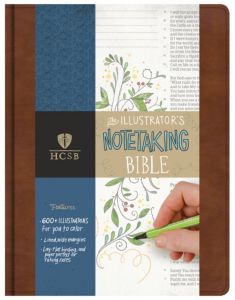
Illustrator's Notetaking Bible

The Illustrator's Notetaking Bible has a nicely bound bible, with a very handy lay-flat design, making it easy to write or color in it.  On the inside each page has only one column of text with large margins on either side.  Some of the margins have lines for writing in, many of them have pictures that one may color in (the Illustrator part). 

I like to doodle sometimes while listening to sermons, sometimes it helps me think and stay focused, so I thought that this was an interesting concept.  But upon examination it was rather disappointing.  In a way, it is reminiscent of the illuminated manuscripts of the past, except that in the illuminated manuscripts I've noticed that the text didn't seem to have as dwarfed by the illustrations as this one appears to me to do on many of the pages (perhaps they did, I just don't remember).  If the text of the Bible itself weren't so small or if it were more…I don't know, 'fancy' I guess, it would seem more fitting and more as if the text and pictures work together rather than compete. 

Some of the pictures were too much like graven images (or were exactly so) as there were some pictures supposed to be depicting Christ.  Besides the graven image thing, it just seems disrespectful to have an illustration that one can color in that is depicting the Lord of the Universe!  And then some of the illustrations in the margins seem odd placed next to certain texts.  For instance, coloring in a beautiful illustration running down the margin of a page depicting flowers and ribbons right next to the text where Jeremiah is thrown into a cistern, and where he tells Zedekiah that he will be handed over to the King of Babylon if he does not surrender to that King?  That just seems rather odd and indifferent to what the text is saying.  What illustration should you use for a spot like that? I have no idea…but probably not pretty flowers.

So, I'm not thrilled with this Bible, I wish that they had done a better job at enhancing the text and that they had not added the pictures of depicting Christ.


Many thanks to the folks at B&H/Lifeway Bloggers for the free review copy of this book! (My review did not have to be favorable)  

My Rating: 1 Out of 5 Stars