Showing posts with label Bible. Show all posts

Friday, May 1, 2020

The Lexham English Septuagint


I was quite excited when I saw that a new English translation of the Septuagint was coming out. I'm always interested in new Septuagint resources. 


The Septuagint is an old, Greek translation of the Hebrew Old Testament. Some (or all?) of the manuscripts of the Septuagint that we have today are much older than the Hebrew manuscripts on which most of our English Old Testaments are based so it can be pretty useful in textual criticism and Bible study as well (Some quotations that the Apostles made, from the Septuagint, are significantly different than our current Hebrew Old Testament text).


 If an English speaking person says they're quoting from "the Bible", we don't associate "the Bible" as only referring to one particular translation (unless you're KJV only). When we talk about the "Septuagint", it's sort of like saying  "the Greek translation of the Old Testament", it's just a shorter way of saying it.  There were several old, Greek translations of the Bible and we don't know which one is the 'original' one that was around in the Apostles' time and that they would have utilized.  Also, there doesn’t seem to be a reason to think that there was only one Greek translation during the time of the Apostles, there may have been more than one, and good and bad translations, just like we have today with good and bad English translations. Since we don't know exactly which Greek Version(s) the Apostles used, it's good to have a variety of copies of the LXX, the English translation of the Greek translation in my case, since I don't really know Koine Greek.


 This  translation is a nice one to add to this list, it is particularly interesting because of the way they give more, unique translations that you may not have otherwise considered.  For instance, in the Psalms, one of the "headers" I'm used to seeing is usually something like,  "To the Chief Musician: A Psalm of David".  In one of the other English LXXs I have, the NETS Bible, it is translated, "Regarding Completion.  A Psalm.  Pertaining to Dauid."   Well, this new translation, has, "For the End: A Psalm of David". When I saw that it was a like a lightbulb turned on.  "For THE END?"  As in, the "End times", "last days", the end of the world? 


I mentioned it to one of my sisters (who loves studying and learning koine Greek), and she looked up the word for "end" and it was telos, which is used in some other places in the Bible to refer to the end times (For instance, Matt.  24:13-14).  That sort of put a whole new perspective on the Psalms, not that we didn't think any of them were prophetic before (obviously the Messianic ones were), it's just that, if this view is correct, many of these Psalms are directly said to be speaking about the end times.  Some of them certainly sound eschatological, for instance, "Our God is a place of refuge and strength, a helper when afflictions find us very much.  On account of this, we will not fear when the earth is troubled and the mountains are transferred in the hearts of the seas…Come, see the works of the Lord, which he set as wonders upon the earth.  Removing wars until the ends of the earth, he will crush bow and shatter weapon…." (Psalm 45: 1-10)


Another interesting nuance in translation is Amos 9:1. The ASV (Using the Masoretic text) reads:  "I saw the Lord standing beside the altar: and he said, Smite the capitals, that the thresholds may shake…"


Brenton's English LXX reads: "I saw the Lord standing on the altar: and he said, Smite the mercy-seat, and the porch shall be shaken"


The LEX reads, "I saw the Lord standing by the alter, and he said, 'Strike upon the lid of the Ark of the Covenant and the gateway will be shaken…"


That's interesting in that, if it is the Ark of the Covenant, then that would (If I remember correctly)be a later reference to it in the Old Testament, than in the current Hebrew Old Testament we use. I don't remember the Ark of the Covenant being mentioned again after the fall of Jerusalem to Nebuchadnezzar.  Just an interesting thing.


You'll notice some significant/interesting differences between this text and the Masoretic.  If you grab a Hebrew based Old Testament and turn to Daniel 11:1-2, I'll quote it from the ASV: "And as for me, in the first year of Darius the Mede, I stood up to confirm and strengthen him. And now will I show thee the truth. Behold, there shall stand up yet three kings in Persia; and the fourth shall be far richer than they all: and when he is waxed strong through his riches, he shall stir up all against the realm of Greece."And then compare it to this English Septuagint:   "And in the first year of King Cyrus, he spoke to me to strengthen me and to make me act valiantly.  And now I have come to impart the truth to you.  Look, three kings have arisen in Persia, and a fourth will arise…."  That's a rather significant difference as it changes who the coming Kings are.  Are we supposed to count starting from Darius or Cyrus? Makes for some interesting eschatological problems. 


One of the main reasons the Septuagint is so interesting is that there are places in the New Testament where, when Christ and the Apostles quote certain texts from the Old Testament and their quotations line up significantly more with the LXX than with the Masoretic text.  And that's where I want to explain a part in this translation that I didn't particularly like. In Psalm 39 (Psalm 40 in a 'regular' Bible) vs 7 is translated, "You did not want sacrifice and offering, but you restored a body to me."  "Restored", instead of, "prepared" or "made" a body for me as English translators often render that word in translating the author of Hebrews' quotation of that verse in 10:5. Now some may point out that it's still better than the Masoretic text  (the Hebrew text recension pretty much all of our Old Testaments are based on now), which doesn't say anything similar. The problem I have is that, to me, "Restored" sounds as though a body was had, taken away or lost, and then given back.  It just seems to carry a different picture from how the author of Hebrews saw/read the text in Hebrews 10 (and the Greek word there seems to be the same as the one in Swete's Greek text for the Psalm).  The author of Hebrews seemed to view that verse as indicating that a body was prepared for Christ to offer it as a sacrifice.  Now I can see a way around it by saying, "well, look at it this way, 'restored' makes it seem as though He'd been given a body back that he'd had before, so maybe it could be referring to the resurrection of Christ."  Ehh…maybe? But again, that's not how the writer of Hebrews seemed to read it. 


Anyway, I felt like I had to get that out.  Moving on now.


Be sure to read the Introduction to this translation, it's very interesting, telling about the translators'/editors' goal of making your experience in reading this translation like the experience of those originally reading the Greek translation.  So instead of trying to bring the terminology to match today's culture, they "bring today's reader to the ancient culture", so if the language was originally not as gender inclusive as we would be today, they stick with the more gender exclusive language.  If the original Greek translation of the Hebrew was a bit awkward, the English will read awkwardly,   "The English translation should feel idiomatic where the Greek is idiomatic.  It should feel formal where the Greek is formal.  It should feel foreign where the Greek feels foreign.  In other words, it is not only acceptable, it is positively desirable for the LES to feel like a translation, to the extent that the Greek readers would have been aware that they were reading a translation.  Ideally, the translation should be as rough or as smooth as the Greek would have seemed to a Greek reader who knew no Hebrew…"  I really appreciate that.


I like the format of this book as well. I don't want to check right now, but I’m pretty sure that all of my other English translations of the LXX have the text laid out in two columns on each page.  This one only has one column of text, so it reads like a regular book.  The cover is very beautiful as well, I was quite impressed just by its looks when I opened up the box. 


I really like the LES overall. I own several English translations of the LXX, and I have never really found one that I prefer above the others, rather, I find all of them equally great study and reference resources to have around. This one is a great edition to any collection of Septuagints.


Many thanks to the folks at Lexham Press for sending me a free review copy of this book (My review did not have to be favorable).


This book may be purchased at Christianbook.com and at Amazon.com


Saturday, January 11, 2020

Quote of the Day

"A fellow lecturer told his Bible class that it did not matter whether the biblical character Job was real or fictional.  For him, the point off Job's book is to teach us about suffering, and the historicity of Job is immaterial to that lesson.  I cannot disagree more strongly, and hopefully this illustration will help clarify why. 

Suppose you are going through a difficult time in your life.  Perhaps it is from the death of a close relative or you struggle with debilitating illness. Just like the psalmist who felt abandoned by God in his deepest time of need, you feel lost and adrift in your suffering, with no sense of God's care.  In this state, you ask me to bring you wise counsel and comfort.

I tell you a story about a man who built a spaceship to travel to Venus.  Due to a technological breakthrough, he was able to equip his vessel with heat-resistant panels, making it safe to venture close to the sun.  Unfortunately, along the way the panels failed and his eyes were burned out of their sockets.  With all hope seemingly lost, in his despair he called out for help and God rescued him.

What would your reaction be to my story?  Would you thank me for the incredible comfort I gave you?  Or would you look at me with a glare, wondering how I expect this silly story to assist you?....Fiction can provide little comfort for the realities of life.  It is akin to telling someone struggling through financial difficulty, "Don't worry, you'll win the lottery."  Or to a man who lost his legs in a car accident, "Let me read you a story about a man who drank some sugar water and his legs grew back overnight."

The real God of creation acts in the real events of human history.  Our Christian faith is not rooted in esoteric platitudes or ethereal propositional truths to which we grant our mental assent.  Our faith is rooted in concrete experiences, with God breaking into history in amazing ways…"

- Victor Kuligin - From his book: Snubbing God: The High Cost of Rejecting God's Created Order

See more quotes on my quote collection blog: https://snickerdoodlesquotes.blogspot.com/

Thursday, January 25, 2018

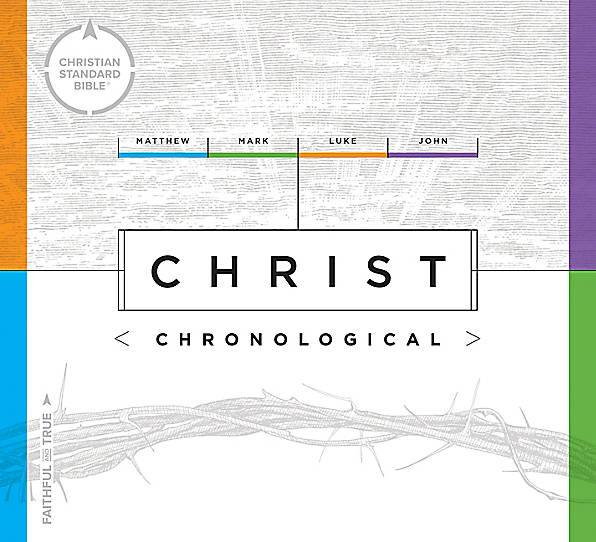
Christ: Chronological


This book,"Christ: Chronological" is a sort of chronological parallel Bible.  Using the Christian Standard Bible translation the Gospel accounts, written by Matthew, Mark, Luke and John, are arranged in a chronological order and they are placed alongside each other in parallel columns when dealing with the same account. The text from each Gospel is in a different color, blue for Matthew, Green for Mark, a reddish color for Luke and purple for John.  Along the very bottom of each page is a 'color code' key as it were, reminding you which color represents each Gospel.

Very nicely bound (a hardcover book, and wider than a typical Bible - it's in a square shape), the book lies quite flat when opened, so you can easily lay it down on a table while reading it without keeping one hand on it to make sure that the pages won't turn on their own.   The font is easy to read, a good size, and also, despite the font being various colors, they are bold colors and so stand out on the page.

The book is divided into a sort of chapter format, though they are not called chapters and are not numbered.  The 'chapters' have main titles like "Jesus Turns His Focus Toward Judea". Within each 'chapter' are many 'sections' some of which have descriptive headings for sections within the 'chapters', and above each section are the chapter and verse references for the Scriptures within them. There are many short introductory notes that begin parts that have parallel accounts.  These notes comment on apparent differences between the accounts and offer suggestions as to how they are actually complementary.  The font size of these notes is small enough that you can just glance over them, if you'd like, and continue reading the Scriptural account of the life of Christ. The flow of the Gospel account is a bit choppy, with the many section headings throughout and then single columns breaking off into four columns of varying lengths and then back again to one…etc. It is still very readable though, and serves its purpose well. 

 It is always interesting to compare the Gospel accounts, to see how they complement one another, how some of the accounts give more detail than others who focus more on particular details. All in all they form quite the picture of our Lord's sacrificial life, His teachings, His death and His resurrection.  This book is a nice way to read all of the accounts together.


Many thanks to the folks at B&H publishing for sending me a free review copy of this Bible (My review did not have to be favorable)!

My Rating: Five out of Five Stars
 *****

This book may be purchased at Amazon.com and Christianbook.com

Wednesday, November 29, 2017

The Spurgeon Study Bible


The Spurgeon Study Bible is a very neat idea.  As most people somewhat acquainted with Mr. Spurgeon know, he was not a verse-by-verse through a book of the Bible kind of preacher.  He usually would choose a verse (or portion of verses) for one Sunday and would preach on that and then preach on another (non-related, often from a whole different book)verse the next week. And also, some may also notice that his preaching was not always very exegetical.

That being said, this commentary is a great compilation!  It sort of gives a glimpse of how it would have been if Spurgeon went by a more verse by verse preaching style, and it focuses on snippets from his sermons that are more exegetical.

The version that I have is the brown and tan cloth over board Bible.  It is very nicely bound and seems quite durable.  The spine has some fancy looking ridges on it and the front has Spurgeon's signature printed on the bottom left.

There is a lot of good commentary in this work.  But there are also, of course, places where the commentary is not so great. To give an example, in one place he says,  "I hate that plan of reading the Scriptures in which we are told, when we lay hold of a gracious promise, 'Oh, that is for the Jews.'   Then I also am a Jew, for it is given to me!  Every promise of God's Word belongs to all those who have the faith to grasp it…."  That is a ridiculous, irreverent and, to speak very plainly, quite a selfish statement.  Why does everything have to be about us individually? And it absolutely cannot be applied in a general way.  What if there was a married, childless, ninety year old woman who greatly desires to have children and so she reads Genesis and Matthew,  and grasps hold of the promises given to Sarah and Elizabeth, that they would bear children in their old age,  and applies them to herself in faith?  Is that a reverent interpretation of God's Word?

Anyway, I still think that this is a worthwhile Bible to get.  There is a lot of good commentary in here, and of course, it is filled with pithy statements like, "Let us never think that we have learned a doctrine until we have seen its fruit in our lives." and "Anything is a blessing that makes us pray"

And I was particularly pleased at Spurgeon's conclusions in some places that are more or less controversial today.  For instance, in speaking of the flood's being a universal flood some of the commentary says, "If Moses had meant to describe a partial deluge on only a small part of the earth, he used misleading language.  But if he meant to teach that the deluge was universal, he used the words we might have expected that he would use.  I should think that no person, merely by reading this chapter, would arrive at the conclusion that has been reached by some of our learned men - too learned to hold the simple truth of God. " Wow! That's really stating it plainly.

And then, speaking of 1 Corinthians 9-10 ("What no eye has seen, no ear has heard….") he expresses incredulity at "How frequently verses of Scripture are misquoted!  How frequently do we hear believers describing heaven as a place of which we cannot conceive.  They quote verse 9, and there they stop, not seeing that the marrow of the whole passage lies in verse 10.  The apostle was not talking about heaven at all.  He was only saying that the wisdom of this world is not able to discover the things of God, that the merely carnal mind is not able to know the deep spiritual things of our most holy faith…" Rather, these things "must be revealed by the Spirit of God, as they are to all believers."  I was delighted that he had come to that conclusion as I know that my dad (a pastor) has been frustrated by the same thing.

As one would expect with just about anything written by Spurgeon, there is a lot of quotable stuff in the commentary. Overall, it's exactly what one would expect in a Spurgeon study Bible.

Many thanks to the folks at B&H Publishers for the free review copy of this book (My review did not have to be favorable)!

My Rating:  5 out of 5 Stars
*****

This Bible may be purchased at websites like Christianbook.com and Amazon.com

Wednesday, November 8, 2017

365 Classic Bedtime Bible Stories


I became interested in reviewing this book when I saw a preview of it online.  365 Classic Bedtime Bible Stories (inspired by Jesse Lyman Hurlbut's Story of the Bible) illustrated by Alessia Girasole is geared towards children ages 3 and up and, from what I saw in the preview text online, it looked like it might be a pretty good resource to have for teaching kids. 

Upon first examining the book I was very pleased to see that they didn't seem to be trying to cut out the more gruesome and sad parts of the Bible.  Some of it struck me as sadly amusing, mainly because of the illustrations.  To give an example, one of the 'stories' gives the account of the 'scoffing' nobleman who didn't believe Elisha when he said that food would be sold at extremely low prices the following day (there was a severe famine in the land).

 The nobleman died the following day from being trampled by people rushing toward the food.  This is illustrated (bloodlessly) in the picture accompanying the story.  It amused me because the pictures in the book are rather 'cutsey' looking cartoons and are geared more for very young children and here is this illustration of a man being trampled by a bunch of people! It also struck me funny because the back of this book describes it as being a way to make "bedtime reading a delightful learning and faith-building experience for both you and your kids." 

One of those 'delightful' stories happens to be one that ends with that ends in this way: "He was knocked to the ground by the crowd and crushed to death."  Sweet dreams kids! Just kidding.  It's good for kids to learn the truth, and it will probably be a good discussion starter about belief in what God says, assuming that you want a discussion started at bedtime.  Or you could just read the next two stories after that.  I say two because if you are reading on, in order to end on a happier note, you won't want to end on the next story either as it ends with a man being smothered!  An illustration is provided for that one as well though it only shows the man ABOUT to be smothered, not in the process of being smothered (if that's any comfort!). 

Sadly, though, there were several exceptions to their accurate accounts of events in the Bible. I'll give three examples:

1. The sections that give the account of Gideon's life end with the statement, "There were, at different times, fifteen judges over Israel.  But of them all, Gideon had the most wisdom, courage, and faith."  Where did they get that from? Do they even remember what happened later in Gideon's life? Gideon requested that people give him gold, "And Gideon made an ephod thereof, and put it in his city, even in Ophrah: and all Israel played the harlot after it there; and it became a snare unto Gideon, and to his house. "(Jdg 8:27)  That doesn't give the impression that Gideon was even close to being the best judge of Israel.

2. When speaking of the account of David and Bathsheba, this book says that when David saw her "He loved her and wanted her to be his wife" and so he had her husband Uriah killed.  No… David committed adultery with Bathsheba before having her husband killed and he apparently had no intention of taking Bathsheba for his own wife until he had learned that she was pregnant and couldn't set things up to make it seem as though Uriah was the father. That's when he had Uriah killed.  The people who put this together didn't have to go into great detail of course, but they didn't have to resort to giving inaccurate Biblical history.   

3. The same with the account of Saul in the cave.  This book says that he rested in the gave while David and his men were hiding in there (it even has a picture of Saul wrapped in a blanket sleeping in the cave), and that David cut a corner of Saul's robe while he was sleeping.  But, that of course was not what Saul was doing.  They could have said that he was "using the bathroom" or "relieving himself" and let parents do the explaining.  Or they could have just said that he was in a cave. But say that the Scriptures say something that they did not say!

One more thing, and this is somewhat minor, the words used in the book could have been dumbed down a bit more,  down to the level of a little kid's intellect.  Instead of saying, "He remained there", they could have said, "He stayed there."  Or Instead of "He wept", they could have said "He cried" and so on.  Not only would it make it easier for little kids to understand but it would make it more consistent with other parts of the book where they actually did change it to more modern vernacular.  They  used statements like, "It was stinky", "Come on" and "You're phonies!".  So why do that with only some of the text and yet leave others that are easily changed to something simpler?

The pictures are interesting and kids like looking at them (a couple of my little brothers seem to like them), they generally fit well with the stories. though not all of them are accurate.  I'm pretty sure that Aaron should be illustrated as being older than Moses, not younger (Moses has grey hair and Aaron has brown hair in this book).  I mainly wish that they had chosen not to depict Christ in the illustrations, or at least not to show His face.  That would be more respectful.  Instead they make Him look like a European man with long hair. 

Overall, though, the people who put this book together seem to have done a pretty good job in many of the 'stories' they recount, sticking closely to the text of the Bible in their summaries.  My little brother enjoyed listening to some of it and talking about the pictures.  Just be ready to read it with scrutiny, and with verbal criticism and explanation to make sure that your kids are getting accurate information.

I received a complimentary copy of this book from Barbour Publishing and was under no obligation to post a review


My Rating: 3 out of 5 Stars
***

This book may be purchased at Amazon.com and at Christianbook.com

Thursday, June 1, 2017

God With Us - By Glenn r. Kreider

I was talking with one of my uncles some months ago and he was lamenting the lack of good Christian books out there, pointing out that the only good 'Christian' books are the ones that lead you to read the Bible itself instead of more books about the Bible. God with Us: Exploring God's Personal Interactions with His People Throughout the Bible by Glenn R. Kreider is one such book.  I don't believe that I had heard of this book before, or at least if I had it didn't catch my attention at the time.  A friend gave it to me and I ended up being very pleased with it.

In the book, Kreider focuses upon the humility of God.  He goes through the different periods of Biblical history pointing out many instances of God's graciousness towards mankind.  I'll list some particular snippets that I found fascinating:

First, in his section on Abraham Kreider points out that God could have responded in anger for Abraham's asking how he would know that he will gain possession of the land (instead of just accepting that it would happen), but He didn't, "God's response is compassionate, gracious and kind.  He cuts a covenant with Abram.…..The covenant does not make the promises of God more secure, but it does give Abram something he knows and understands." God didn't have to make a covenant at all, but He graciously did so.  And despite Abraham's flaws, God condescends to be known as the God of Abraham, Isaac and Jacob (who also were very flawed).

 Later on, in His call to Moses God condescends to answer Moses' objections to being chosen to lead his people out of Egypt, and has already provided a helper for Moses in the person of Aaron - This made me realize too that God could have made Aaron the leader of His people.  But even though Moses objected so much, God graciously still used Moses. 

And then of course, the amazing condescension of God to send His Son to earth as a human being….and as an infant, not an adult. Kreider says that for a while he had a hard time with the account given by Luke of when Jesus was 12 years old and deliberately stays behind in Jerusalem when His parents leave for home - in particular, Mary's apparently frustrated response towards Him, "My Son, Why have you treated us like this?..."   How could she dare do that seeing that she had been told beforehand that Jesus was "the Son of God"? And then he explains that his conclusion, " "Anyone who was in the presence of God in the flesh would recognize his deity, I thought.  I Now believe that this story reveals to us that Jesus' deity was well concealed.  Apparently, the difference between Jesus and her other children was not as obvious to Mary as I had thought.  Jesus never sinned, never rebelled against her; he never behaved in a depraved way."  He goes on to explain that, in a way, Jesus was, as it were, 'immature'(not meaning to indicate that Christ's action in staying behind was immature).  In other words, He still grew in wisdom, as that chapter points out, though in the process of growing in wisdom/'maturing'  He never sinned. And so Mary apparently had trouble perceiving His divinity because of this, despite having seen His perfect goodness.  I thought that was an interesting point. 

I also loved the concept that God has condescended to have His Son be in human form forever, "he humbles himself by adding to his complete deity complete humanity, not temporarily but permanently."  And not only this, but that Christ will be with His people forever on the new earth,  "The hope of redeemed humanity is not heaven but earth.  Heaven is a temporary home until the day of resurrection, when heaven will come down to earth and the God of heaven will make the earth his home (Rev. 21:3).  When the work of redemption is completed, the triune God will condescend to dwell eternally on this planet."

All in all I thought that it was quite thought provoking.  There were some things (as in any book other than the Bible) that bothered me a bit: such as Kreider's stating that, ""Although sin and rebellion will continue, God promises never to respond as harshly as he did in the flood." - I guess that he doesn't think that the future judgments to come upon the earth are not that bad? That confused me - especially as he says that he is premillennial.  And then he says that "Since the Scriptures testify about Jesus, any reading that fails to hear Jesus, any interpretation that fails to elevate Jesus, and any bible study that fails to focus on Jesus is incorrect and worthy of judgment." But what if certain passages elevate God the Father? What if they focus upon Him and not upon Christ…or what if they focus upon the Trinity as a whole? * Sigh*….. 


But I still liked the book.  Kreider does a good job of pointing out this other attribute of God, humility, that we ought to emulate, and that we will emulate because we have God- The Holy Spirit living inside of us.  It makes you want to take another look at the Bible with, not necessarily a new perspective, but with a heightened desire to notice God's condescension and humility towards humanity  that is revealed therein.  

Some of the websites where this book may be purchased are Christianbook.com and Amazon.com

My Rating:  5 out of 5 Stars *****

Wednesday, April 5, 2017

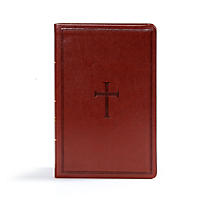
CSB (Holman) - Ultrathin Reference Bible - Brown Leathertouch

The Christian Standard Bible is a new revision of the Holman Christian Standard Bible.  They have made some changes, and it seems to me that many of those changes are toward a more literal translation, which is a good thing. 

Here are some samples:

In Matthew 19:28 the HCSB renders it:
"Jesus said to them, 'I assure you: in the Messianic Age, when the Son of Man sits on His glorious throne…" This new revision has it as, "Jesus said to them, 'Truly I tell you, In the renewal of all things, when the Son of Man sits on His glorious throne…'" - CSB

Not that I'm disputing that the renewal of all things references the Messianic age, it's just that "the renewal of all things" is a more literal rendition of what Christ said, more toward a formal equivalence rather than a dynamic one - which I believe is a safer route.

To some degree the same holds true with the following:

Daniel 9:25:"Know and understand this:  From the issuing of the decree to restore and rebuild Jerusalem until Messiah the Prince will be seven weeks and 62 weeks…" HCSB

"Know and understand this:  From the issuing of the decree to restore and rebuild Jerusalem until an Anointed One, the ruler, will be seven weeks and sixty-two weeks" CSB

1 Peter 3:1-2: "In the same way, wives, submit yourselves to your own  husbands so that, even if some disobey the Christian message, they may be won over without a message by the way their wives live when they observe your pure, reverent lives." HCSB

"In the same way, wives, submit yourselves to your own husbands so that, even if some disobey the word, they may be won over without a word by the way their wives live when they observe your pure, reverent lives."  CSB

The translators also switched "languages" in 1 Corinthians 14 to "tongues", though I still think that Languages was a good translation.

There are also noticeable changes in the way the translators interpret the text, for example, in 1 Corinthians 7, where Paul is explaining that if a husband or a wife has an unbelieving spouse who wants to leave them, that they should let them leave, they then translate his next words as, "Wife, for all you know, you might save your husband.  Husband, for all you know you might save your wife." CSB  Whereas the HCSB said, "For you, wife, how do you know whether you will save your husband?  Or you, husband, how do you know whether you will save your wife?"  - 1 Cor 7:16?   Which is a rather significant change.

There were some things that I did not like about this translation.  For instance, they seem to have caved a little bit more on the gender inclusive language - 1 John 3:17  "If anyone has this worlds goods and sees a fellow believer in need but withholds compassion from him -how does God's love reside in him?" CSB

"If anyone has this world's goods and sees his brother in need but closes his eyes to his need - how can God's love reside in him?"   HCSB  They do note that their goal is to translate the Bible faithfully, they simply change some gender specific language to gender inclusive when the text itself allows for it. I still don't think that that is necessary, but okay.   

And then there is a problem that I had with the HCSB that I still have with this revision.  One of which is that, despite saying in their introduction that their "OT Textual notes show IMPORTANT differences among Hebrew (HB) manuscripts and ancient OT versions, such as the Septuagint…(emphasis mine)", they do not include the LXX variant of Psalm 40:6, Sacrifice and offering thou wouldest not; but a BODY hast thou prepared me: (Brenton- Emphasis added), Whereas the Masoretic text (which only goes back to about 900 A.D. [or CE]), the text the Majority of our Old Testaments are based on, says, Sacrifice and offering thou didst not desire; MINE EARS HAST THOU OPENED: burnt offering and sin offering hast thou not required." (KJV - emphasis added).  The difference is extremely significant as the writer of Hebrews quotation of that verse matches the Septuagint and not our Masoretic text in that it says that God prepared a body for the speaker rather than opened his ears.   And yet they include a manuscript variant of the number of the beast, 616 - which variant is quite suspect as Irenaeus (a person who lived in the earlier days of the church who is thought to have been a follower of Polycarp a follower of the Apostle John) said that this variant was false, and that the older manuscripts did not contain it nor did those who knew the Apostles support it.  If they included this variant of the number of the beast then I do not  understand how they did not give the variant of Psalm 40 which is supported by the writer of Hebrews in the Bible!

One other thing that confused me:  The CSB is presented as having been translated directly from the original languages rather than using an existing translation as its basis. There is a chart on the website for this translation showing many translations and separating them on the basis of whether or not they are translated directly from the ancient languages as opposed to using an existing English translation as the basis.  The CSB is shown to be a translation not based upon an existing translation. But to me this seems to be contradicted by the admission that the CSB is a revision of the HCSB.   That just struck me as rather deceptive.  Perhaps I simply didn't understand the chart….

Otherwise, this is quite a nice translation  Also, this Bible is very nicely bound, with a LeatherTouch cover (it feels very nice).  The text is in two columns with a center column cross reference.  There is also a concordance at the back as well as full color maps.  All in all, very nice.


Many thanks to the folks at B&H publishers for sending me a free review copy of this book (My review did not have to be favorable).

My rating: 5 out of 5 stars
 *****

Among other websites you may purchase this Bible at Christianbook.com and on Amazon.com

Wednesday, January 25, 2017

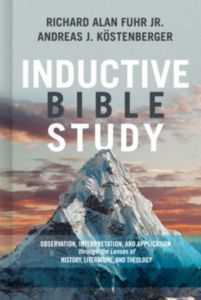
Inductive Bible Study - Richard Alan Fuhr, Jr. and Andreas J. Kostenberger

Looking for a book that will give you good guidelines for studying the Bible well? Inductive Bible Study by Richard Alan Fuhr Jr. and Andreas J. Kostenberger is a good resource on the topic. As the authors of this book explain, God chose to reveal His will to us through His written Word, rather than through personal revelation/new revelation.  He chose that it would be learned progressively with effort rather than instantly without any work on our part. We should revere God's choice method of conveying the knowledge of Him that He wants us to have and His will that is revealed through this collection of holy documents.  Fuhr and Kostenberger take you through a series of steps that will assist you in reverently discovering and handling what God's Word says with accuracy and reverence.

The steps you are taken through range from: comparing English Bible translations, Asking the right questions of the text, using commentaries, word studies, practicing discernment and of course, one of the most important steps of all, recognizing the importance of context and authorial intent.  It is pointed out that, "Those who read the Bible with little awareness of surrounding context often do so because they have been trained (by example) to think through Scripture in terms of devotional nuggets, memorizing verses and reading for inspirational insight rather than interpretive understanding."  Context is emphasized strongly, and related to that, I very much appreciate the cautions about word studies (though they are still encouraged),  where it is made clear that when studying individual words or phrases in a passage, it should be remembered that the meaning of those words will ultimately be discerned through the surrounding context of the phrase, not just their bare lexical meaning, "contextual meaning will always take precedence over lexical meaning."

The authors write very well, are easy to understand and the steps in each section are outlined in charts, which helps with remembering and simplifying what one has learned.  They give illustrations to demonstrate hermeneutical errors, some of which I found sadly amusing. For example, Fuhr talks about a missionary conference that he once attended where the theme verse was Joel 3:14, the verse was used as a reference to people ready to make a decision for Christ, but when one looks at the surrounding context of the verse, the 'decision' referenced in the verse is referring to God's decision to bring judgment on the nations, not salvation! 

They recommend many study resources (look for these in the footnotes as well), and also provide demonstrations of the inductive method by using it on various texts of the Scripture.  Being 'doers of the Word' and not merely 'hearers' of it is also stressed.  They make the interesting argument that, "While the Holy Spirit is certainly capable of providing interpretive insight, we'd suggest that illumination has more to do with appropriation than interpretation."  In other words, the work of the Holy Spirit is more seen in the Christian's personal application of the truths of Scripture to their life than by their coming to the correct conclusion as to the meaning of any given section of Scripture (though this is very important of course).  They do clarify that not all texts of the Scripture are necessarily directed at 'doing', some texts give us more knowledge about the God whom we serve by obedience to His will (by the enablement of the Spirit).  But both are a part of what we glean from our Bible study: knowledge of God and His will, and then living in light of the revealed truth. 

I want to mention two more things, first, ironically I must admit that I disagreed with some of their conclusions on the interpretation of some example texts (I will probably take another look at them), but the authors themselves encourage the reader to not be afraid to disagree with a Bible commentator if one thinks (by means of correct hermeneutics of course) that a they are not interpreting a text correctly.  Also, the authors kept using female pronouns when speaking of any given Bible studier, which terminology was rather tough to get used to (despite being a female myself) and was rather distracting.  I think that using male pronouns would be more in keeping with the Bible's teaching of male headship and of woman being taken from man in the creation rather than vice-versa. it simply seems more biblical to have any given person referred to with masculine pronouns rather than having a male read feminine pronouns and apply them to himself.  I understand that our culture is very concerned about gender inclusiveness, but this book is primarily directed at Christians, most of whom would (or at least should) have already come to grips with the primarily masculine pronouns of the Bible, especially those that, though masculine, refer to both male and females. To me it's like someone using the term "womankind" to refer to both males and females, instead of 'mankind'.  I am just not comfortable with it.

But overall, I really liked this resource, and would recommend it to pretty much Christian looking for an aid to accurately studying the Word of God.


Many thanks to the folks at B&H publishers for sending me a free review copy of this book (My review did not have to be favorable).

My Rating:  *****
Five out of Five Stars

Here are a couple of the websites where this book may be purchased:  Amazon.com and christianbook.com

Tuesday, October 18, 2016

The Reader's Bible NKJV

The Reader's Bible (this one is the NKJV) is designed as a single column, "paragraph style" Bible, with no verse or chapter numbers, just the names of the Books.  This makes it so that you read the Bible more along the lines of how it was originally put together in a codex, which did not have all of the numbered chapter divisions in the books of the Bible that we have today.

This Bible is definitely reader friendly, it is easy to read through without the potential distraction of verse numbers (though they are handy) and it is a unique experience to have the historical narrative filling the whole page as one column rather than as two, more like how a regular book of history book or biography is put together.  You can keep a general track of where you are in any given book by looking at the bottom corners of the pages which tell you which chapter is on the page you are reading.

 The only thing that I don't like is that they kept the chapter breaks (without the numbers, just a bolded letter at the beginning of the section).  Some of the breaks actually seem to break the flow of narrative or thought in the wrong place (This is the same in regularly numbered Bibles).  They stop your eye when your eye should keep going, it sort of makes one's brain think that you are starting to read a new thought rather than continuing the flow or build of thought that you are already on.  This has the potential mess up a person's understanding of a text.  I wish that they had at least placed the chapter breaks more conveniently….though I still think that in many cases they could have been done away with altogether, especially in the epistles of the NT which would then read more like regular letters.

Other than that, I really like this edition.  Also, it is a beautifully bound, elegant looking hardcover.  It is also a Holman Bible, which I have found to be pretty high quality Bibles.


Many thanks to the folks at B&H/Lifeway publishers for sending me a free review copy of this Bible!  My review did not have to be favorable.

One of the places where this Bible may be purchased is at CBD

Saturday, September 3, 2016

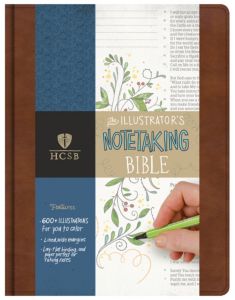
Illustrator's Notetaking Bible

The Illustrator's Notetaking Bible has a nicely bound bible, with a very handy lay-flat design, making it easy to write or color in it.  On the inside each page has only one column of text with large margins on either side.  Some of the margins have lines for writing in, many of them have pictures that one may color in (the Illustrator part). 

I like to doodle sometimes while listening to sermons, sometimes it helps me think and stay focused, so I thought that this was an interesting concept.  But upon examination it was rather disappointing.  In a way, it is reminiscent of the illuminated manuscripts of the past, except that in the illuminated manuscripts I've noticed that the text didn't seem to have as dwarfed by the illustrations as this one appears to me to do on many of the pages (perhaps they did, I just don't remember).  If the text of the Bible itself weren't so small or if it were more…I don't know, 'fancy' I guess, it would seem more fitting and more as if the text and pictures work together rather than compete. 

Some of the pictures were too much like graven images (or were exactly so) as there were some pictures supposed to be depicting Christ.  Besides the graven image thing, it just seems disrespectful to have an illustration that one can color in that is depicting the Lord of the Universe!  And then some of the illustrations in the margins seem odd placed next to certain texts.  For instance, coloring in a beautiful illustration running down the margin of a page depicting flowers and ribbons right next to the text where Jeremiah is thrown into a cistern, and where he tells Zedekiah that he will be handed over to the King of Babylon if he does not surrender to that King?  That just seems rather odd and indifferent to what the text is saying.  What illustration should you use for a spot like that? I have no idea…but probably not pretty flowers.

So, I'm not thrilled with this Bible, I wish that they had done a better job at enhancing the text and that they had not added the pictures of depicting Christ.


Many thanks to the folks at B&H/Lifeway Bloggers for the free review copy of this book! (My review did not have to be favorable)  

My Rating: 1 Out of 5 Stars

Saturday, August 13, 2016

The Murderous History of Bible Translations - by Harry Freedman

I often sense a tendency in myself to take having an English translation of the Old and New Testaments for granted.  But, as Harry Freedman demonstrates in his book, The Murderous History of Bible Translations: Power, Conflict, and the Quest for Meaning, I shouldn't take it for granted and should appreciate all the more the effort and sacrifice that went in to getting the written Word of God into a book that ordinary people could read. 

In this book Freedman does an excellent job at writing, he grasps and keeps one's attention, and it flows nicely.  He takes you through history, beginning with the translation of the Old Testament and then including the New in the focus as well.   Translating God's Word into the common vernacular of any people was often very tumultuous and controversial, and we see this down the passage of time that the author examines, and through many different translators who often took many risks to make the translation. 

Though I really like the book, I feel the need to mention that there were several things that I did not like, for instance, statements like:  ""…even to this day, radical fundamentalism hasn't gone away.  And religious extremism relies upon a revealed, unmediated, literal reading of Scripture, one which rejects the prism of human interpretation."(pg.139)  Perhaps I am misunderstanding what the author is saying, but I think that' religious extremism' is that which focuses upon the "prism of human interpretation" without interpreting the Word of God with a literal/grammatical-historical hermeneutic. To be extreme is to not take the Bible for what it says, to not interpret it literally.  Interpreting the Bible "literally" in my view is to interpret it correctly in context: taking allegory as allegory, historical narrative as narrative, prophecy as prophecy, …etc. But again, perhaps I  misunderstand what he meant by that statement.


This book seemed more or less secular look at the history of Bible translation, but Freedman did a very good job at giving the perspective of the translators (whether Christian or Jewish) whose lives he recounts.  All in all, despite statements that I disagreed with, I really liked the history given, it is very, very interesting and an informative read.  Knowing this history should drive Christians more to reading this Holy Book that people in the past translated and read in secret, suffered and died for, many considered the Words it contains as much more valuable than their lives or comfort in this earth.  Shouldn't we do the same and do God the honor of reading it?

Many thanks to the folks at Bloomsbury Press for sending me a free advance review copy of this book! (My review did not have to be favorable)

This book is slated for release on November 15, 2016

You may preorder it at Amazon and on the Bloomsbury website  (and probably from other sites as well)

Rating: 5 out of 5 stars *****

Saturday, July 16, 2016

Saving the Bible From Ourselves: Learning to Live and Read the Bible Well - By Glenn R. Pauuw

Saving the Bible From Ourselves by Glenn R. Pauuw is a book about people's misuse of the Bible, how it has come to be used as a book that is a collection of isolated propositional statements that are written specifically for me and for my special encouragement.  Overall this book is argument against those views of the Bible (it critiques  other views as well) and I believe it is a rather good argument.  I mainly listed those two things because they are the things that captivated me most in this book. Then I will give my critique.

First, Pauuw does an excellent job at attacking the rather modern approach to the Bible that takes the form of hunting for individual verses that seem relevant to us, "…find the fragments you need at the moment.  If you are looking for your daily inspiration, then find a devotional fragment.  If you are arguing with the local heretic, find a doctrinal fragment.  If you are facing an ethical question, find a moral fragment.  They're all in there, already neatly numbered for you.  You just have to find the good ones." He makes a good case that part of what instigated this fragmentary approach was the addition of verse numbers and chapters to the text of the Bible. 

Second, and very much related to the first, is Pauuw's critique of our use of the Bible as though it were written directly to us personally (or at least the comforting parts and the parts that we like, the curses…not so much).  Pauuw demolishes the perspective that we can make ourselves the authority in discerning what we need from the Bible, and he demonstrates that we should trust the wisdom and sovereignty of God in His design of His own Word, and that means the WHOLE Word of God.  To use the author's own words: "How can the Bible possibly lead and direct our lives if we are the ones who predetermine which parts of it speak to us?  Fragmentary patters of reading entail a fragmented sense of authority."  Perhaps my favorite part in the whole book is where Pauuw presents the "Parallel -Universe Bible" where he demonstrates what would happen if we used verses that we do not find so applicable to ourselves in the same way that we use our favorite verses, that are often taken out of context, to apply directly to ourselves (for instance: everyone likes Jeremiah 29:11 but what about Deut. 28:29?).  I found that part absolutely hilarious (I was almost crying I was laughing so hard) but very clear in the point that is being made. 

So why did I only rate this book at 3 stars (out of 5)? Well, for one thing there were a bunch of statements and descriptions of things that were too…I don't know…"mystical" might be the right term.  Perhaps it was just me, but some of the way things were phrased seemed just plain weird to me (and I didn't necessarily understand it all).  He talked about things like "Story" or "Chaos". Another thing was that Pauuw approached (in my opinion) irreverence in how he spoke of God, in statements like: "God was willing to take a great risk with the Bible: He left it in our hands…"    and, ""To  enter history really is to give it a go in the rough-and tumble.  Even for God."  Those were just some of the things that bothered me about this book. There was a lot to be gleaned in it but was interspersed throughout the bothersome thing, and so ironically (having in mind Pauuw's excellent critique of the 'snacking Bible), if I ever read this book again I would read it in a 'snacking' sort of way.  That is why I only gave it three stars.  But on the other hand Paauw made a good (and convicting) case for reading the whole Bible rather than just fragments of it.  I'll end with quoting an excerpt that I really liked (there were several that I liked):

"Snacking (on isolated Bible fragments) hides things to be sure, but it also distorts the things it does show us.  For example, ,the Snacking Bible is not great news. It has gospel verses, but no gospel, because the gospel is the announcement of a particular turn of events within an ongoing story.  The gospel is not a sentence about justification by faith or a verse reference on the forgiveness of my sins.  The gospel is not the Romans Road.  The gospel is not John 3:16.  What the apostles Paul and John wrote - what God's Spirit enkindled in them - was something entirely different than these boiled-down reductions.  Evangelist D. L. Moody said he could write the gospel on a dime.  Well, Paul and John couldn't, and didn't."


Many thanks to the folks at InterVarsity Press for sending me a free review copy of this book to review (My review did not have to be favorable)

This book may be purchased (among other places) at Amazon and Christian Book Distributors

Wednesday, June 29, 2016

The Knight's Map - R. C. Sproul

The Knight's Map by R. C. Sproul is an allegory for children and is very much like the Pilgrim's Progress.  Its focus is on the tale of a Knight without loyalties to any king who receives a mysterious letter, and also a map, from a King (whose existence is doubted by people), the King invites the Knight to follow the map to find a Treasure that will not fade away.  The Knight encounters many obstacles along the way, mainly these obstacles take the form  of the Knight being misled by other people like Mr. Skeptic and Mr. Liberal who try to draw the Knight's attention away from trying to read the map correctly (and even discouraging any attempt to read it at all). 

The book has many nicely drawn (or rather, painted) pictures that I am sure would have captured my interest as a child. The story is well-written and would hold the interest of adults as well as children.  There is a question and answer section at the back that could be helpful to parents in prompting their children to think about what the story represents, though I think that the actual story has enough explanation in and of itself through the dialogue of the Grandpa (who is telling the story) and his grandkids at the beginning and ending of the book.

I think that my biggest problem with this book is that I wish it were longer.  It just seemed too short, even for a kids book, but perhaps that is because I am judging with an adult's brain.  I think that that is a sign of a good book, when it leaves you wanting more.  Perhaps someday Mr. Sproul will come up with an adult's version, one that delves into even more detail about those who want to distract us from the Bible/map that God provides us with.  I find allegories like that in this book fascinating.  But even if he doesn't come up with an edition for older people, this book is good in its own right, simple and straightforward picture of a person seeking God and God's provision of understanding and guidance along the way to discovering Him. 


Thanks to the folks at Reformation Trust Publishing for the free review copy of this book(My review did not have to be a favorable one). 

Among other sites, a couple of the places where one may purchase this book is at Amazon.com and at the Ligonier store

Saturday, May 28, 2016

Understanding the Congregation's Authority - by Jonathan Leeman

Understanding the Congregation's Authority by Jonathan Leeman is a short and yet quite thorough explanation and defense of what Leeman calls, "Elder-Led Congregationalism".  He does not advocate congregationalism nor Elder-Rule, rather he presents the concepts of 'congregational authority' as 'responsibilities' and the role of the pastors/Elders he presents as the God-given 'trainers/councilors' of the congregation. 

Each member of the congregation is responsible to prod one another to love and good works, building and discipling their brothers and sisters in Christ (which may involve correction) and coming to be discipled as well, to attend church regularly not making a habit of forsaking the assembling of their church family, and the congregation is also responsible to submit themselves to the elders of the church(the Elders do not make them submit), which Elders are to train up the congregation to fulfill their responsibilities by preaching/teaching the Word of God.

I thought that the author's overall premise was good and I thought that he argued most of his points very well, the things that I didn't feel comfortable with were his 'reformed' terminology, for instance referencing Christ and Christians as the 'true Israel', his referencing the observance of 'the Lord's Table' as being a time of Communion with the Lord and it also being a sign of the new Covenant.  I don't think that I agree that the church exercises the authority of the "Keys" through baptism and the Lord's Supper (a man is to examine HIMSELF as to his manner of living while taking the Lord's supper), I don't really see that in the Bible rather I see the congregation cutting off an erring member from fellowship because they are not living in a Christ-like way (not primarily cutting them off from partaking of the elements though that necessarily follows). But perhaps I didn't understand what he meant.  And lastly I didn't agree with a lot of his 'Priest-King' hermeneutic, that Adam was basically a priest-king mediating between God and creation and then applying the term to Abraham, Moses, David and then all Christians….it didn't make biblical sense to me.

Aside from the above and perhaps some other things, I really liked Leeman's argument and would recommend the book to other Christians as he does a great job at showing that if you're  a Christian, whether or not you are an Elder you  have a God-given job to do and you should take it seriously. 

I'll end with a quote from the book: "You, as a baptized Christian and ordinary member of a church, are responsible for protecting the gospel and the gospel's ministry in you church by discipline other church members.  Remember Ephesians 4:15-16.  The church builds itself up in love as each part does its work.  You have work to do to build up the church and part of that includes the ministry of words.  A few verses later, Paul says, 'speak the truth, each one to his neighbor, because we are members of one another'(V. 25).  Speak truth to them, and help them to grow. Our words should be 'good for building up someone in need, so that it gives grace to those who hear' (Eph. 4:29).  Also, make yourself available to be spoken to.  Are you willing to listen?  Basic Christianity involves building up other believers.  It is a part of fulfilling the Great Commission and making disciples."


Many thanks to B&H Publishers for sending me a free review copy of this book! - My review did not have to be favorable.

You may purchase this book at websites like Amazon and Christian Book Distributors

Thursday, May 5, 2016

NLT Guys Slimline Holy Bible

The NLT Guys Slimline Holy Bible is nicely bound, very slim and lightweight. The cover has some of the 'leather-touch' material that feels very nice (not that boys will care that much), and the bright blue lines intermixed with the black should make it very easy to spot if misplaced and also catches the attention which would hopefully be a reminder for young guys to read it each day.   The letter font on the inside is small but not too small, I found it quite easy to read.  At the back of the book, Bible includes a dictionary/concordance, a list of suggested memory verses on various topics, a Bible reading plan and of course the usual maps of the Holy land and Europe.

The translation itself is very readable, the translation notes say that they were trying for a mix of formal equivalence and dynamic, I think this translation leans a bit more to the latter, a 'thought for thought' type of translation which then necessarily has some heavily imposed biased interpretation on certain texts.  I'll give a couple of related texts as an example,   Matthew 19:9: "….whoever divorces his wife and marries someone else commits adultery - unless his wife has been unfaithful"  and 1 Corinthians 7:15, "But if the husband or wife who isn't a believer insists on leaving, let them go.  In such cases the believing husband or wife is no longer bound to the other…"   Both of these verses evince a bias on the part of the translator.  In the Matthew text they make the 'exception clause' permit remarriage rather than just a separation of the couple, and in the Corinthians text they make it sound as though the couple are no longer bound to one another in marriage (in God's eyes) rather than using the simple statement, "no longer bound." Which statement does not give the impression that the marriage is done in God's eyes.  I do not see how people don't see the problem with the 'remarriage allowed' interpretation (which in my view is an eisegetical interpretation not an exegetical one). When you think about it for a moment you realize that if a marriage is ended in God's eyes by adultery or separation then the couple CANNOT forgive one another and stay married - they MUST legally divorce and separate if the marriage is finished before God, otherwise the couple would be living together out of wedlock (in God's eyes) even if they are not legally divorced.  Legal divorce was permitted by Moses because of the hard hearts of the people, but Christ came to give us NEW hearts.  Remarriage after legal divorce should not be an option in a Christians eyes because they have a new heart, not a hard heart and if they must be separated from their spouse then they should be willing to live a celibate life for the sake of the Kingdom of Heaven (Matt. 19:11-12, 1 Cor. 7:10-11).  I know it's hard to accept but we should not reject or accept what we like in God's Word simply because "it's not fair" or "I don't feel that God would allow that".  Our feelings and our idea of fairness are not the authority, God is, and His Word is our standard, not ourselves. So, as you see, I think this translation is a bit too biased/not literal enough.  *Cough* sorry for rambling on, I just had to get that out and it's been on my mind because we're hitting the topic at my church.

I also didn't understand why some traditional words like, "Justification" were changed to "made right with God" but others, like the word "tongues" in 1 Corinthians 14 were kept instead of changed to "different languages".  It just seemed rather inconsistent.   'There were several translations of verses that I liked and thought did a pretty good job of carrying the original idea of the passages over into modern English but overall I think that they could have done a better job, (the ICB seems to be more consistent in that area).

Overall the translation is okay (maybe a little too clear/modern/explicit a translation in some parts- especially for kids) though I strongly prefer the NASB.


Many thanks to the folks at the Tyndale Blog Network for sending me a free review copy of this Bible (My review did not have to be favorable)