Showing posts with label biographies. Show all posts

Thursday, April 11, 2019

Lt. General William K. Harrison Jr.


I first heard of William K. Harrison Jr. on the radio some time ago.  He was being used as an example of someone who made sure he read the word of God every day, even when things got really busy; and things were really busy in his life, as it was noted that this man was a general in World War II.

 Not a lot of information was given, but that piqued my interest. But I was sort of afraid he'd be some sort of nominal Christian guy who just read his Bible for just for the sake of 'morality', rather than being the real deal.

I tried to find more information about him, and discovered some articles that he had written


And the other one is "May A Christian Serve in the Military".  I'll give an excerpt from that one here: 

From the section in that article,  "The Real Cause of War".
"From a Biblical standpoint the answer is simple. The world is dead in sin. Lust, plunder, and war are the natural characteristics of the human race, dead and lost in sin (Romans 1:18-32). Many good Christians seek to eliminate war by dressing up the outside of the cup, seeking to cure the apparent causes of war. The real cause of war is in the sinful heart of man. The Lord said that except a man be born again he cannot see the Kingdom of God. Being born again is a miracle. It comes only when one believes in the Lord Jesus Christ as his personal Savior and as the Son of God. People believe when they hear the gospel. Never has the preaching of the gospel succeeded in converting more than a portion of hearers at any one time.

Even at Pentecost in the great city of Jerusalem only 3,000 believed at the most wonderful exhibition of gospel power in church history. The rapid growth of Christianity in the Roman Empire resulted first in the persecution of Christians, and then ultimately in the decay of spiritual Christian life into the dark ages of medieval centuries. The Protestant Reformation did not produce more than a partial awakening. Today there is an apostasy from the simple, pure Word of God and faith in Jesus Christ, the only begotten Son of God and the only Savior.

We are not called to preach the gospel to save the world from war and crime. We can preach the gospel all we want to, but only a few believe. Christ said that broad is the way that leads to destruction and many are they that find it, and narrow is the way that leads to life and few are they that find it. The preaching of the gospel is to them who are saved a savor unto life, unto them who are lost a savor unto death. The Scriptures say that God is now taking out a people for His name. I can find no place in the Scripture where it intimates that the preaching of the gospel of grace will succeed in converting the world.

On the other hand, it does say that the gospel should be preached to all the world as a witness…."

Those articles made me curious to know more about this guy.  I did some research on the internet, and there was only a bit of information.  The end of the above articles give a short summary of who Harrison was:  "Lieutenant General William K. Harrison, Jr., retired in 1956 after forty four years in the Army. He was assistant division commander of the 30th Infantry Division, rated by General S.L.A. Marshall as the best division in the European Theater during World War II. He was chief U.N. negotiator at Panmunjom, Korea, and subsequently served as commander in chief of the Caribbean Command. General Harrison served as president of OCF from 1954-1972 and as president emeritus from 1972 until his death in 1987."

Wikipedia didn't have much more information.  But I found that there was a biography of Harrison called, "A Man Under Orders"by D. Bruce Lockerbie.  It was published in 1979,is out of print, and the copies I was finding were rather expensive (I think one of the ones I found was $60), even its "list price" is absurd, $1000 something dollars. 

Instead, I found book about the 30th division that he was assistant commander of in World War II.  The book is, "OldHickory: The 30th Division: The Top-Rated American Infantry Division in Europein World War II" by Robert Baumer.  The book was quite interesting in and of itself (you can buy it on Amazon), and Harrison is mentioned quite a bit, though it doesn't really go into his beliefs. But it was interesting to see how much of a leader he was and how courageous. Baumer says, "He would become one of the most frequently seen general officers of WWII in the front lines with his men, and widely admired for his courage."

The author, Robert Baumer, apparently read my review of his book, and he noticed that I had mentioned that I was having difficulties finding a copy of Harrison's biography.  The author messaged me and said that he had a copy of the book that he didn't need anymore, and that he'd send it to me.  It was very, very kind of him. 

So I read the book, and loved it.  Or rather, loved to see what God did in the life of this man.

He was a Christian for most of his life, and God's sanctification of him usually involved his not getting what he wanted. Harrison's aspiration was to use his leadership skills as a soldier.  During World War I, when he graduated from West Point, he wanted to go be sent from there to France, but was instead sent to Arizona to guard the border.  Then, he was assigned to teach languages at West Point.  "While Harrison kept himself respectable in the classroom, his heart had never been teaching foreign languages.  He felt as though he were wasting time. To amuse himself, he turned to puzzling out problems in tactics doing his best not to atrophy as a soldier."   He learned how to teach well, and this served him well later, he became "renowned" for his teaching of troops.  And God kept teaching him submission by giving him tasks that he didn't want.

As mentioned above, he liked solving tactics problems, and he liked coming up with solutions to other military problems as well, just for fun and to keep his military mind sharp.  Even that came in handy later on. 

I was very interested to find that God pivotally used him in World War II.  Two events really stand out.  First, a little before America entered the war, he was assigned to General Marshall's Committee on Allocation of Responsibilities which was given the job of figuring out a reorganization of the Army High command (which was in great disarray).  This especially needed to be done in case war broke out. After weeks of the other members wrangling and disagreeing about how to do it, Harrison, who had kept pretty quiet most of the time, said that he had the solution to the problem.  And that afternoon, dug though the papers he had doodled on for fun and found one that he had done several months earlier. ""On a single sheet of paper, he had sketched out a plan to reorganize the United States Army." He edited it a little and presented it the next day. And that was the plan the committee ended up going with.  Asa result of this, he was promoted to Brigadier General.  A few years later, he was awarded a Distinguished Service Medal for having come up with the plan.

He ended up becoming assistant commander of the 30th infantry division.  His commander, Hobbs, turned over his own responsibility of training the troops over to Harrison.  The top commander was supposed to do that but Hobbs apparently didn't want that responsibility.  Harrison did the job well.  And then when they went overseas, he seemed to be the real leader of the men.  Harrison was one of the "most seen generals on the battlefield".  He did most of the legwork for Hobbs and loved to lead from the front.

The second pivotal thing he did that God used to really help the Allies, came in the midst of disaster. Having arrived in France , The 30th Infantry Division was going to participate in Operation Cobra, which, was to push further into France.  This operation was to begin with a major saturation bombing of the enemy with the troops then moving in afterward. On the day it was to begin, Harrison was with the men up front.  To the men's surprise, the planes (whose pilots didn't have an accurate visual) bombed their own men.  They started firing back at their own planes. The invasion didn't take place that day. They tried again the next day, but the SAME THING happened.  More than 600 of the men had been hit. Harrison, who was with the men again, was almost killed, surviving "an almost direct hit from not one but two bombs". he was thrown down but unharmed. His initial response was out of character, he was very angry, and screamed up at the pilots, calling them an indecent name. I wish that the biographer, who included a lot of dialogue from interviews he'd had with Harrison, would have had Harrison comment on his bad response, which I'm sure he wouldn't have condoned.  Anyway, he calmed down pretty quick though.

 The attack still had to happen, and so, despite many of  their own men being dead or wounded from the friendly fire, Harrison successfully pushed the men forward.  I'll let the Distinguished Service Cross he received later on for this action sum it up. His citation read, "On 25 July 1944, General Harrison quickly reorganized the leading elements of his division which had previously become disorganized by the bombing of friendly aircraft. Realizing that the success of the entire operation depended on the 30th infantry Division carrying out its mission, General Harrison, with complete disregard for his personal safety and unselfish devotion to duty, accompanied the demoralized troops as they began their advance. Through his valor, courage, and presence in the very front of the attack, General Harrison inspired the men to a successful completion of their mission."

A Brigadier General, Stewart L. Hall, who was the 30th Divisions Intelligence chief said, "I believe it was General Harrison's example at that instant that turned the tide3 of the war in the early days of the fighting in Normandy."

Anyway, despite all his hard work, he still didn't get the recognition/promotion that he wanted.  It was when he was wounded some time later(from being up at the front again) that he realized that he had become proud, "Being wounded and out of action became a pivotal incident in Harrison's life, as he himself concedes. 'You see,' he admits, 'I'd been kidding myself all along that I was working to serve God.  But I'm very human, and without my realizing it, I was really striving for myself.  I was particularly upset because, I guess, my abilities as the next Napoleon weren't being recognized.  I knew, and I think my men knew, who was responsible for making the 30th Infantry Division everything it was cracked up to be.  But I was still only the Assistant Division Commander.  My pride made me forget God altogether.'"  He refocused and got back to work with a better perspective.

After the war, he was still  assigned to jobs he didn't really want.  He was summoned to  Japan, "…Harrison was surprised and dismayed to learn that he had not been assigned to a division; rather, he had been personally selected by Macarthur to be executive for economic affairs, then later chief of the Reparations section, Allied Powers' General Headquarters."

And then, when trouble broke out in North and South Korea, Harrison wanted to be assigned to duty in the battle zone, but instead, upon being called to Washington, "he was informed that he had been appointed chief of the Army-Air Force Troop Information and Education Division, another desk job." He was responsible for "propaganda and university extension courses." Still, he did his best in the job, recognizing Who had given it to him:  "What did I know about education or propaganda! Nothing, and I cared even less!  But I figured God wanted me doing that job, or else He wouldn't have placed me there."

A bit later he was assigned to be in command of a training center. He liked training soldiers better than the propaganda job he had had, though it still wasn't the battlefield.  Near the end of 1951, he finally was about to get, what he thought was, his chance to be in the action.  He was appointed Deputy Commander of the 8th Army.    He was finally going to the front.  After a few weeks of inspection tours to acquaint himself with the situation, he was interrupted by another job assignment.  That of being on the Truce team.

This was yet another job he didn't want, and a job that he didn't really agree should be done at this point.  He thought that it would be futile and that they should conquer the North Koreans before negotiating a deal.  But again, God had given him this job, so he needed to do it to the best of his ability.

"Ever since he had been a little boy, Harrison had been preparing himself for a major command in the army.  As Mark Clark says of him, 'Bill was always a cavalry man looking for that chance to shock the enemy with a charge.' But his ambition had never been fulfilled; his skill as a field commander never recognized and so, never tested.  Instead, at the climax of his service, his country called upon him to exercise every other quality for which he had been schooled.  Where a cavalry charge would have failed, lessons learned in the drudgery of bureaus, sections, committees, boards, and other General Staff desk jobs succeeded.  In the always astonishing providence of God, those very traits that Harrison's long years of varied duties had taught him - patience tact, analytical incisiveness, and a resilient spirit buoyed by faith - were what he most needed at Pammujom."

It was a very tough job, but Harrison was able to show the North Koreans that he meant business.  As everyone knows, a sort of deal was reached and has been in place ever since.  Harrison has been in the news, in a way lately, with the heightened conflict with South Korea this past year or two, news articles have revisited the original Armistice along with pictures of Harrison signing it  (sitting at the table on the left in this picture).


I do want to warn about some things though.  Harrison seemed quite staunch in his Christianity, but then there is this excerpt from the book:  "But while he did not use his rank to promote religious activities within the Division, he did what he could to encourage the work of chaplains.  When he found a chaplain doing his best to help the men by raising their morale - whether Harrison agreed with him theologically or not - he encouraged him to carry on."  I didn't quite know what to make of that. I suppose if they were just raising morale fine…but I'm hoping that he didn't encourage any chaplains who have major theological/soteriological differences, like Roman Catholicism (which teaches that Jesus Christ is not the only Mediator between God and man, along with other unbiblical  things).   

I also want to note that there is some swearing and vulgar language in this book.
  
But overall I really liked the account. It's so nice to read of brave soldiers who fought well.  But I truly admire Christian soldiers, as they are the ones with true bravery.  True bravery isn't merely conquering fear, it's trust in God, that all things really do work out for good for His people, conforming them to the image of Christ (Rom 8:28-29).  It's really sad reading about brave men who risk their lives for their country when you realize that they are not Christian, and that they would go straight to Hell if they died.  When you think about it, from a biblical perspective, the bravery of non Christian soldiers is insanity because they ultimately either don't think about God, or trust in their own good works or something other than Christ, and have no overriding fear of meeting their Maker. Even if the military person makes it through war, if he still doesn't become a Christian, it's horribly sad when he dies even just of old age. But that's not the case when you read that a Christian died. It makes me think of the verse, "The Lord takes no delight in the death of the wicked" (Ezek 33:11) in contrast to "Precious in the sight of the Lord is the death of His saints"( Psalm 116:15)

The biography was written while Harrison was still alive (I think he was in his 80s at the time). But he was still living a life of faith at the time, and it sounds as though he did until the end when he went to be with the Lord in 1987. Harrison was a Christian, he trusted in God and knew that God had taken care of his sin, and so was brave in the midst of danger, knowing that God was in control of whatever happened.  That is true bravery.  God-given bravery. And even the monotonous parts of his life were inspiring because he trusted God even in those, doing his best with whatever God gave him to do.  It truly was encouraging to read about God's work in this man's life.

I hope that the book is republished again sometime (maybe without the bad language). Right now there are some more copies available for sale (lowest is $100 right now)on Amazon. But I have found that it is also available to read/digitally borrow for free online at OpenLibrary.  

<iframe width="165" frameBorder="0" height="400" src="https://openlibrary.org/books/OL4727927M/A_man_under_orders/widget"></iframe>

Tuesday, December 4, 2018

Made for the Journey - By Elisabeth Elliot


Made for the Journey by Elizabeth Elliot is an account of her first year as a missionary to Ecuador.  I've read it before as it was previously published as These Strange Ashes. 

Elliot started her missionary full of excitement and triumphal expectation.  She was heading out the jungle to attempt to learn the Colorado Indian language in order to reduce it to writing and translate the Bible into that language. There is a note of underlying criticism throughout of the 'traditional' missionary way of doing things. Having started her work, she fights to have success in even figuring out the language.  She combats laziness in herself, but does start making some progress with the language.  Then everything falls apart.  People die, in tragic ways, including her main language informant.  She has difficulty continuing the study, but does have a good amount of language information to leave with those who would stay while she moved on to different work.  And then, after she leaves, the suitcase she entrusted to the missionary left behind with all (yes, ALL) of the language information is stolen and never recovered.  All of her work seemingly for nothing.

Elliot grappled with the thought, does God actually want these people saved? She came face to face with the sovereignty of God.  As she comments, "Faith's most severe tests come not when we see nothing but when we see a stunning array of evidence that seems to prove our faith vain." Now, I want to note here that though Elliot seems to believe in the overall sovereignty of God, she seems to have some trouble with the particular sovereignty of God, God's work inside of us. At the beginning of the book, in contemplating mankind she says, "Why did He give them in the first place freedom of will, power to choose, when surely He knew that their choices would be evil?...The power to exercise the will has been delegated to us and God will not usurp it."  But God does usurp our wills.  Changing someone into a completely new person is a very drastic act, a very personally invasive act. When we become Christians God changes our will, He makes us New Creations (2 Corinthians 5:17), we are taken out of slavery to sin and we become the slaves of God(Romans 6:22).  I think that Elliot unconsciously acknowledges this in her writings as she seems to contradict herself in places.

There are a few other things I had trouble with, for instance, she talks about the hard part of a missionary trying to figure out how to convert people to Christianity without changing their culture.  I don't completely understand this fear of changing the culture of those we witness to.  Yes, we don’t want to convert people to our ethnic culture, but the culture of those who convert to Christianity will inevitably change. For instance, If people have a culture where they do not wear clothes, they will find in the Bible that God is the One who instituted the wearing of clothing. They will realize that wearing clothing is an acknowledgement of humanity's fallenness. That after the Fall, public nakedness is presented in the Bible as a shameful thing.  Even after we become Christians, though our inner man is renewed, our outward flesh is not yet glorified (2 Cor 4:16, Rom 8:10-11,23).  Though, interestingly, it looks as though clothing will be worn even in the New Heaven and new earth (Rev 6:11, 7:9).  Any practice of any particular culture that is not in accordance with God's will, will disappear in the lives of people who grow in Christlikeness.  And that's not a bad thing.

That said, I still really liked this book.  I just needed to get those things out of my system.  Elliot writes very, very well and really pulls you into the account. You feel as though you are in the jungle with her, experiencing her excitement, exhaustion and confusion. You can "see" and "feel", as it were, the jungle around you and the strange sites and the different people she comes in contact with, her descriptions are so vivid. She portrays clearly her own bewilderment with the acts of God in her work as a missionary, but then pulls the perspective back to submission to God's sovereignty and rightness, whether or not one sees the "why" or the "rightness" of things, we believe in the righteousness of the God who allowed them and so submit. I'll end with a quote from the book, "Faith, prayer, and obedience are our requirements.  We are not offered in exchange immunity and exemption from the world's woes.  What we are offered has to do with another world altogether."

Many thanks to the folks at Revell Reads (A division of Baker Publishing Group) for sending me a free review copy of this book! (My review did not have to be favorable)

My Rating:  5 out of 5 Stars
*****

This book may be purchased at Christianbook.com and Amazon.com

Wednesday, November 1, 2017

Mrs. Oswald Chambers - by Michelle Ule


The only thing I knew about Oswald Chambers was that he wrote the devotional, My Utmost For His Highest, which I looked through some years ago (I don't remember if I read it all the way through) and liked some of the concepts that I found in it.  When I saw this biography of his wife I thought that it would be a good way to know more about the couple. It  really informed me quite a bit and gave me a better picture of these two people, or a rather it gave me the only picture I've had so far as I didn't know really anything at all about them.

Gertrude Annie Hobbes, known as "Biddy" (Oswald's nickname for her), was not expecting the life that God had planned for her. She had trained for and had become excellent at taking shorthand notes and was a good typist as well.  Her goal was to be the first female secretary to the prime minister of England. God had other plans.  She and Oswald Chambers initially 'fell' in love on a ten day voyage to America.   Oswald was a  volunteer circuit lecturer for the League of Prayer and had been asked by her mother to look after her daughter on the trip.  He was already acquainted with Biddy, but this trip solidified a friendship between the two and initiated a correspondence between them and visits, which led to their becoming engaged and then married. 

They served the Lord together, starting a Bible training college for the League of Prayer and after some years, during World War I they left England to work with the YMCA in Egypt ministering to soldiers stationed there. They brought their only child, Kathleen, with them.  I really appreciated that instead of seeing Kathleen as secondary to the primary work of ministering to other people, and sending her off to boarding school or having her live with relatives or another family (as other couples involved in mission work sometimes did), they saw her as their own God given responsibility and another person whom God gave them to minister to and so they took her with them.  While there, Biddy transcribed Oswald's messages in shorthand, as she had done in England.

After some time of ministering in Egypt Oswald died and Biddy was left a widow and with a young child to look after.  Biddy didn't despair and kept on with the work that she believed God still wanted her to do.  She took over some of the teaching sessions Oswald had held and often used his works, reading out loud from them.  Some time after World War I ended Biddy and Kathleen returned home and Biddy continued the work she had started while in Egypt, of typing up and translating her shorthand notes of Oswald's lectures  (she had trunks/boxes full of them) and sorting through and compiling them into pamphlets and books.  She saw it as a God-ordained ministry granted to her, to organize and publish her husband's preaching.  Late in life Biddy ended up having some mental problems (not fully explained) and she died in 1966 at the age of eighty two.

 I want to mention that I had some concerns about Biddy and Oswald's beliefs.  But let me say first that this biography seems more like an overview of the couple and their faith,  so I am not sure the extent of their beliefs in most of these things.  I'll mention a few of my concerns.  First, they were associated with the Holiness movement, and from what I understand that is associated with believing that Christians can attain perfect sinless lives on this earth despite having yet unglorified bodies.  But Biddy and Oswald never seemed to think that they ever attained that perfection, at least from what I learned of them in this book. 

Second, they had some weird views of how God directs His people.  They used isolated verses from the Bible to confirm some of their decisions. For instance, while in Egypt, having gone there before sending for Biddy and Kathleen, Oswald was trying to figure out where they would live. I quote from the book,  "Oswald possessed no funds to build but expected God to supply what he required.  God confirmed the decision when Oswald dread the Daily Light verse that night, taken from 2 Chronicles 6:18: 'Behold, heaven and the heaven of heavens cannot contain thee; how much less this house which I have built!'"  That was just plain weird. I think that Chambers was highly in error in treating the Scriptures that way and that he was treading on dangerous ground.  That type of hermeneutics seems to make people lean toward becoming modern false 'prophets'.  Saying, "thus sayeth the Lord!" when the Lord has not said it (see Ezek 22:28).  If the context of the Scriptures do not matter, and if we do not use a literal, grammatical, historical hermeneutic then the Scriptures can be made to say anything we want them to say!

And lastly, Biddy 'preached' at times, and that to men.  She led some of the study sessions through the Bible (including leading some of the Sunday sessions), and had other studies while in Egypt.  I am not sure if she used Oswald's lectures (reading them out loud as she often did for the classes she took over) or if she came up with her own.  I felt rather uncomfortable with that as it goes against what the Bible says about women not speaking in a teaching position in an assembly of the church that includes men (and she mainly would have had men as her audience out there in Egypt).

Despite concerns like the above I still liked this biography, it was well written and quite interesting.  And I still liked Biddy and Oswald overall and thought that they were good examples, especially in realizing the sovereignty of God in life, and their submission to whatever He ordained to happen in their lives (even recognizing His hand in the interruptions of daily life).  I'll end with a quote (from Oswald I think) that I particularly liked, "We have to trust in God whether He sends us money or not, whether He gives us health or not.  We must have faith in God, not in His gifts."


Many thanks to the folks at Baker Books for sending me a free review copy of this book (My review did not have to be favorable)!  


My Rating: 4 Out of 5 Stars
****

This book may be purchased at places like Amazon and Christianbook.com

Thursday, August 31, 2017

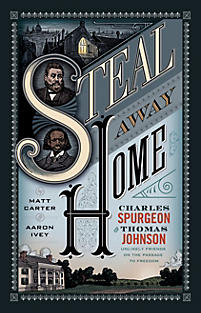
Steal Away Home - By Matt Carter and Aaron Ivey

Steal Away Home: Charles Spurgeon & Thomas Johnson - Unlikely Friends on the Passage to Freedom by Matt Carter and Aaron Ivey, is a novel that tells of a friendship between those two men.  One was a pastor who became quite famous, and yet had a lot of troubles in his life, and the other a former slave who became a preacher and then a Missionary to Africa.  This book is an attempt to imagine their lives leading up to their ultimate meeting and friendship.  Various chapters deal with either the perspective of Spurgeon or that of Thomas in a particular year.  The time advances through the chapters, showing the growing perspective of the men individually.

I really wanted to like this book, but sadly I didn't.  First, , as I was reading this book I kept running across parts where the thought kept nagging me that something about the depiction wasn't right.  I went and looked at some other books I have on Spurgeon and realized the thought was generally correct.  The authors don't seem very concerned about getting the history right. 

I'll give a couple of examples:  First, when Spurgeon's wife, Susannah, heard Spurgeon preach and  laid eyes on Spurgeon  for the first time, the book describes Susannah as struggling with conviction, focused upon a spiritual question provoked by Charles' sermon.  But in real life Susannah herself says, "Alas, for my vain and foolish heart! I was not spiritually minded enough to understand his earnest presentation of the Gospel and his powerful pleading with sinners", rather she remembers that his odd attire attracted most of her attention and caused her some amusement.  The portrayal afterward when they met at dinner seemed odd as well, Spurgeon and Susannah are depicted as flirting with each other, even though they were only just meeting each other! I never understood that to be the case.  Another inaccuracy in the book is that Susannah is present in the building at the time of the Surrey Gardens Music Hall disaster and Spurgeon runs to her immediately after attempting to conclude the message.  In reality Susannah was not there, she was at home having not yet recovered from childbirth.  I understand that this is a work of fiction, but I understood that it was going to be building around the historical facts, not changing them.  This just seemed like an attempt to make the events romantic, when they were not.

Second, I didn't like that Charles and Susannah are portrayed together in bed.  Nothing really indecent is described there but I feel really uncomfortable with that type of thing.  The conversations that this book depicts them having in bed could have been had in the living room during the day.  There was also at least one description of Spurgeon touching his wife that make me feel uncomfortable, it seemed slightly sensual.  Maybe I'm just too picky, but I don't need to picture them caressing each other in order to realize that they loved each other.  I don't understand why this needs to be depicted? 

And then, ironically, some  of Spurgeon's struggle with depression is depicted in a depressing way.  Spurgeon is shown to struggle with various fears,  fear about his wife dying, about himself dying with no one to mourn him, fearing that too many people need him, feeling that no one needs him, and he has struggles with the "why" of his and his wife's sufferings.  Things like that.  He finally finds peace late in the book when Thomas talks to him, but that doesn't make much sense. I don't understand that what Thomas told him was different from what he had already been contemplating himself, in real life and in the book.  And I really didn't think that Spurgeon's almost despairing "why?" was in keeping with his character.

I never thought that Spurgeon lived through a good portion of his life doubting the sanctifying purpose of God in suffering. From what I've read, he seemed to understand it most of his life as a Christian! And I always thought that good deal of his sadness and depression stemmed from his grief for others.  That he mourning for the souls of people and their not caring for God rather than fearing that they did not care about him.  That he mourned for the state of the church and the indifference of so called Christians to getting the Gospel right and Biblical doctrine right.  I also remember his grieving that he didn't preach adequately. In a way, a lot of Spurgeon's sorrows seemed to me to be godly sorrow, rather than worldly sorrow.  But perhaps I misunderstood Spurgeon's depression in my readings of biographies about him, or perhaps I just don't remember correctly.

But the way they have him deal with his depression (or not deal with it) also bothered me.  One spot talks about him using nature:  "Whether it was a starry night on the patio, a morning in the garden, an afternoon with bees, or a week in the countryside with a friend, Charles did his best to surround himself with things that felt natural, real, and truthful.  Because when a person wars against depression, and tries with all their might to push away the haunting darkness……that person pays very close attention to the things that illuminate truth.  Like sunshine after a weeklong shower, truth is wonderfully bright to a depressed heart."  That didn't make biblical sense to me.  That the things which are seen illuminate truth and, by implication, provoke faith?  Doesn't that contradict what Hebrews 11:1 says about faith? And other Biblical passages as well? Truth is found by hearing the Word of God, and faith comes by that Word, not by staring at nature or finding things to stir up one's emotions or feelings.

The portrayal of the two wives, Spurgeon's wife and Johnson's wife, gave me an impression that the wives were the spiritual leaders of the families.  I know in Spurgeon's family that wasn't the case in real life. Spurgeon was his "wifey's" spiritual leader.  That change grated at me, but maybe I just read it the wrong way.  And then Spurgeon seemed too, how shall I describe it?  Too flighty? Too mystical?  He didn't seem as grounded in the truth of God's Word as the real Spurgeon was.

The book didn't talk about the DownGrade controversy, or Susannah's book fund for pastors who were struggling financially. Facts like those would have been interesting to have delved into and contemplated. Showing Spurgeon's fight to keep to the truths of the Bible rather than give in and promote the doctrines of men. Instead the book just seemed to desperately be trying to interweave Johnson and Spurgeon's lives more than they probably actually were.  Even at the very end, they portray Susannah softly singing "Steal Away" to Spurgeon as he is dying.  Maybe she did, though I don't remember it.  I remember having read in a biography that the song that was sung close to the time Spurgeon died was "Emmanuel's Land", which, as nice as Steal Away is, has a lot more biblical concepts than the latter. 


 I have focused on the book's portrayal of Spurgeon and his wife because I don't know much about Thomas Johnson. But, knowing how they portrayed the Spurgeons, I'm not sure I'd completely trust the portrayal of Johnson or his wife either.  I am very disappointed.  The book was well written, I just didn't find this Spurgeon to be the Spurgeon I read about in the biographies.  Historical Fact is more fascinating than historical fiction, and the individual facts of history were all ordained of God, so we can't make them any better!  The facts God ordained, events, people, times, how much people met, how little they met…etc, are all perfect! Work with those!  I really wish that the authors of this novel had grounded their fiction more solidly in the facts God ordained rather than amending them to fit some other story line they wanted to run with. 

Many Thanks to the folks at B&H Publishers for the free review copy of this book (My review did not have to be favorable)!

My Rating:  1 out of 5 Stars
*

Thursday, December 8, 2016

Martin Luther by Simonetta Carr


Martin Luther by Simonetta Carr is a nice overview of the life of Luther for children.   It starts with Luther's birth and moves on through his life as a child in schooling and then on to his college days, where the thunderstorm happens that scares him into a monastic life where perhaps he could earn his way to Heaven.  As a Monk we learn that Luther was very meticulous and very much into examining his own thoughts and motives for sin; his ritualistic confession of his sins grew so frequent (sometimes happening just moments after he had  confessed other sins) that it irritated his superiors who then "told him to confess only big sins."

 Luther ultimately is promoted to higher positions, moving on to the city of Wittenberg to be a professor of Bible studies. Ultimately he also ends up preaching in the city church as well as "supervising ten monasteries".  Tetzel comes into Germany with his indulgences and as a consequence Luther writes his "ninety-five questions" (I like how Carr simplifies much of the language for children). He simply wanted to discuss them on a scholarly level, but they end up being translated into the common language of the people and causing a big stir in the nation and around Europe.   And then of course the famous 'Diet of Worms" happens, Luther gets taken away to a Castle…etc. Ultimately Luther ends up marrying and having several children.  We see how generous Luther and his wife are, they help many people during hard times. They also go through hard times themselves, losing some of their children in death, but they still trust God.  The book comes to a close with Luther's death followed by a quick summary of his influence. 

There are pictures scattered around the book: old and new paintings and drawings of Luther in various events God ordained that he would go through.  There are also pictures of some of his relatives and other historical people mentioned in this book.  Also included throughout the book are photographs and old drawings of the various towns and buildings Luther frequented, as well as a few photographs of objects, such as a lute and a chest used to "collect money from the sale of indulgences".

Carr writes in a way that I think children will easily understand and also manages to simplify  explanations of erroneous beliefs of the day as well as important Biblical concepts. As Examples, Carr talks about people thinking that they could earn their salvation or the salvation of others, and that many believed that Christ and God were both angry judges of sinners to be appeased by 'saints' (described as "godly people who had died") .  She also conveys Luther's struggle with what "the righteousness of God" (as discussed in the book of Romans) actually means and his final realization that in this verse (Rom 1:17), "this is not a righteousness God demands,  but a righteousness God gives in Jesus Christ."

At the end of the book there is a Did  You Know? section and after that a selection of excerpts from Luther's small catechism. I found the "did  you know" section especially interesting. I did not know (or at least I didn't remember) that Luther's last name at birth was actually Luder but he changed the spelling to Luther, "as a wordplay on the Greek eleutherius, which means "free man".  I think that kids (and adults) will both enjoy that section as a potential discussion prompting conclusion to the book. 

All in all, I really liked this book.  I really appreciated that she does not make Luther come across as a hero to be worshiped but rather as a man, saved by God's grace and not his own merit, who was used by God to bring people to a correct knowledge of the Gospel and to point them to the Word of God as the only authority.

Many thanks to the folks at Cross Focused Reviews for sending me a free review copy of this book (My review did not have to be favorable)

Two of the websites (among others) where you may buy this book are at the Christian Book Distributors site and Amazon.com 

Tuesday, February 9, 2016

The Illustrated Life of Paul by Charles Quarles is, as the title demonstrates, an account of the life of Paul with illustrations (mainly photographs) of the places he is associated with, maps to give one a picture of where he went, and photographs of archaeological finds from Paul's era.  For the most part, Quarles does a good job of sticking to the Biblical account, and I do not remember him questioning, or even hinting at doubting or questioning the Bible's accuracy in the least.

But I have a few issues with this book.  First, Quarles takes some liberties in imagining Paul's thoughts and feelings.  Here is an example of his imaginative pictures:  "Paul was happy to be back in Jerusalem.  He had lived in Jerusalem longer than any other place.  It still felt more like home to him than anywhere else.  His sister's family lived there (Acts 23:15).  He was thrilled to see her, her husband, and her children.  His nephew was practically a grown man now.  Where did the years go?  Paul wondered.  Paul had no regrets over the years he had invested in sharing the gospel around the world, but he did sometimes miss the joys of hearth and home, of watching his nieces and nephews grow, and of reminiscing with his sister about their childhood….when Paul looked into his sister's face, he still saw his father's eyes, and her smile was just like his mother's.  Looking into her face always brought back a flood of memories." He doesn't give these imaginative scenes a lot, normally he just gives a straightforward account along with historical details, he includes a bit of speculation, but doesn't paint imaginative scenes like the one above, but that just makes his ventures into imaginative 'pictures' of Paul even more out of place and embarrassing.

Second, and related to the above, the author makes statements in various places throughout the book that bothered me, speculating on why the Apostle's may have gone to such and such a city, or why they did such and such.  When he was speaking of Paul in Athens he was commenting on the strategic advantage of getting people in that city to see the credibility of the Gospel,  "If the gospel won acceptance in this intellectual center, it could no longer be dismissed as the fantasy of madmen.  Instead, Christianity would be recognized as a reasonable faith accepted by some of the world's most brilliant thinkers."  I really don't think that Paul's goal was to have the Gospel recognized as 'intellectually credible' by the brilliant thinkers of the day, rather I would assume, based on his writings that he would have expected the opposite,  "For it is written, I will destroy the wisdom of the wise, And the discernment of the discerning will I bring to nought. Where is the wise? where is the scribe? where is the disputer of this world? hath not God made foolish the wisdom of the world? For seeing that in the wisdom of God the world through its wisdom knew not God, it was God's good pleasure through the foolishness of the preaching to save them that believe. Seeing that Jews ask for signs, and Greeks seek after wisdom: but we preach Christ crucified, unto Jews a stumblingblock, and unto Gentiles foolishness; but unto them that are called, both Jews and Greeks, Christ the power of God, and the wisdom of God. Because the foolishness of God is wiser than men; and the weakness of God is stronger than men."  (1Co 1:19-25)

And third, among the illustrations of the book is at least one nude statue of a man (the 'god' Hermes).  I don't need to know what the 'gods' of the day looked like, nor do I think that such illustrations are appropriate in a Christian book.  

Overall, I simply didn't 'love' the book, and I'm not exactly sure why.  Perhaps because one could simply pick up the Bible and read Acts and Paul's epistles to learn about his life?  I mean, technically speaking, it was Luke's biographical account of Paul that made it into the Bible, so who could really write a  better biographical account? I have absolutely no problem with people writing biographical accounts of Biblical characters as long as they make sure to have the Bible as the primary and most authoritative source of their information, and Quarles does a pretty good job.  it was okay and others may like it better. It does give interesting historical background information of the time.

 I really liked how Quarles ended the book, by encouraging a proper perspective of Paul as God's slave/servant, and that people should not admire the Apostle too much:, "Although those who study the life of the apostle cannot help but be moved by his faithfulness, inspired by his passion, and awed by his commitment they must not forget that Paul would blush, not with embarrassment but anger at such accolades.  To those who would deify him, he would retort, 'Men! Why are you doing these things?  We are men also, with the same nature as you' (Acts 14:15).  To those who would sing his praises, he would quickly reply, 'Was it Paul who was crucified for you?  Or were you baptized in Paul's name?" (1 Cor 1:13)….Although this book has attempted to help readers better know the mind and heart of the apostle Paul, Paul himself would insist that this was not the point….'For I didn't think it was a good idea to know anything among you except Jesus Christ and Him crucified. (1 Cor 2:1-2)  Know him, Paul would say.  Know him….If knowing Paul stirs a yearning ot know the One for whom he suffered, the One whose name he proclaimed, the One for whom he died, then Paul lived and died well. (then he quotes Phil 1:20)."


Many thanks to B&H/Lifeway blog review program for sending me a complimentary review copyof this book (My review did not have to be favorable)!

Wednesday, July 15, 2015

Marie Durand - By Simonetta Carr

Marie Durand by Simonetta Carr is an interesting, though short, account of the Christian lady.  I didn't know anything about Marie before reading this biography, the name sounded familiar but didn't point to any substantive information in my mind. Now, I understand that she was a French lady living during the 1700s who was imprisoned on account of her brother's being a pastor.  She could have gotten out of prison by denying the faith but did not do so and stayed in in prison for 38 years.   
Marie Durand Book Cover
There are interesting illustrations throughout, and also photographs of items and places from Durand's era.  At the end of the book there is a pronunciation key to help one read and pronounce the French words, a 'Did You Know?' section giving more information about the people and lifestyle of that era, and a letter from Marie to her niece Anne.  Also, I liked the Epilogue, where Carr gives an overview of what happened after Marie died. The 'Age of Reason' or Enlightenment was critiqued quite well, and I think in a way that even young children will understand.  Here is a small excerpt:  "During that Age of Reason, or Enlightenment, as that time became known, they started to reject or ignore most teachings human beings can't fully explain, such as that God works miracles, that Jesus is God, or that God is one in three persons."  I especially liked the statement she gives of Paul Rabaut in this section where he states that, "I will not reject a mystery for the only reason that it cannot be understood."  That is a statement that still fits today.  

The only thing that I believe would make this book better would be for it to have a list of other books of Marie Durand and the times in which she lived, so that any children (or adults) who get a thirst for more information on, or a deeper look at, the subject would have some suggested resources already on hand.  But, despite its shortness, this biographical overview is quite inspiring, it shows children (and adults) a Christian whose faith they may strive to imitate.   

Many thanks to the people at Cross Focused Reviews for sending me a review copy of this book(My review did not have to be favorable.
 

One of the places this book may be purchased is at Amazon.com

Monday, May 11, 2015

Dead Wake - by Erik Larson

Dead Wake: The Last Crossing of the Lusitania by Erik Larson is one of the most interesting history books I've read in a long while.  Lots of history  books have interesting facts and can keep your interest simply because of the elements of history they present, but this one is among the 'time machine' history books that pull you into the time period and make you seem as if you are a present but invisible observer of the events of the past.   

I really didn't know much about the Lusitania before I read this book, I think that I remember hearing it(or reading it) mentioned in connection with World War I but I didn't really have much of a concept of what happened.  The Lusitania was a British passenger ship headed for England, torpedoed by Germany in the "Great War" before America had joined the fight. Larson tells the story from the point of view of many of the passengers, Winston Churchill and the secret "Room 40" in Britain, and also from the German perspective of the German government and the U-boat commander Schwieger and his crew who sank the ship.  President Wilson's thoughts and perspective are also brought into the book, though in his case I didn't quite see the point as it is mainly about his personal struggles over having lost his wife and then his courtship and marriage to his second wife, Edith.  

Normally when I've read books, fiction or non-fiction, that switch between various characters there are certain one's I am interested and other one's I'm bored with, wanting to get back to the intriguing characters.  But this book is so well written that all of the characters were interesting, I didn't really mind when the perspective was moved from the war officials and Admiralty in England to the Captain, crew and passengers of the Lusitania, though it did get a bit tense when the torpedoes hit as one wants to keep reading about the passengers and their situation and not about what the war office in England was hearing.

 I did think, but this is generally the case with all good books, that it could have been longer.  I wish that Larson had included more of the passengers' perspectives than he did.  I've found, in looking up more on the event, there were a lot more 'stories' he could have included.  And on a more negative note, I wish that he hadn't quoted the swearing, even though it was from actual quotations.  The language is generally more the 'condemning someone' type, and exclamations of where they're condemned to.  Also , some of the accounts of the examinations of the dead were a bit too descriptive. There are some things I don't want, or need to know. 

The events of the sinking are fascinating in a unique way, an almost seeming reversal of 'Providence', only it wasn't really a reversal of course, it was just several people's God-ordained time to meet their Maker.  The events of the sinking were set up perfectly: if they had left a little sooner or even if they had been delayed a little longer they may not have met up with the U-20.   If the British Admiralty had sent word to the Lusitania to take a recently opened alternate route, which was definitely safer, then they may never have crossed paths at all.  If the fog hadn't cleared during the time the two marine vehicles were going through the same area then the U2-20 would almost certainly have passed by the ship under water.  And if the Lusitania had not slowed and turned directly towards the U-boat, the Germans may never have had a shot(being slower than the ship), and it is also remarkable that the torpedo caused as much damage as it did. 

There were people who lived of course, and their stories are very fascinating.  Some of the ways the various characters survived were amazing, and particularly note-worthy when one realizes that it was not their time to die, and that God was the One ultimately saved them.  One particular account was funny and very moving, in the aftermath of the sinking when two brothers both think the other may have died and are searching for each other, they meet up in a morgue while searching for each other among the dead.

All in all it is a very fascinating account, and very well written.  It makes me want to read more of Larson's books.

Many thanks to the people at Blogging for Books for sending me a review copy of this book!  My review did not have to be favorable)

This book may be purchased at Amazon

Friday, May 8, 2015

Ulrich Zwingli - by William Beokestein

Ulrich Zwingli, by William Boekestein is, as the series is titled, a "Bitesize Biography" but there is a good amount of content in that 'bite'.  Despite this biography's size, it gives a lot of information to Zwingli. It actually seems to 'introduce' you to him as opposed to making you a mere acquaintance of his life. 
The things I most remember about Zwingli, from other books and sources on him, are that he died in a not-so justifiable battle/war and that he debated and opposed Luther on the presence of Christ in the 'Lord's Table'.  I've found out that there were several things I didn't know about his life, these things include sanctifying works of God in and through his life such as his doing away with preaching on Bible texts assigned by the Catholic Church, and opting for a verse by verse, book by book method of preaching instead.

On the negative side, there were the manifestations of the sinful 'remnants' of Zwingli's dead old self that still hadn't conceded that God had won the victory(Rom. 7-8).  Some of these negatives are evidenced in Zwingli's struggle with sexual sin(he solicited prostitutes), even when he had come to an accurate view of salvation.  He technically shouldn't have been a pastor because of that, but he was still a 'Priest' in the Catholic church of that time and they weren't exactly promoting Biblical justification or sanctification.  As the author puts it, "Zwingli's intellectual abilities had greatly outpaced his moral fortitude".  Perhaps the key point in Zwingli's struggle was that it was actually a struggle with this sin, and not a resignation to it.  It does look as though he ultimately did manage to get to get to a point of acting on the Spirit's promptings to habitually 'kill' those sins,  and he married a widow and had several children with her.
 
Like all Christians, Zwingli had his flaws, and his own battles with his fleshly desires, which makes us admire God's use of the man, realizing even more that any truly godly thing that came out of Zwingli's life was God's work, not his own.  And so it is in all of our lives as Christians, we are dependent upon God for all aspects of salvation, and we take comfort that God's work doesn't just stop at our justification but that it continues with our progressive sanctification and ultimate glorification(Rom. 8:30). 

If you want to get a quick view of Zwingli's life and God's use of Him, this biography would do very well.

Many thanks to the people at Cross Focused Reviews for sending me a review copy of this book(My review did not have to be favorable.

This book may be purchased at Amazon

Tuesday, December 23, 2014

Bonhoeffer (Abridged) - By Eric Metaxas

Having read the unabridged Bonhoeffer by Eric Metaxas I was interested to see that there was an abridged version and was curious to see how the abridged version would compare to the original.  It was a nice attempt, but it definitely isn't even half as good.  For one thing, it seemed choppy at parts, for instance, at one point, the Nazi party is a small minority party in the government and then all of a sudden Hitler is in power. As far as I can recollect, It didn't really talk about the growth of the Nazis like the other one did.  I understand that in order for it to be 'abridged' lots of things would have to be 'cut', but I thought that it should have had a little bit more of the background of what was going on politically in Germany just for clarities sake.  And another example of its 'choppiness' was where Bonhoeffer declares that he won't go to the 'Fano' conference if a particular 'Reich-church' leader went too, and then we find that Bonhoeffer goes to the conference, but I didn't notice any mention of whether or not that 'Reich-church' leader was there. 

This all just my opinion, and it may just be that my knowledge of what's missing biases me towards the fuller account.  You might want to look at a review by someone who hasn't read the original to see what they thought of it, it may not seem as choppy to them.  Ultimately, you get a pretty good overview of the events of his life, and I still have the same caution towards his view of Catholicism, like I mentioned in my review of the unabridged account of his life, it seems that he may have thought that the beliefs of Catholicism were accurate enough that the people who hold to them are saved.  It makes me a bit nervous of what he actually believed about the salvation of God.  If he actually loved Roman Catholics, then he would try to explain to them what God's word actually says about there being only one Mediator between us and God, and how our works will not save us, earn us any points before God, nor will the 'merits' of the saints give us any 'clout' before God.  God Himself provided us Righteousness in His Son Jesus Christ.   

All in all, I just felt that one didn't get 'acquainted' with Bonhoeffer in this abridgement, it was more like a recounting of events in his life rather than a look at what was going on in the man himself.  But again, some people may like summaries. 
 
I received a free review copy of this book from the Booklook blogger program in exchange for my review which did not have to be favorable.
 
This book may be purchased from Amazon and Thomas Nelson's site.

Friday, November 21, 2014

Samuel Rutherford - Bitesized Biography by Richard Hannula

I did not know much about Samuel Rutherford before reading this 'bite-sized'  biography by Richard Hannula.  I associated his name with the song "The Sands of Time are Sinking" and thought that he was the author.  The content of the song made me desire to know more about Mr. Rutherford. It turns out that the song was written by Anne Ross Cousin, but it was inspired by Mr. Rutherford's writings and sayings, so my curiosity stayed. Samuel Rutherford was a Scottish pastor who lived in the 1600s who underwent persecution along with other Christians under the reigns of Charles the I and II.   He was married twice(his first wife died) and had nine children altogether, only one survived him.  One of the things I admired about God's working in him was his deep love for his congregation, even when banished from them he was concerned with their welfare, and kept up a correspondence with them to keep encouraging them in their lives as Christians. 

Though very focused upon the life that we will have with Christ "beyond the veil", Mr. Rutherford seemed to morph the worldly kingdoms/governments of this life set up by man(Christian or not)with the Eternal Kingdom that Christ will set up Himself.  And the author seemed to agree to some extent as he mentions at one point that Rutherford, "unwisely linked the cause of the covenanter army with the cause of Christ".  Rutherford and his colleagues seemed intent upon having all of the Scottish people governed not just physically, but spiritually as well, even to the point of coercion, "Rutherford urged Parliament to impose the true Christian faith in a unified national church…".  He appears to have defended 'Christian armies', fighting for their rights when a King uses His power wrongly.  Ironically, in his defense of Covenanter resistance to King Charles he compared the King to Nero, the same wicked Caesar who was probably in power when the Apostle Paul wrote, "Every person is to be in subjection to the governing authorities. For there is no authority except from God, and those which exist are established by God."(Rom 13:1 NASB)  Paul did not call for the Christians to raise up an army in defense of the faith, nor did any of the Apostles when there was persecution from the government or from religious leaders.  Also, another problem I had, and this is going to sound really odd, Mr. Rutherford seemed so focused upon Christ that God the Son almost seems to eclipse God the Father in his eyes.  But that might just be because of the quotes that were selected for this book.  

All in all this was a nice look at the life of Rutherford, and, as with all biographies of Christians, it makes one amazed and comforted by the amazing grace of God in using such flawed instruments as mankind. The book is quite small, and truly is 'bite-sized' enabling you to quickly learn about Rutherford and to get a taste for whether or not you'd like to read his works, or a larger biography like the ones listed at the end of this book. 

I'll end  with one of my favorite quotes from the book by Rutherford, "Look beyond time…they have but children's wit who are delighted with shadows and diluted with feathers flying in the air."


Many thanks to the folks at Cross Focused Reviews for sending me a free review copy of this book to review(My review did not have to be favorable.)
 
This book may be found on Amazon