Showing posts with label ministries. Show all posts

Thursday, February 20, 2020

Leveling the Church - By Micah Fries and Jeremy Maxfield


Leveling the Church: Multiplying Your Ministry By Giving It Away - by Micah Fries and Jeremy Maxfield is attacking the notion of, what they call, the "super pastor", the idea that the pastor is in charge of everything in the church and pretty much meets everyone's personal spiritual needs. Instead, they believe that the biblical model is for the pastor and elders to train men to be able to do various tasks that many think the pastor is solely responsible for.

I wasn't quite sure what I thought of this book at first, but I've concluded that I like it overall, though with some caveats which I'll mention in a moment.

 The premise is very interesting.  As I mentioned above, the case is made that the pastor's job is not to take on everything himself, but to build up others to be able to take on ministerial tasks, like visiting the sick in the hospital, counseling, and visiting in general. As the authors put it:  "…while the pastor ought to engage in ministry actions like visiting others, such ministry is our familial responsibility.  The vocational responsibility of a pastor or church leader is, particularly, to engage develop the church community so we can all engage in acts of ministry together…"

They attack the notion that Christianity is individualistic in its nature, that it is focused upon ourselves: MY spiritual growth, MY being spiritually fed, MY being ministered to, MY needs need to be met:  "…we have repurposed the Christian faith in a way that is generically individualistic.  We claim that we don't need the church to worship, that we can worship anywhere.  We claim that no one can judge us.  We claim that our relationship with God is our business alone…….  Consider, how we regularly judge the success of a worship service.  We leave and say things like, 'That was great! I really got fed today!'  That sounds mature, and faithful.  It sounds like we are prioritizing good biblical teaching, but it is actually in opposition to biblical worship.  When we judge the effectiveness of a worship service by what it does for us, we have made ourselves the object of the worship experience."  Rather, as this book points out, we Christians are supposed to gather together regularly, meeting one another's needs(and those aren't always personally felt needs), talking, and getting to know one another, and pushing each other to live as we ought.  The authors put it bluntly:  "We are specifically encouraged to gather together so we can be in each other's business."  This group responsibility for one another's spiritual needs and well-being truly fits with the Biblical model.

As to some of the things I was wary about: There was a positive quotation of a Catholic priest with no disclaimers about his beliefs. I'm afraid that perhaps this means that the writers consider Roman Catholicism an expression of the true Gospel. But it's not, it can't be. From what I understand of the teachings of Roman Catholicism, other mediators between God and mankind are proposed besides Jesus Christ and the idea seems to be propounded that Jesus Christ's righteousness is not the only righteousness available to cover one's sins (Mary's and other saints' righteousness are also available). Also the focus and reverence of the virgin Mary is quite idolatrous (also her being another mediator for us in Heaven, and her not being a sinner). I don't remember the authors quoting or saying anything else that indicated that they espoused Roman Catholicism, rather they emphasized the importance of getting the Gospel right.  So perhaps this quotation was just something that wasn't thought through…

Second, I didn't quite understand what is meant by "Multiplication" .  I was getting mixed impressions of what they meant by that.  At first I got the idea that the goal is not necessarily to multiply the people in your church but rather to grow spiritually.  But then it started to sound like numbers of people are important.  "Our vision is to see one percent of the metro area worshiping with us on any given weekend…we had to reach new people and see them developed into multiplying leaders."  They measured baptisms, measured the amount of people in certain small groups..etc.  That leads me to the question: Who builds the church? Doesn't Christ?  Who are we to assume that we know how many people He should be adding to our particular local gathering? The number of people in our area appointed to eternal life (Acts 13:48)?  what if 1 percent is too low? What if it is too high? Besides, what if one percent of our area do believe, but are attending other biblical churches in the area? What if our particular church is supposed to stay a small body of believers? The Lord will add our number if He sees fit, but it is not our place to set a numerical goal, nor I might add (in our day and age) an ethnic, age or gender related goal of the types of people we want in our group.  The Lord builds the church, we don't pick the people He builds it with or how many people or how fast it should grow numerically.

I also a bit concerned about some implications I got from things they said about ministry, it seems as though they think that the ministry done by people ought to be an 'official' church ministry, outside of the regular sermon meeting on Sunday. "…our life in the church has to be more than a once-per-week gathering for an hour of worship.  This will mean, for example, investing in a Sunday school class or small group or serving in an area of ministry."  Don't get me wrong, I agree that we don't just sit and listen to the sermon, leave, and that's our church life.   But what if it's not an official, church recognized area of ministry that you've signed up for?   What if your ministry is meeting another church family in the week and the majority of the rest of your church family never find out that you did  that?   Or just talking and encouraging someone else while meeting on a Sunday?  Does it have to be 'official' or known by the rest of the body?

The last question I want to mention that this book brings up in my mind is, how does the Pastor equip the Saints? I see the thought that he is to equip other people to work with him and help lead, but how, really, will the spiritual growth of the people happen?  Does equipping the Saints mainly happen by the Pastor offering practical training and appointing tasks or by preaching the Word?  Biblically he mainly seems to be instructed to equip them by preaching the Word.  By reproving, rebuking and exhorting people.  Feeding the sheep - That seems to be his main instruction for equipping the Saints. 

Perhaps the other elders are to take care of practical training and appointing tasks? Or perhaps the people are to be looking for ministry opportunities on their own, look for needs that need to be met, not just for the church building, but the needs of individual members, the building up of individual members, the provoking of one another to love and good works independent of having to have a permanent, recognized part in a small group ministry geared toward any specific work.   Some of the works will be done in the large group (listening to teaching of the Word of God on Sunday), small groups (helping someone paint rooms, clean things, just getting together..etc.) and one on one works (sweeping the floor in the church kitchen, mowing a fellow member's lawn, visiting the sick, widows, elderly, or helping someone with their personal struggles).  None of the works need to be publicly acknowledge by the corporate church.

Having said all of that, I'll repeat that the book was quite good overall, very thought provoking (as you can probably tell by my ramblings).  The authors give a good demonstration that Christianity is not to be lived in isolation, but as a community, as a body of believers each member needing the other.  And they also show that people shouldn't expect the pastor to be the one to do, or even to lead, most of the ministry that happens in the church.  People shouldn't go to church just to "fill up" but to live out what they've learned, and  not just living it on Sunday but on every day of the week.   I'll end with one more quote from the book:   "… if spiritual maturity is typically measured by daily Bible reading as individuals, and if discipleship (if it happens) is typically measured by the reproduction of sound doctrine and maybe Scripture memory, and if leadership is qualified by theological education (and perhaps business savvy for directing growth strategies and managing staff recruits), then we're functionally gnostic.  We've focused our efforts on the acquisition of spiritual knowledge in the mind while disregarding the spiritual significance of daily life in the physical world.  An incomplete gospel is an incorrect Gospel."

Thanks to the folks at MP Newsroom for the free review copy of this book (My review did not have to be favorable)

My Rating: Four out of Five Stars
****

This book may be purchased at Christianbook.com and Amazon.com


Thursday, September 6, 2018

The Spontaneous Expansion of the Church: And the Causes Which Hinder It - By Roland Allen


The Spontaneous Expansion of the Church by Roland Allen is a rather short but very thought provoking book.  In it, he somewhat implicitly asks the question, Who builds the Church? Leading to that thought, he critiques our method of Evangelization, are we doing it right? Do we need to organize the expansion of the church?  Do we need to establish mission stations, do we need missionaries who depend upon appeals for money for their support.  Will the Gospel spread if we don't purposefully come up with a plan to spread it?

Allen warns that what we are trying to do in our methods is to organize the work of God, to dictate where people will get saved and a time period in which their salvation must happen.  But as Allen points out, "For spiritual work spiritual organization is necessary; but can we create a spiritual organization of spiritual forces?  Only a divine intelligence can do that.  But we attempt to do the work of that divine intelligence; by fixing our stations and immobilizing our men….But to be God's agents in spiritual movements we must follow, not lead.  We want to lead, and, in trying to lead, we are simply left behind.  We say:  'Here we will have our buildings,' but the spiritual movements may be growing unseen by us in another place and by other means….The organization is always too late.  For we can organize the external results of a spiritual movement, but we cannot organize a spiritual movement. "

 One of the main points of the book  is that we don't need professional missionaries or Christian organizations dedicated to evangelism in order to spread the Gospel. The Church is the only Christian organization promoted by the Bible and therefore we should assume that the Gospel will be spread by means of its members working within that organization rather than in a parachurch organization.  How will the Gospel be spread in other countries? Well, Allen points out that God can use any way He wants. He can use a member of a local church in Lansing, Michigan going on a business trip to Ethiopia to spread the Gospel to an Ethiopian he meets in the process of doing whatever work he does there.  Let's say he talks to Ethiopian about the Gospel, the Ethiopian believes, and the American Christian gives him a Bible and goes back to America, as his business is done. But even though that American Christian leaves, the Ethiopian studies the Bible given to him, and spreads the Gospel to his fellow Ethiopians and thus a church can springs up, without there being any money having ever been particularly dedicated to spreading the Gospel in that area of Ethiopia.  Christ will build His church.

Interestingly, Allen points out that the "great commission" is not repeated in the epistles, and the Apostles did not make evangelistic appeals to the churches, they didn't give out calls for people volunteer to go into far away countries to spread the Gospel.  They apparently assumed that the Holy Spirit would bring individual church members to the right people and to the right places without their needing to organize the work or plan it out.  This may sound absurd today, but we don't need "Professional Missionaries", all Christians are missionaries.  He points out that people "have been obsessed with the idea that a man to express his missionary zeal properly must be a member of some other body within the Church and that church membership is not sufficient." 

 Oh, and by the way, this guy was writing in the 1920s! It is still so applicable to today, perhaps more so than even in his day.

Another thing that Allen critiques that really seems to be prominent in our day is the "Social Gospel"; warning that feeding the poor and helping the sick is not the Gospel itself. You really can't preach the Gospel without "using words".  "'Seek ye first,' said Christ, 'the kingdom of God and His righteousness, and all these things shall be added unto you.' Putting intellectual enlightenment and social reform first in time, we have, by deeds which speak louder than words, taught men to seek 'all these things' first, and some today justify their action by identifying intellectual enlightenment and social and political reform with the Kingdom of God and His Righteousness.  To identify the Kingdom of God and His Righteousness with social and political doctrines always has led, and always must lead, to disaster.  The Kingdom of God and His Righteousness are founded in Christ, but these doctrines and reforms can easily be divorced from Christ, and are pursued by many who won no allegiance to Christ." To apply this today, ending world slavery, creating democracies and republics, is not the Gospel of Christ.  Somewhere in the book Allen says something along the lines of: A person can become a vibrant Christian and remain a slave, a person can be a dedicated, enthusiastic Christian and live in a country ruled by a dictator, a Christian can be a joyful Christian and be malnourished.  A change of outward circumstances is not the Gospel.  Christ is All-Sufficient, no matter what circumstance we find ourselves in.  Point to Him first, and anything else that He thinks is needed for the convert will come after their acceptance of Him.

Lastly, Allen greatly laments Christian organizations reliance upon money.  He notices that anytime missionaries see an opportunity for the further spread of the Gospel they make it seem as though it cannot take place without money. Christian organizations unconsciously teach their converts that money is the power of God unto salvation. "They continually bemoan the fact that their greatest difficulty, their most serious anxiety, their most bitter disappointment, arises from the lack of support from home.", lacking the support either of money or of more paid recruits, they assume that the work of God won't get done, not considering that perhaps God doesn't want it to happen their way, perhaps God wants that particular organization to close. That's one of the questions he asks, would a Christian organization be willing to close in order to further its cause if that's what it would take?

There are other things Allen addresses that are quite interesting and intriguing thoughts.  But, to sum up Allen's book:
He warns us that we are trying to make people into New Creations ourselves, essentially taking the job of the Holy Spirit into our own hands.  We don't need to make people moral before they can come to Christ, that will come afterward, we don't need to change people's surrounding  circumstances before they can be a vibrant Christian.  We don't need money to spread the Gospel. We don't need professional missionaries and Christian organizations to spread the Gospel. We don't need money to create a church.  Christ will build His church. 

 I highly recommend this book.

Many thanks to Wipf and Stock Publishers for sending me a free review copy of this book! (My review did not have to be favorable)

This book may be purchased at Amazon.com

My Rating:  5 out of 5 Stars
*****

Wednesday, March 8, 2017

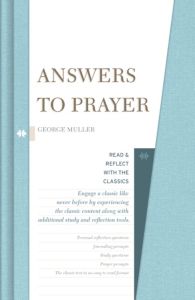
Answers to Prayer - George Muller

Answers to Prayer by George Müller is part of the Read & Reflect With the Classics Series (I am reviewing the hardcover version) which provides thought provoking questions and also prayers at the end of each chapter.   Müller's book details various accounts of God's all sufficient grace in the works that God had prepared for him to do.

The way that Mueller approached the ministries that God graciously gave him is very unique compared to most present day Christian ministries (and perhaps most ministries in Müller's day as well).  Ministries today are very focused and reliant upon, money.  They  hold fundraising drives, have commercials on the radio asking for people's support, and some will send tons of letters and emails begging for monetary help. I think of one ministry in particular, which, although its founders believe in God's absolute sovereignty, they contradict their belief by implying that their ministry cannot continue without the help of people, that "your support makes ministry happen". 

Many ministries act as if they are the most important ministry in God's Kingdom and that if you do not give money and they expire, that God's Word will not be given out any more.  Muller did not act like that.  He knew that God did not need human beings in order to get His work done. 

Müller took a more faith-based approach, relying upon God rather than upon people for help.  He would not ask people for help with ministries, he asked God, period.  And God provided.  "Never since the Orphan work has been in existence have I asked one single human being for any help for this work; and yet, unasked for, simply in answer to prayer, from so many parts of the world, as has been stated, the donations have come in, and that very frequently at a time of the greatest need."

He also came to the conclusion that one should not rely on people's promises to give money and that one should not even think about those promises: "Now this morning it came to my mind, that such promises ought to be valued, in a certain sense, as nothing, i.e., that the mind ought never for a moment to be directed to them, but to the living God, and to the living God only.  I saw that such promises ought not to be of the value of one farthing, so far as it regards to thinking about them for help."  This is quite a contrast to ministries who beg for pledges of money, and put large or regular donors names up on plaques.  They make more of the people, more of the tools,  that God uses than the Supplier Himself!  God is the One who supplies all our need, and though he may use people to do it, they are but channels (think "Channels Only").  God doesn't need people, or their money, AT ALL in order to supply our needs!

As Müller puts it, "Earthly friends may lose their ability to help us, however much they desire so to do; but He remains throughout eternity the Infinitely Rich One.  Earthly friends may have their minds after a time diverted to other objects, and, as they cannot help everywhere, much as they may desire it, they may, though reluctantly, have to discontinue to help us; but He is able, in all directions, though the requirements were multiplied a million times, to supply all that can possibly be needed, and does it with delight, where His work is carried on, and where He is confided in.  Earthly friends may be removed by death, and thus we may lose their help, but He lives forever, He cannot die.  In this latter point of view, I have especially, during the past 40 years, in connection with this Institution, seen the blessedness of trusting in the Living God alone.  Not one nor two, nor even five nor ten, but many more, who once helped me much with their means, have been removed by death; but have the operations of the Institution been stopped on that account?  No.  And how came this? Because I trusted in God, and in God alone."

Müller would at times give updates on God's provision for the ministries in times of great need, but this was to encourage Christians in the faith, not to work on their emotions to make them feel compelled to give supplies.  At least one time Muller and his fellow workers put off giving an update because at the time they were, from a human perspective, in desperate straits, and they did not want other people to know it, wanting to rely solely on God for help.

Many ministries want God to give them a yearly supply rather than just their daily bread.  The ministries that God gave Müller charge over lived day by day in reliance upon God's supply, many times literally being given the means for their daily needs DAILY on the day they were needed, rather than in advance.

I really liked this book. The only thing that I didn't quite like were the prayers that were added at the end of each chapter.  I would rather that they have been commentary rather than prewritten ways that we can use to talk to God. Yes, we do not know how to pray as we ought, but neither does the person who wrote those prayers.  Though I don't think that using other people's prayers is necessarily wrong, Christians ought not to rely upon other Christians to write their prayers for them, we have the best Helper of all in the Holy Spirit who is our Interceder in our prayers (Romans 8:26-27).    There are good concepts in them though, "You provide what I need, and if I don't have it, I can absolutely trust that I don't need it. "

Before I end, and I really need to end because this is quite long, at the end of the book there is an appendix containing an article by Muller on "The Careful and Consecutive Reading of the Holy Scriptures".  It is an excellent read, and describes Muller's goal in writing this book.  He advocates the consistent daily reading of the Scriptures, over and above any other book.  He describes how he once slacked in that area and how he had gotten into the habit of reading other books, including Christian ones, instead of the Scripture.  "…thus, like many believers, I practically preferred, for the first four years of my divine life, the works of uninspired men to the oracles of the living God."  As he put it, "God himself has condescended to become an author" and this is the "book of books" containing all that we ought to know!  We should not value Christian books (including this one) above the Scriptures, the Scriptures themselves should be our delight. 


Many thanks to the folks at B&H Publishers for sending me a free review copy of this book (My review did not have to be favorable).

My rating:  5 out of 5 stars
*****

This book may be purchased at (among other websites) the Christian Book Distributors website and Amazon.com