…Spurgeon observed many, 'who, by hearing continually the most precious doctrine that belief in Jesus Christ is saving, have forgotten other truths, and have concluded that they were saved when they were not, have fancied they believed when as yet they were total strangers to the experience which was not grounded upon the divine word rightly understood, 'nor proved by any facts in their own souls.' They resented any suggestion of self examination by gospel tests as 'an assault upon their assurance' and 'defended their false peace by the notion that to raise a question about their certain salvation would be unbelief.' Their ill-placed certainty has put them in a hopeless condition and they ignore biblical warnings and admonitions by 'their fatal persuasion that it is needless to attend to them.' Their historical knowledge of the work of Christ has settled them in a conviction 'that godly fear and careful walking are superfluities, if not actually an offense against the gospel.'
From the book: Living By Revealed Truth: The Life and Pastoral Theology of Charles Haddon Spurgeon by Thomas Nettles
See more quotes on my quote collection blog: https://snickerdoodlesquotes.blogspot.com/
Showing posts with label Salvation. Show all posts
Showing posts with label Salvation. Show all posts
Monday, February 24, 2020

Friday, October 25, 2019
Carpe Diem Redeemed - by Os Guinness

I really wanted to
like this book but it was quite disappointing.
It's sobering, definitely; maybe even motivating. But…how do I put this? It's not very
encouraging. Guinness does not come across as someone who believes that
salvation is found in faith in Christ alone.
He seems to believe
that ethnic (or religious?) Jews will be saved whether or not they believe that
Jesus is the Messiah, God in the flesh, Who takes away sin and gives us His
righteousness. At first I thought that maybe
I was just reading too much into some of his statements, like this one "Both Jews and Christians owe their salvation entirely
to God - Jews in terms of their national exodus from Egypt and Christians in
terms of their personal exodus from lostness". But then it became clearer along the way and
he made statements like, "There are no more
realistic faiths than Judaism and the Christian faith, but Jews and Christians
live with an undimmed hope even in the darkest hour." Judaism is
not a faith that will save, that takes care of sin. Man is not "justified by the works of the law" (Gal 2:16) And the Epistle to the Galatians attacked
those who were trying to make people believe that Judaism saves: "Christ
is become of no effect unto you, whosoever of you are justified by the law; ye
are fallen from grace."(Gal 5:4)
If anyone's faith, Jew or Gentile, is not placed in Christ as the
solution, the Righteousness, for his sins then his hope is misplaced and will
not save him from God's judgment. "We are Jews by birth and not Gentile sinners, yet we know that no one is justified by the works of the law but by the
faithfulness of Jesus Christ. And we have come to believe in Christ Jesus, so
that we may be justified by the faithfulness of Christ and not by the works of
the law, because by the works of the law no one will be justified."
- Galatians 2:15-16
Guinness says: "There is
a promised time as well as a promised land.
(On that great day, the only question dividing Jews and Christians, as a
Jewish friend says, will be to welcome the Messiah together, and then ask him
whether his coming is his first or his second.)."When the unsaved
Jews see the Messiah for the first time, their reaction will not be to ask Him
if He had come before, rather it will be mourning, deep grief, because they
instantly know that Jesus IS the Messiah who came 2000+ years ago. The Apostle Paul did not believe that Jews
who rejected the Gospel were saved, he wanted them to be saved but he knew that
if they did not accept the righteousness of God, rather than their own, they
could not be saved: "Brethren, my heart's
desire and my supplication to God is for them, that they may be saved. For I
bear them witness that they have a zeal for God, but not according to
knowledge. For being ignorant of God's righteousness, and seeking to establish
their own, they did not subject themselves to the righteousness of God."(Rom 10:1-3) Paul acknowledges that God did not
spare unbelieving Jews and that He will not spare unbelieving Gentiles either: "Well; by their unbelief they were broken off,
and thou standest by thy faith. Be not highminded, but fear: for if God spared
not the natural branches, neither will he spare thee. Behold then the goodness
and severity of God: toward them that fell, severity; but toward thee, God's
goodness, if thou continue in his goodness: otherwise thou also shalt be cut
off. And they also, if they continue not in their unbelief, shall be grafted
in: for God is able to graft them in again. (Rom 11:20-23) God
saves both Jews and Gentiles by faith in His Son.
GOD BELIEVES IN WORTHLESS PEOPLE WHO DO NOT FEAR HIM AND ARE
ENSLAVED TO SIN?Second, Guinness seems to
believe that human beings are not all that bad.
He says things like,
"God loves and believes in us as humans even more than we love and believe
in ourselves" . God doesn't believe in us at all. Rather, the Bible describes us as "Dead in trespasses and sins." (Ephesians 2:1) Our 'righteousness' is as
filthy rags, worthless and disgusting (Isaiah 64:6). Both Jews and Gentiles are
naturally evil, worthless and do not fear God (See Romans 3). There is nothing good to believe in with
regard to us humans. That's the amazing
thing about the love of God, He didn't believe in us but He loved us and
therefore changed us. God's love is
shown by His making us New Creations (not by believing in who we were
originally) - 2 Corinthians 5:17.
THE FREEDOM TO DO EVIL IS AN ESSENTIAL ATTRIBUTE OF
HUMANITY?
The author seems to
believe that freedom to do evil is the greatest thing we can have and that
without it we have an essential component of our humanity taken away. But he
warns, Man has a "proneness to corrupt freedom" But, I have a
question: isn't freedom already corrupt
if it includes the ability to choose wrong?
Isn't freedom essentially evil if it includes the ability to defy God?
I quote again from
the book, "Made ' in the image and
likeness' of God, we humans are exceptional, responsible, and
consequential. We are free and capable
of real choice - ' I have set before you life and death, the blessing and the
curse. So choose life' (Deut
30:19). Being free, we could always do
otherwise than we have chosen and done, so
we are responsible for what we have chosen and done. We are therefore significant and responsible,
though we are not sovereign as God is, and we are always limited by our
finiteness and by our proneness to corrupt freedom and so to go wrong, do wrong,
and even to become prisoners to our freely chosen wrongdoing."
Let me tell you how
I understand this paragraph: being made in the image and likeness of God means
being able to do evil. That's how I
understand what the author is saying.
Which gives the implication that evil is just as much a part of God's
character as good, if He could choose either one. But isn't that a blasphemous
thought? God NEVER changes (James 1:17).
He is always good.
Why do we HAVE to have the ability to do bad
things? Will we be free to do evil in Heaven? Always having a character that
may or may not choose right or wrong? Heaven may not be all that great then
since we'll be free to defy God at any point in eternity! I’m being sarcastic of course.
"According to the Bible, an inclination to evil
through the corruption of the will now lies at the heart of human nature and
its use and abuse of freedom. "
But technically it's not an abuse of freedom since the freedom to choose
wrong is a moral right, or a good thing to be able to do (I know, that's
strange sounding). If freedom to choose wrong is a moral necessity/virtue, then
people should not be punished for being free.
But, the Bible
indicates that Man is not as free as he thinks.
We learn from God's word that man is a "slave to sin"(Romans
6). He cannot truly please God, he never
can live up to the mark of God's perfection. We do not want the freedom TO
sin. We want to be slaves of God ("But now being made free from sin and become
slaves to God…"Rom 6:22), we want to be slaves of righteousness
("and being made free from sin, you became
slaves of righteousness." Rom 6:18)
Saving world society and particularly, America?
And then, he seems
to think that we Christians need to rejuvenate the world, as it were, bring it
back to what it was intended to be and to save the United States of
America. Let me give you a an idea of
his argument: "The end of history as Israel
was about to experience it at that moment was explicitly Israel's on direct
fault. Sadly, the same appears to be
true for the American republic at the moment.
If there is no repentance and turnabout, Americans seem intent on
bringing down God's judgment and the world's opprobrium on their own heads
through their own willful behavior."
America is not and
was not a Christian nation. No nation ever has been nor ever will be until the
Millennial Kingdom. America may have
been founded on Judeo Christian principles, but it is not a Christian nation. Remember what it says in 1 John, "We know that we are from God and that the whole
world lies under the control of the evil one." (1 Jn 5:19) America
is no exception. In the past, America
might have been more strict about keeping some Christian morals and being
mono-theistic, but, as in any premillennial age, her people were still ruled
and blinded by the 'god' of their age (2 Cor 4:4), even if that "age"
looked morally better than ours. For all we know, America was populated by a
bunch of self-righteous mono-theists who attempt to keep some of the ten
commandments. Satan would be okay with that. And that might be what we get back
to if America, as a whole, comes up with a semblance of repentance.
I should end this
now. So, to sum it all up: though
sobering, this book is not firmly founded on God's Word as its source of truth.
Thanks to Intervarsity Press for sending me a free
review copy of this book (My review did not have to be favorable)
My Rating: Two Stars out of Five
**
This book may be purchased at Amazon.com
Wednesday, January 10, 2018
Long Before Luther - By Nathan Busneitz

The book is divided into four parts, part one is, "The Reformers and Justification", which examines what the Reformers believed and where they discovered those beliefs in the Bible.
Part Two deals with the "Church Before Augustine". "The Reformers looked primarily to Scripture to establish their understanding of justification by grace through faith alone, yet they also claimed secondary affirmation for their position from the writings of Christian leaders throughout church history." This section examines the beliefs of the early church (I don't feel comfortable/Biblical calling them "Fathers") in regard to justification by grace through faith apart from works, the forensic nature of justification, distinction between justification and sanctification and the imputation of Christ's righteousness.
Part Three, "Augustine and Justification". This gives a close look at Augustine's beliefs regarding salvation. There is a whole section devoted to this because "The Reformers looked to Augustine more than any other church father in their defense of the doctrine of salvation by grace."
Part 4 "The Church After Augustine" examines the beliefs of Christians who came in between Augustine and Luther.
Though I think this is a very useful and well written work, I think that there is a more pressing issue in the church today, and that is an elevating the 'Reformers' too much. Actually, when I first decided to review this book, I was hoping that it was a critique of the near worshipful attitude of the reformers that many, in the church, particularly those who call themselves 'reformed', seem to possess. It's no wonder that people think the Reformation was the starting point for the 'doctrines of Grace', many professing Christian act as though the 'fullness of time' climaxed at the Reformation, that the faith we hold to originated at that time. And I critique myself when I say this. When I was younger I loved learning about the 'Reformers', tended to 'hero-worship' them, and what they taught, and collected quotes from them. At one point I ended up in a debate with an 'Arminian', over salvation/election, and he wanted me to stop using quotations by Luther, Calvin and other Christians and just debate by using the Scriptures themselves. I think that that was really helpful to me. And, in thinking back on it, it's rather embarrassing to think how I must have looked, appealing to the writings of many Christians to support my point, rather than primarily using the Bible as the sole authority. Rather than pointing people to the Reformation we should point back to the Formation. I'm not against the reformers and still admire God's work in and through them, but I think we really should start watching ourselves and make sure that we deal with any 1 Corinthians 3 scenarios.
But I still like this book. Busenitz does an excellent job in giving written proofs that the 'doctrines of grace' were not invented by the Reformers. If anyone is struggling with an idea like that I would recommend this book. It's not very long, but it is quite a solid defense of the unoriginality of the Reformers. When it comes to salvation we don't want to be original, we want to be right in our belief - our eternal souls are at stake!
Many thanks to the folks at MP Newsroom for sending me a free review copy of this book! (My review did not have to be favorable).
My Rating 5 out of 5 Stars
*****
This book may be purchased at Amazon.com and Christianbook.com
Thursday, December 8, 2016
Martin Luther by Simonetta Carr

Martin Luther by Simonetta Carr is a nice overview of the life of Luther for children. It starts with Luther's birth and moves on through his life as a child in schooling and then on to his college days, where the thunderstorm happens that scares him into a monastic life where perhaps he could earn his way to Heaven. As a Monk we learn that Luther was very meticulous and very much into examining his own thoughts and motives for sin; his ritualistic confession of his sins grew so frequent (sometimes happening just moments after he had confessed other sins) that it irritated his superiors who then "told him to confess only big sins."
Luther ultimately is promoted to higher positions, moving on to the city of Wittenberg to be a professor of Bible studies. Ultimately he also ends up preaching in the city church as well as "supervising ten monasteries". Tetzel comes into Germany with his indulgences and as a consequence Luther writes his "ninety-five questions" (I like how Carr simplifies much of the language for children). He simply wanted to discuss them on a scholarly level, but they end up being translated into the common language of the people and causing a big stir in the nation and around Europe. And then of course the famous 'Diet of Worms" happens, Luther gets taken away to a Castle…etc. Ultimately Luther ends up marrying and having several children. We see how generous Luther and his wife are, they help many people during hard times. They also go through hard times themselves, losing some of their children in death, but they still trust God. The book comes to a close with Luther's death followed by a quick summary of his influence.
There are pictures scattered around the book: old and new paintings and drawings of Luther in various events God ordained that he would go through. There are also pictures of some of his relatives and other historical people mentioned in this book. Also included throughout the book are photographs and old drawings of the various towns and buildings Luther frequented, as well as a few photographs of objects, such as a lute and a chest used to "collect money from the sale of indulgences".
Carr writes in a way that I think children will easily understand and also manages to simplify explanations of erroneous beliefs of the day as well as important Biblical concepts. As Examples, Carr talks about people thinking that they could earn their salvation or the salvation of others, and that many believed that Christ and God were both angry judges of sinners to be appeased by 'saints' (described as "godly people who had died") . She also conveys Luther's struggle with what "the righteousness of God" (as discussed in the book of Romans) actually means and his final realization that in this verse (Rom 1:17), "this is not a righteousness God demands, but a righteousness God gives in Jesus Christ."
At the end of the
book there is a Did You Know? section and after that a
selection of excerpts from Luther's small catechism. I found the "did you know" section especially
interesting. I did not know (or at least I didn't remember) that Luther's last
name at birth was actually Luder but he changed the spelling to Luther, "as a wordplay on the Greek eleutherius, which
means "free man". I
think that kids (and adults) will both enjoy that section as a potential
discussion prompting conclusion to the book.
All in all, I really
liked this book. I really appreciated
that she does not make Luther come across as a hero to be worshiped but rather
as a man, saved by God's grace and not his own merit, who was used by God to bring
people to a correct knowledge of the Gospel and to point them to the Word of
God as the only authority.
Many thanks to the
folks at Cross Focused Reviews for sending me a free review copy of this book
(My review did not have to be favorable)
Two of the websites (among others) where you may buy this book are at the Christian Book Distributors site and Amazon.com
Friday, November 18, 2016
From Heaven - A. W. Tozer
From Heaven: A 28-day Advent Devotional with excerpts from the works of A.W. Tozer, is one of the strangest devotionals I have ever encountered (though I haven't looked at or read many). Strange in a good way though. When I think of devotionals, I think of generally light portions of readings per day, with a verse of Scripture that is contemplated at a high level and that is then meant to be applied to oneself in an extremely personal way. Tozer's devotional, like any devotional, has a small reading for any given day, but the content of the reading is anything but small and goes much further than provoking one to mere introspection, it provokes one to contemplate the true awesomeness of our God and His love and grace.
/F-cover/without%20spine/9781600668029.jpg) There are things in this devotional that I was delightfully surprised to see in a Christmas devotional (or any devotional for that matter), like, "Put the emphasis where the Bible puts it, on the Christ at the right hand of God, not on the babe in the manger." And, "Among the harmful abuses of the Christmas season in America is the substitution of Santa Clause for Christ as the chief object of popular interest, especially among the children. The morality of Mother Goose stories and fairy tales has been questioned by serious -minded Christian parents, but my opinion is that these are relatively harmless because they are told as fiction and the child is fully aware that they are imaginary. With Santa Claus it is not so. The child is taught falsehood as sober truth and is thus grossly deceived during the most sensitive and formative period of his life."
There are things in this devotional that I was delightfully surprised to see in a Christmas devotional (or any devotional for that matter), like, "Put the emphasis where the Bible puts it, on the Christ at the right hand of God, not on the babe in the manger." And, "Among the harmful abuses of the Christmas season in America is the substitution of Santa Clause for Christ as the chief object of popular interest, especially among the children. The morality of Mother Goose stories and fairy tales has been questioned by serious -minded Christian parents, but my opinion is that these are relatively harmless because they are told as fiction and the child is fully aware that they are imaginary. With Santa Claus it is not so. The child is taught falsehood as sober truth and is thus grossly deceived during the most sensitive and formative period of his life."
This devotional will get you into the true Christmas spirit (and I'm not saying this sarcastically). You will contemplate with awe the fact that God sent Christ to come at all, "What would be the logical mission upon which God would send His Son to the world? We know what our nature is and we know that God knows all about us and He is sending His Son to face us…..Our own hearts-sin and darkness and deception and moral disease- tell us what His mission should be. The sin we cannot deny tells us that He might have come to judge the world!" You will dwell upon the wonder of the work of God in salvation in sending His own Son to save us, and that this Son is God Himself in the flesh, come to bring us His righteousness and come not just to dwell among His people for a short time, but Who dwells IN His people. You will also contemplate Christ's second coming and be shocked that you do not long for it as you ought, "Another reason for the absence of real yearning for Christ's return is that Christians are so comfortable in this world that they have little desire to leave it……….We want to reserve the hope of heaven as a kind of insurance against the day of death, but as long as, we are healthy and comfortable, why change a familiar good for something about which we actually know very little?... Again, in these times religion has become jolly good fun right here in this present world, and what's the hurry about heaven anyway? Christianity, contrary to what some had thought is another and higher form of entertainment. Christ has done all the suffering. He has shed all the tears and carried all the crosses; we have but to enjoy the benefits of His heartbreak in the form of religious pleasures modeled after the world but carried on in the name of Jesus. So say the same people who claim to believe in Christ's second coming."
All in all, though there were a few statements I did not agree with (like the parts where Tozer describes God's love for us as COMPELLING Him to do certain things rather than God being in complete control of His own love), but for the most part I really liked this devotional, and highly recommend it. As I mentioned earlier, it will get you into the true Christmas spirit!
Many thanks to MoodyPublishers for sending me a free review copy of this book (My review did not have to be favorable)
One of the places where you may purchase this book is at the Christian Book Distributors website
Tuesday, January 19, 2016
Fool's Talk: Recovering the Art of Christian Persuasion - Os Guinness
 Fool's Talk: Recovering the Art of Christian Persuasion by Os Guinness is quite a convicting book, a book that really makes you think about how serious we really are about evangelism/apologetics. It provokes the question: how much thought do we really put in our conversations (or even our small-talk) with unbelievers? Do we hold back on saying anything related to the Gospel because we are ashamed of being considered foolish because of our belief in God's Word? Or if we do evangelize, are we just sticking with simple pre-contrived evangelization questions like, "If you were to die today and stood before God and He asked you why He should let you into Heaven, what would you say?" Are we willing to truly put thought into persuading someone of the truth of Christianity, giving answers to their questions, and asking thought-provoking questions ourselves, rather than merely turning to someone else's pre-designed method of evangelism. Do we not seriously think of persuasion outside of some other persons pre-written evangelization answers/questions (though not outside the word of God)? And are we loving when we talk to others, truly more concerned about winning the person rather than just winning an argument?
This book's author does an excellent job at making one think about the answers to questions like the above. For instance, as evinced above, he critiques modern-day evangelism, and makes the case that the 'method' used to evangelize actually does matter, "Recent forms of evangelism are modeled on handbooks for effective sales technique…After all, if all truth is God's truth, it is surely legitimate to use the best tricks of the trade, but this time use them in the service of the truth." "Not so…" Guinness answers. "…The Lord's work must always be done in the Lord's way. The method must serve the message. Technique is never neutral. It can be positive and useful, and it can also be harmful. Sometimes it an even be so brilliantly effective that its danger lies in its weaning us away from needing God at all. True apologetics is the art of truth, and its art must be shaped by the distinctiveness of the truth it proclaims."
He also does an excellent job at keeping one's perspective straight, because, though we do want to persuade others as best we can, and as Scripturally as we can, we are not to have the posture of winning discussions with non-believers at all-costs, the truth is true even if we do not defend it well, or even if we don't have answer to a certain question. Not matter how good are argument is, God is ultimately the only One who can change a person's heart and give them faith, though we do hope to have the opportunity to be used of God in helping others see the truth of the Gospel, "Faith's certainty lies elsewhere than in the rapier sharp logic or the sledgehammer power of the apologist. At the end of the day, full certainty comes from the conviction of the Holy Spirit."
There were some things in the book that had I had trouble with though. At one point the author says, "The next time you see Auguste Rodin's Thinker look at it closely" Ummm…. Sorry but if that work of 'art' is what I think it is (an unclothed statue of a man…who is in the process of thinking…probably trying to figure out what he forgot to do that day, he forgot to put on clothes!) I think that then next time I see it I'll look away quickly! I don't care if it doesn't show anything really inappropriate, it's the implication of nakedness that bothers me. Naked statues don't fit the list of attributes the Apostle Paul gives as to what we should think on/meditate on in Philippians 4:8, "Finally, brethren, whatsoever things are true, whatsoever things are honorable, whatsoever things are just, whatsoever things are pure…(ASV)"etc.
Also, I really have trouble with some of Guinness's statements…I was really shocked by some in particular, "Just so did God shame the world's folly, subvert the world's pride and put death to death through the death of his Son. And the sober truth is surely that this was the way, the only way that it had to be done. There was no other way. God is always able to respond to sin and defiance with power….Power, however, usually overcomes by destroying what defies it. Thus, as Reinhold Niebuhr insisted, there is a limit to what even the power of God can do as power alone, for 'such power does not reach the heart of the rebel.' Power can fence us in, but only sacrificial love can find us out. Power can win when we are ranged against it, but it cannot win us." That REALLY takes away the miracle of Christians being made by God into New Creations, their hearts of stone that couldn't love God being made, by God, into hearts of flesh that love Him and His ways. That's power, being used because of God's love yes, but it's His transforming power just the same! If God didn't use power to change our hearts to love Him, and give us faith, we would not believe in Him, nor would we wish to follow His ways! See Colossians 2:8-16, that's not just love, that's God's power! He acts with His power because of His love for us! Just as God will do with the nation of Israel in the future (see Ezek. 36)
Some parts of the book get a bit tedious as you get more into it, but overall, I liked the book, and think that it is a good resource for helping us give thought about the answer we should always be ready to give when asked about the hope that we have (1 Pet. 3:15). I'll end with one of my favorite quotes from the book:
"To follow Jesus is to pay the cost of discipleship, and then to die to ourselves, to our own interests, our own agendas and reputations. It is to pick up our crosses and count the cost of losing all that contradicts his will and way - including our reputations before the world and our standing with the people and communities we once held dear. It is to live before one audience, the audience of One, and therefore to die to all other conflicting opinions and assessments. There is no room here for such contemporary ideas as the looking-glass self; and no consideration here for trivial contemporary obsessions such as one's legacy…"
Many thanks to the folks at InterVarsity Press for sending me a free review copy of this book! (My review did not have to be favorable)
One of the places where this book may be purchased is Amazon.com
Monday, October 12, 2015
Short Answers to Big Questions about God, the Bible and Christianity - by Clinton E. Arnold and Jeff Arnold
Short Answers to Big Questions about God, the Bible and Christianity by Clinton E. Arnold and Jeff Arnold is just what its title declares it to be, it is an endeavor to answer, in only a few pages, many questions new Christians, or unbelievers, have about God, the Bible or Christianity. The book is not as good as I had hoped it would be. My main problem with it is its presentation of the relationship/interaction between God and mankind.
 First, its discussions of the love of God toward people are presented too much like the modern concept of "falling in love", an uncontrolled, "couldn't help it" type of thing. Here are a few quotes to demonstrate what I mean: "God isn't just loving, he is love……And he isn't just a loving person 'in theory'; he literally, at this very moment, is aware of his deep love for you. "and, "he loves you because he created you…If you have a child, you have felt this love before; you don't love your child because of what they've accomplished; you love them because they are your child. This is how God sees you. …" I don't remember anywhere in the Bible where God's love is declared to have been bestowed on us simply because we are His creations. God created Satan too but He doesn't love him even though he is His creation. "The problem of sin created a serious dilemma for God…It is his nature to hate sin….yet he earnestly wants a relationship with his people…..", "In his perfect purity, holiness, and righteousness, God is deeply offended by our sin. Yet he longs to have a close relationship with us. Since he cannot simply overlook our offenses, he devised a merciful and loving plan to deal with this problem…" To me, this makes God's love come across as a human loving a pitiable sickly little child, but God's love isn't generally presented that way (unless you count the picture of God's love towards Israel, but even then, it was His choice), it's more like God choosing to love a corpse, or a zombie…those dead in their sins and yet using their decaying faculties to rage against God and His attributes and desires. God CHOSE to have pity on us, God CHOSE to love us detestable creatures, creatures who naturally choose to despise Him and His laws in favor of their own selves and desires. He chose to make us New Creations, breathing spiritual life into us.
Soon after I stopped feeling this intense love and presence of God, I started grasping for things that normally brought that passion back. I would drive almost an hour away to find churches with great worship bands and speakers……I knew on some level that there was something off about the way I was approaching this, but I felt like I needed to do whatever it took to get that feeling back. And then one day it struck me: my faith had stopped being about God and had become about how I felt. That was really selfish of me. It shouldn't have mattered how I felt if I trusted that God was real. At that point the best thing for someone like me was to remove those feelings so that my faith would once again become about God, not myself. ….the end result was that I began learning how to center my life around God with or without the feelings that I once had…….To make Christianity purely about feelings is to make it about ourselves rather than God. God doesn't promise to constantly flood us with intense emotion…From the earliest days of the church, Christians have based their closeness to God on theology - on what they knew about God from Scripture - rather than feelings. Many of the first Christians shed blood for believing in God. If anyone had the right to feel distant from God, wouldn’t it be the people suffering for his sake? Instead, the early disciples rejoiced at the chance to suffer for Christ (Acts 5:41)."
I received a free review copy of this book from the Baker Books Blogger Program and my review did not have to be favorable.
First, its discussions of the love of God toward people are presented too much like the modern concept of "falling in love", an uncontrolled, "couldn't help it" type of thing. Here are a few quotes to demonstrate what I mean: "God isn't just loving, he is love……And he isn't just a loving person 'in theory'; he literally, at this very moment, is aware of his deep love for you. "and, "he loves you because he created you…If you have a child, you have felt this love before; you don't love your child because of what they've accomplished; you love them because they are your child. This is how God sees you. …" I don't remember anywhere in the Bible where God's love is declared to have been bestowed on us simply because we are His creations. God created Satan too but He doesn't love him even though he is His creation. "The problem of sin created a serious dilemma for God…It is his nature to hate sin….yet he earnestly wants a relationship with his people…..", "In his perfect purity, holiness, and righteousness, God is deeply offended by our sin. Yet he longs to have a close relationship with us. Since he cannot simply overlook our offenses, he devised a merciful and loving plan to deal with this problem…" To me, this makes God's love come across as a human loving a pitiable sickly little child, but God's love isn't generally presented that way (unless you count the picture of God's love towards Israel, but even then, it was His choice), it's more like God choosing to love a corpse, or a zombie…those dead in their sins and yet using their decaying faculties to rage against God and His attributes and desires. God CHOSE to have pity on us, God CHOSE to love us detestable creatures, creatures who naturally choose to despise Him and His laws in favor of their own selves and desires. He chose to make us New Creations, breathing spiritual life into us.
Second, in answering the question "Why Bad things happen to good people", part of the explanation is given like this, "God gave us the free will to make our own decisions. Without this freedom, we would be unable to truly love God - or each other, for that matter; we would simply be robots following commands. So when we ask how an all-powerful God could allow someone else to wrong us, the problem with what we're asking is that God's power has nothing to do with it;….God could, if he wished, end all pain on this earth right now. He could step in and directly control everyone's actions, thoughts, and feelings in order to keep anyone from doing anything that causes harm. But imagine the cost: an entire world full of people who move around like puppets, never saying or doing anything that wasn't controlled for them. No one wants that." So will we be robots in Heaven, not able to choose evil? When God makes us into New Creations, Christians, does that make us puppets? Is it really more loving for God to let a person choose to make choices that will lead to condemnation for eternity than it is for Him to change their dispositions to desire the right and accept Him so that they will live in the New Heaven and the New earth for eternity? That logic doesn't come from the Bible. That logic doesn't even make sense when it comes to parents with their children, it would not be loving for a parent to let their child slap their brothers and sisters around and then also give them the option to choose to stick their finger into a light-socket. The loving thing to do would be to stop them from doing both of those things, not giving them a choice in the matter, even if they aren't happy in the process of being stopped. "…without this freedom, we would be unable to truly love God.." really? Where does the Bible say that? True love comes from God (see 1 John), it doesn't originate with human beings. God defines love, and we learn in the Bible that true love is selfless. So to rephrase the above statement, "Without the freedom to be selfish, we wouldn't be able to truly be selfless?" As you can see, I don't believe that question about why bad things happen to good people was answered biblically in this book.
Things like the above really bothered me. This is not to say that there weren't good things in the book, there were. I just don't think that this book would necessarily be the best to give an unbeliever or an immature Christian because some of the answers given do not match up with what the Bible says. I really liked their section on why we don't always sense the presence of God. That chapter contains many statements that I really like, actually, I think they're excellent! So I'll end on a positive note with my favorite excerpt from the book:
Soon after I stopped feeling this intense love and presence of God, I started grasping for things that normally brought that passion back. I would drive almost an hour away to find churches with great worship bands and speakers……I knew on some level that there was something off about the way I was approaching this, but I felt like I needed to do whatever it took to get that feeling back. And then one day it struck me: my faith had stopped being about God and had become about how I felt. That was really selfish of me. It shouldn't have mattered how I felt if I trusted that God was real. At that point the best thing for someone like me was to remove those feelings so that my faith would once again become about God, not myself. ….the end result was that I began learning how to center my life around God with or without the feelings that I once had…….To make Christianity purely about feelings is to make it about ourselves rather than God. God doesn't promise to constantly flood us with intense emotion…From the earliest days of the church, Christians have based their closeness to God on theology - on what they knew about God from Scripture - rather than feelings. Many of the first Christians shed blood for believing in God. If anyone had the right to feel distant from God, wouldn’t it be the people suffering for his sake? Instead, the early disciples rejoiced at the chance to suffer for Christ (Acts 5:41)."
I received a free review copy of this book from the Baker Books Blogger Program and my review did not have to be favorable.
Tuesday, June 2, 2015
The Printer and the Preacher - By Randy Petersen

Sadly, this book did not satisfy my hopes. First, though the author's writing style is not boring it is too unorganized for my taste. I have read books before where the narrative goes back and forth through time and I know that this can be done in an interesting, yet still unconfusing way, but this book does not do it well. On any given page, especially towards the first half of the book, one can be in Franklin's early life, then his later, or in Whitefield's early life, or his later life, then again in Whitefield's later life and then in Franklin's early life… and so on. It felt as though one was in a defective time machine so that when you put one foot out in 1776 the machine goes crazy and you actually step out for a momentary glimpse of 1730 but ultimately find yourself experiencing vertigo in 1765. At least in my opinion that was how it seemed, perhaps others won't mind it, but I would have preferred a more steady chronological approach.
And then, I thought that Petersen wrote a bit too flippantly, especially in regards to Franklin's wrong beliefs. For a good deal of the book he seemed to be rather lighthearted about Franklin's rejection of the Gospel especially when writing about Franklin's perspective of morals and his piecing together his own form of religion. Peterson does show his own Christian views at one point, harshly critiquing Franklin's thought that being saved by faith alone (without works) is not a Christian doctrine, "But he [Franklin] was still dead wrong. It is certainly a 'Christian doctrine' that we are saved by faith alone and not by our deeds…" But then he continues his account of their lives in care-free style that seems to push aside the importance of eternity, and the seriousness of Franklin's rejection of the Gospel. I'm sure Peterson did not mean to do this, but that was how it came across to me.
Other things bothered me as well, such as the author's harping on the emotional responses of the people towards Whitefield's messages and his emotional delivery of the truth. The author makes statements like this: "Throughout his career, George was accused of over-emotionalizing the Gospel. His dramatic antics got people so excited, they might agree to anything, or so the critics said. But that was the whole point. Whitefield knew that the Gospel broke into most peoples' lives through their emotions, not their minds…What they lacked, George felt, was a transformation of the heart - and that would best happen not through logical argumentation, but through an emotional appeal." I may be wrong, but I don't ever remember that Whitfield put emotion above words and logical thinking, especially in regards to the Word of God. And even if he did believe as the above statements say I would still have to flatly disagree. The Bible doesn't say that faith comes from emotion, rather it states that faith comes by hearing the Word of God (Rom. 10:17). It doesn't say that emotion is quick and powerful, sharper than any two-edged sword, rather the Word of God has those attributes (Heb 4:12). Emotion is an effect but not the cause of the New Birth.
And then the author uses other statements, like, "…about the same time the great reformers were crafting a new faith." New? "Crafting"? Weren't they returning to the one and only Word of God? And again he says, "Whitfield bought heavily into the Calvinist theology…" I wouldn't use the term "bought into"…
So, to put my opinion simply: Petersen had too flippant a perspective of the history of these two men who both have eternal souls and whose beliefs about Who, and what life is really about, really did matter when it comes to where they would spend eternity.
I received a free review copy of this book from the Booklook blogger program in exchange for my review which did not have to be favorable.
Monday, July 21, 2014
C. S. Lewis and Mere Christianity: The Crisis that Created a Classic - By Paul McCusker
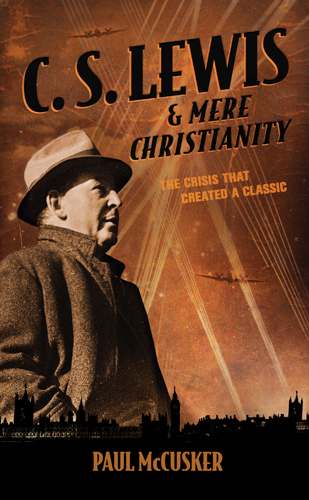
C. S. Lewis and Mere Christianity by Paul McCusker is the story of how C. S. Lewis' book, Mere Christianity came to be. It took a little bit for me to get used to the way the book was put together. The story is told, not by mere sequence of events, but also by 'flashbacks' to C. S. Lewis' history, and constantly switches from section to section from what C. S. Lewis is doing, to what is going on at the BBC, and also explanations of what world events are happening in regards to Hitler, Churchill and the war in general. I got used to it quite quickly, and it does keep the interest pretty well, though sometimes you want the part you were just reading to continue going instead of switching to a different topic.
There are also what I'll call 'information boxes', some of them very large/long, that pop up in the middle of the part you were just reading, some give biographical summaries of people who were just mentioned in the narrative, others explain different aspects of the war, and there were still other topics as well. It was a bit odd and I couldn't quite figure out if it was annoying or not. At least I know I didn't absolutely dislike them, it was just unusual to me.
This account of the making of "Mere Christianity" (of which I have only read snippets) is quite interesting. I didn't fully realize that it originated from some of the radio broadcasts Lewis did during the war on various topics related to Christianity. The book gives quite a bit of information of what was going on in his life at the time. As he was working on the scripts for the radio broadcasts, he was taking care of, and dealing with, his 'adopted' mother(who apparently was quite bossy), helping and encouraging his brother who had problems with alcohol, teaching at Oxford, doing his duties as a home guard, writing books, as well as other tasks.
I'm always a bit wary of Lewis because of his rather ecumenical views, and my perspective is no different having read this book. As an example of where I am concerned about his views, it seems that during the war Lewis felt as though he should go to a 'confessor', and convinced himself of it by thinking of a quote, apparently speaking of Christian beliefs, "Let us hold on to that which has been believed everywhere, always, by everyone", and went to an Anglican confessor, apparently continuing the practice throughout his life. I find his reasoning very flawed and dangerous, especially considering Christ's command: "Enter ye in by the narrow gate: for wide is the gate, and broad is the way, that leadeth to destruction, and many are they that enter in thereby. For narrow is the gate, and straitened the way, that leadeth unto life, and few are they that find it. "(Mat 7:13-14 ASV)
But I did find the book a very interesting read, and a very intriguing look at WWII.
Thanks to Tyndale House Publishers for sending me a review copy of this book!(My review did not have to be favorable)
This book may be purchased at Amazon
Tuesday, April 15, 2014
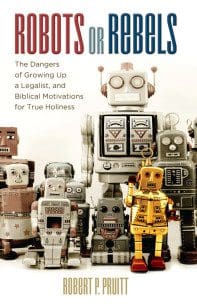
Robots or Rebels: The Dangers of Growing up a Legalist, and Biblical Motivations for True Holiness - By Robert Pruitt
In Robots or Rebels, Robert Pruitt addresses the modern manifestation of legalism that has been around since the Church first appeared in the times of the Apostles, the ones stuck in true legalism he calls 'Robots'. He also warns about rebels, who turn from legalism and flee to antinomianism. As he says in the book, ""Rebels do not love Christ and do not desire to look holy before anyone. Robots, on the other hand, desire to look holy while not realizing that true holiness only flows from the heart and life of one who sincerely loves the Lord Jesus. "
 "Too many preachers and teachers today proclaim a gospel that saves from the penalty of sin, while not necessarily saving one from bondage to sin." This leads to many who profess faith but who have no works, no holiness, to show that they are actually alive. They do not have any evidence that the Holy Spirit is working in them, no evidence that they are among the ones God has chosen to work in to do good works that He has prepared for them.
 "Too many preachers and teachers today proclaim a gospel that saves from the penalty of sin, while not necessarily saving one from bondage to sin." This leads to many who profess faith but who have no works, no holiness, to show that they are actually alive. They do not have any evidence that the Holy Spirit is working in them, no evidence that they are among the ones God has chosen to work in to do good works that He has prepared for them.
 Churches full of tares may make professing Christians do a pendulum swing and focus solely upon good works, building up a legalistic system of salvation. "Many in the church became so concerned with the sinful problems that were manifesting in the culture…that they ceased to ground people in the doctrines of the Bible. In other words, because of the need to maintain righteous lives in the midst of a more and more unrighteous culture, they sought to establish the superstructure of Christian living without the foundation of Christian doctrine." Works-salvation is not salvation but guaranteed condemnation.
And then you have your rebels who see the wrongness, or hypocrisy of the legalistic system of salvation, and many of them turn to antinomianism while holding on to the title of 'Christian'. Rebels bring reproach on Christianity as well. "In seeking to become like the world, the rebel gives indication that the Word of God, the church, the gospel, and even the Lord Jesus, can have no real impact on anyone's life. At times in order to prove that he is like the world, the rebel will live in a manner that is even more evil than is typical of those who are lost. This individual may not only live in moral corruption, but may speak violently against the things of God. When those who are lost observe such a person, they are turned away from the church, away from the Bible, and away from Christ. Rather than encouraging the lost to repent an trust Jesus, these rebels are encouraging them on their way to hell. Nothing could be more unloving."
Pruitt emphasizes that Christianity is not the following of certain rules and doing good works to earn our salvation, and it is not the freedom to fulfill our fleshly desires, rather it is the freedom bought by Christ and His righteousness to actually be pleasing to God and to do works out of love that actually please Him, it is freedom from self, freedom from sin, and it is the freedom to be conformed to the image of Christ.
Personally, I thought that the flow of the book was a little mixed up, at some points it sounded as though he was about to rebuke rebels but he goes on to critique legalists. And, this might seem a bit nit-picky, I also don't quite agree with his interpretation of 1 Corinthians 8, as he seems to think that Paul is assenting that knowingly eating meat offered to idols is okay as long as it won't hurt someone's conscience. We are going through 1 Corinthians in our church and have just reached that chapter, and it seems that Paul is not saying that it is good to eat meat offered to idols since in chapter 10 he points out that it is not really offered to idols but to demons and Christian's shouldn't have anything to do with that. So it is not just a conscience issue in that case but also, it would seem, an association issue. It is alright if a Christian eats that meat ignorantly, but not if they know where it came from, since they do have knowledge and must use it rightly.
But overall I think that it is a pretty good book. I'll end with one of my favorite excerpts that is dealing with the wrong focus on parachurch organizations, legalistic ones in particular, but this applies to any parachurch organization:
"……Adding to the fertile soil for legalistic parachurch gurus to adversely influence churches and individuals is the modern idea that we must have experts in every area of life. Rarely does a week go by that I (as a pastor) fail to receive a call informing me of a new video series that is "must viewing" for every church body. The expert on marriage relationships; the expert on child rearing; the expert on interpersonal relationships; the expert on this; the expert on that has made a video series. Surely no mere pastor can keep up with 'the experts.' And so, we are encouraged to turn our churches over to Dr. ___________. After all, he or she supposedly knows mor ethan any of the rest of us, and if we will just do what he or she says, we will all succeed in our Christian lives. This is not intended to be a blanket condemnation of everything and everyone who is part of what might be called a parachurch ministry. However, any and every time the parachruch dictates to the church rather than the other way around, parachurch is out of place. And any individual who follows a parachurch ministry more closely than his own local church has a definite problem with his priorities, since parachruch organizations are never mentioned din the Bible…….If you listen to those trying to sell many of these products you are likely to conclude that pastors just aren't necessary anymore. And why would anyone in the pew want to listen to old 'what's -his- name' week after week when they could be listening to 'the expert!'
Many thanks to Ambassador International for sending me a free review copy of this book! (My review did not have to be favorable)
This book may be purchased from Ambassador International
and Amazon.com, as well as other stores.
Saturday, June 22, 2013
Counterfeit Gospels - Treven Wax

"Christians and non-Christians are often drawn to counterfeit gospels. Even those of us who have walked with the Lord for many years may be inclined to accept cheap imitations of the truth. Why? Because they are easy. They cost us less." And one might add, "they build up our church attendance". A small section, in the chapter on the "Churchless Gospel", caught my interest in particular. Discussed is the idea of some Christians who think that we should model ourselves on the practices of the early churches as the early churches would have obviously been more pure, more godly than ours. To these people Wax poses the question, "Which early church do you want to be like? Corinth? The church took pride in a man's incestuous relationship. Meanwhile, the worship gatherings were not being done decently and in order. Galatia? Paul was shocked to see that his church so quickly abandoned the gospel…"
I didn't like the reformed/amillennial bent of the book, the sacraments, true Israel…etc. are brought up. This is also evident where Christ is talked about, speaking of evangelizing, "Just talk about Jesus!......Jesus is not merely a means to an end, such as 'heaven,' 'a purposeful life,' or 'peace through trials.' Jesus is the end." What about God the Father? Christ has reconciled us to the Father, we have "access by one Sprit unto the Father, " - Ephesians 2:16-19, "Therefore, brethren, since we have confidence to enter the holy place by the blood of Jesus, by a anew and living way which He inaugurated for us through the veil…"( Hebrews 10:19-22 NASB)See also, "Heb. 7:25, 2:10. Also, I did not particularly care for all of the movie references in the book, they seemed out of place, quite unnecessary.
But I do like the book overall. It is an interesting overview and critique of the futile attempts to improve the perfect Gospel revealed in God's Word. And now, to wrap this up, as usual, I'll end with one last quote from the book, "We must make clear that grace accepts us where we are, but that it never leaves us there."
Thanks to MoodyPublishers for sending me a free review copy of this book! (My review did not have to be favorable)
Subscribe to:
Posts (Atom)
-
This is my first time using one of Thomas Nelson's "Open Bibles", and although not my ideal version of a study Bible(I haven...
-
 The Whole Bible Story: Everything that Happens in the Bible in Plain English by Dr. William H. Marty is a book that endeavors to give you...
 -
 I was quite excited when I saw that a new English translation of the Septuagint was coming out. I'm always interested in new Septuagint ...
