Showing posts with label Bibles. Show all posts

Friday, January 10, 2020

Promises of God Storybook Bible by Jennifer Lyell


The Promises of God Storybook Bible is a high level overview of many of the accounts in the Bible aimed at children. I liked several aspects of it, for one, it doesn't shy away from teaching what many would consider 'deep' truths, that even adults struggle with.  It seems to go by the premise that kids will take God's word in faith (as we all must do). Here are some excerpts to illustrate this, "…He is only one God, but He has three persons that are all completely that one God" and, "He has always known every single thing that was going to happen, and nothing ever happens without His permission.  That means when we hear about something that happened in the Bible, where someone disobeyed God or it seems like God's plans were messed up, God's plans were never messed up. "  It doesn't shy away from concepts of God's sovereignty, for instance in dealing with Rahab the harlot it says, "God had made it so that Rahab would hear all these things, and then He changed her heart to want to follow Him."

At first I was afraid that this book would promote, or at least leave room for, Creation taking place for millions of years.  At first it seemed that it was at least leaving room for that concept as it didn't initially describe six "days", but then it actually did seem to get more specific: "God filled the water with fish and animals that swim!  Big fish and little fish.  They were all created in one second because He said they should exist." Okay, the term "One second" certainly doesn't leave room for evolution! I do wish that it would have clarified creation as taking place in six days though.

This book needs some clarification/corrective commentary if read to/by kids.  I'll give a few examples:  For one thing, the book seems to assume that there were sacrifices for sin before the Mosaic law.  It teaches that God told Abraham to kill Isaac as a sacrifice for sin. I don't remember God specifying that it would be a sacrifice for sin, just that he was to offer Isaac up as a burnt offering (were all 'burnt offerings' sacrifices for sin?).  Also, later on, in dealing with Moses, after he flees Egypt, "The Bible doesn't tell us for sure, but it seems that during this time Moses asked God's forgiveness for killing the Egyptian and made the sacrifice he had to make for that sin."  Again, perhaps I'm wrong, but I thought that sin sacrifices, in particular, were not instituted by God until the Mosaic law.   

It also reads things into some of the accounts.  For instance, it talks about Abraham being worried that God really as going to make him kill his own son.  "His heart must have been beating so hard, and he was probably had tears in his eyes as he worried that maybe God really was going to make him kill his own son." The Bible doesn't say that Abraham was worried that he MIGHT have to actually kill his son, he actually didn't seem to have any question as to whether or not he would have to kill his son, rather he seemed to have instantly made up his mind that he would kill his son because God had told him to do it.  He was all in, also evidenced by his contemplating that God can even bring people back from the dead. 

In the illustrations, Aaron looks significantly younger than Moses - that seems weird as Aaron was older than Moses.  Also, and I expected this, but there are illustrations of Christ.  I always feel a bit uncomfortable with depictions of Christ, and still do - especially with cartoon illustrations.  These aren't as strange and irreverent seeming as some (Beginner's Bible), but still make me uneasy. 

Anyway, this book is sort of an overview/ paraphrase with some interpretative commentary thrown in.

Many thanks to the folks at B&H publishers for sending me a free review copy of this book. My review did not have to be favorable.


My Rating: Three Stars ***

This book may be purchased at Christianbook.com and Amazon.com

Friday, June 1, 2018

CSB Worldview Study Bible


The Worldview Study Bible seeks to remind Christians that the Bible is not just a book that we read to feel more religious, we are changed by it, our thinking, our worldview, our perspective of everything is changed when we use it to renew our mind.

This Bible has many articles in it, scattered throughout and dealing with various 'worldview' topics, articles like: "Biblical Models for Business", "Engaging LGBT Advocates", "Emperor and King Worship in Biblical Times", "Animal Rights" , "A Biblical Assessment of Abortion", and so on.  Some of the articles are quite interesting and helpful.  Others, I had some trouble with some of the content.  For instance, in the article on "Biblical Formation",  dealing with various ways one can utilize the Scriptures, it says, "Praying through the Bible flows naturally from Scripture meditation.  Giants of the faith, such as Martin Luther, Charles Spurgeon, and especially George Mueller, made a habit of praying through Scripture…..Praying the Scriptures helps to assure that one's prayers are biblically sound and pleasing to God."

 I think that if praying through the Scriptures was a way to pray correctly, then Christ would have told the disciples to grab some copies of portions of the Old Testament and pray them. He could have demonstrated by quoting one of the Psalms, or a passage of Isaiah.  But instead he gave them a model prayer.  How does one pray through the book of Leviticus? Or Judges? Should we pray the imprecatory songs, while thinking of a particular person who hates us when we are told in the New Testament to "Love our enemies"?  How would we know that the Scripture we are praying is the right scripture for us to be praying at that moment?  The Apostle Paul shows us that it is already assumed that we will have trouble praying biblically sound prayers, that we do not know how to pray correctly, but that's where the Holy Spirit comes in, "And in like manner the Spirit also helpeth our infirmity: for we know not how to pray as we ought; but the Spirit himself maketh intercession for us with groanings which cannot be uttered;"(Rom 8:26) The Spirit wouldn't need to intercede for us if we already knew how to pray as we ought, and the Bible doesn’t say that we ever will get to a point where we know how to pray correctly, this side of eternity.  That's where our Helper comes in. 

And then, there is an article that seems to downplay the validity of Christian young earth creationists arguing with Christian old earth creationists, as if they should focus on arguing their common enemy (atheistic evolutionists) rather than debate the validity of each other's hermeneutic. But don't we remember that bad doctrine will most likely come from within the "church"?  Aren't we to look out for our brethren and correct them in a fault? Aren't we judging those within the church, see 1 Cor 5:12 (I know, that passage is dealing with practical moral sins, not necessarily bad viewpoints, but its implications may apply here as well), aren't we critiquing the viewpoints of those within our midst, making sure that we all have an accurate view of God's Word? We don't expect the world to listen to us, we don't expect the world to ever have a correct viewpoint, but we do want to help our brethren, fellow Christians, stay away from dangerous hermeneutics.  We are our brother's keeper.      

This Bible also has a good deal of commentary.  A lot of it seems pretty useful, and using a literal grammatical historical hermeneutic.  For instance, in the commentary on Jeremiah 29:11 it says, ""While it is true that from an eternal perspective God has good plans for believers (Ps 84:11; Rm 828), this of cited verse should be understood first with respect to its addressees; exiles who would have to wait an extended time for God to restore them…"  But the hermeneutic seems to change in spots, like in Revelation, where it speaks of the 144,000, "The number 144,000, with multiples of twelve and multiples of ten (completeness), is symbolic of the entire people of God.  That the tribe of Dan is missing while Joseph as well as Manassah (Joseph's son) are listed further supports the symbolic nature of the list."  Huh? How do those things clue us in to this section's not being literal?  The context would seem to indicate that it should most certainly be taken literally. After the description of these tribes, the VERY NEXT verse says,  "After this I looked, and there was a vast multitude from every nation, tribe, people, and language, which no one could number".  Differentiating this group of many peoples from the sealed of the twelve tribes of Israel.  How much clearer, could it be?  It differentiates between those in Christ who were sealed from Israel, and points out a more inclusive group later on, encompassing all peoples?  How much clearer could John get in describing what he saw? Does he have to go through each tribe and say, "And I heard the number of the sealed, 144,000, sealed from every tribe of the sons of Israel: 12,000 from the tribe of Judah were sealed, Judah was the son of Jacob (also called Israel), the son of Isaac, the son of Abraham, born in the year such and such.  The tribe of Judah was made up of all of the living descendants of Judah.  The first descendant's name was George, the second, Robert…..the 12,000th, Charles.  And I also saw that their physical features resembled Judah's.  12,000 from the tribe of Reuben were sealed, Reuben was the son of Jacob (also called Israel), the son of Isaac…." Would that make it more likely to be literal?  I suspect that some would think that the more detailed it gets, the more figurative it is.  Omissions and replacements of tribes does not mean that this is not to be taken literally, it probably should be taken VERY literally and the omission of Dan might be significant in some way, taken as such.  We shouldn't assume that the omission of one of the original tribes indicates that this is not Israel.  Why would God HAVE to choose men from the tribe of Dan to be sealed in order for this to be literal, ethnic Israel? Do we not remember what Paul tells us in Romans 9?  Not all Israel is Israel, and that God has the right to choose whomever He wishes within Israel (even individual tribes).     

This "Worldview" Bible has a lot of good notes, and some interesting essays, I just don't like some of the concepts in the essays, nor do I like the inconsistency in the hermeneutics.  Also, the essays scattered throughout seem a bit too distracting.  I think that if you are going to put multiple essays in a Bible it would be better to put them at the end of the book, and then you can just look up the page number in the index if you want to read a particular article, instead of it breaking up the text.  

This particular study Bible is okay but not great.            

Many thanks to the folks at B&H publishers for sending me a free review copy of this Bible! My review did not have to be favorable.    

My Rating: 3 out of 5 Stars
***

This Bible may be purchased at Christianbook.com and at Amazon.com

Saturday, March 3, 2018

CSB Kids Bible


The CSB kids Bible is a pretty nice Bible. As to its physical characteristics of this Bible, it is a very colorful hardcover which kids will probably like.  Even the edges of the pages are colored.  I do want to note that on the inside of the front and back cover has an orange crinkly pattern, at first I thought that the pages were damaged, but on closer examination I realized that it was just a picture.

 It has some colorful pages scattered at wide intervals through the Bible.  Many of them have summaries of what each book of the Bible contains.  They give descriptions like, "Matthew was originally written for the Jews and shows Jesus as the Messiah and King, in whom the Old Testament prophecies were fulfilled." Many of them give pretty good descriptions but I didn't like all of their summaries as some seem to be leaning toward a "Christocentric" hermeneutic instead of a literal, grammatical, historical one.

Some pages have maps, and others have lists of verses dealing with various topics, like the miracles of Jesus, or "Kids in the Bible" where they list many passages that give accounts of children.  I'm sort of surprised that they didn't include the  account of the boys who called Elisha "Baldy!" (2 Kings 2) , Elisha cursed them and bears came and mauled many of the children. Yeah it's graphic, but it's an account of children and they had the account of Cain and Able (whom Cain murders), which most kids probably already know, so why not that one? Most kids probably don't know that account. I'm saying that partly to be funny but I'm also sort of serious.  Why just include the most 'famous' accounts and not the more obscure?

 Anyway, back to what these pages contain, there are a couple of pages with illustrations of the twelve disciples (as a kid I probably would have liked looking at that page in particular)with some descriptions of what they did and who they were.  I did find it amusing that they didn't really have any information to give concerning some of the disciples. For instance, under "James, Son of Alphaeus" they say, "The Bible tells nothing about this man except his name."

As to the translation, it is a pretty good one.  I do wish that they would list more textual variants in the footnotes though.  For instance, in Psalm 40 vs 6, where it says, "you do not delight in sacrifice and offering; you open my ears to listen." I didn't like that they didn't include a footnote for that verse giving the Septuagint variant , which, instead of referencing "ears" being opened, says, "a body you have prepared for me".  That is an important variant because it is quoted in the New Testament by the author of Hebrews.  If kids follow the verse reference in Hebrews 10 back to the source of the quotation in the Psalms they may be confused that the author of Hebrews seems to be misquoting a prophetic text. 

And then in their page on, "How Do I Have Quiet Time With God?" there was something else I felt rather wary about.  After being instructed to pray about various things, the kids are told to "Listen for God to speak to you".  So listen for an audible voice? Wait for an inward feeling? That just seems like quite a mystical thing to do. 

Parents may also want to know that at times this Bible version can be more 'modern' in translating certain words.  For instance, when referring to physical relations, at times they will translate it, "So-and-So was intimate with his wife" but at others, they are more modern.  For instance, where the men of Sodom see the Angels that come to bring Lot and his family away, they have them as saying, "Send them out to us so we can have sex with them!"

Those things being noted, I like the translation overall.  And parents can talk to their kids about any concerns they have about any extrabiblical information and instructions that this Bible includes.

Overall, this is a nicely bound Bible that has some colorful inside pages, as noted above, and even includes a small topical concordance in the back. I particularly like the font size, it is nice and big, kids should have a pretty easy time reading it. Overall I think this would be a pretty handy Bible for kids. 

Many thanks to the folks at B&H Publishers for sending me a free review copy of this Bible (My review did not have to be favorable)!

My rating:  4 out of 5 Stars
****

This book may be purchased at Amazon.com and at Christianbook.com

Saturday, December 23, 2017

CSB Notetaking Bible (Sage, Cloth over board)


This Bible is very beautifully bound.  It is one of the prettiest cloth bound books I've ever seen.  With a green edge (or "sage"), and a stitching pattern dividing it from the floral design set against a white background.  The cover also seems quite durable.  Of course, the prettiness of this Bible doesn't amount to much if the translation isn't very good, but I can assure you that the translators did a pretty good job.

 It lies flat easily and has a ribbon marker. The pages are a bit thin for writing, a bit transparent too (you can see the writing through the page) it would be nice if they would a bit thicker.  I also wish that the font for the Biblical text would be a bit bigger, it is very small and I'm a bit afraid that one's commentary and notes would  be more prominent than the text itself.  But I think it still serves its purpose quite well.  It also includes a concordance and some full color maps.

This is a very pretty version of the Notetaking Bibles, and as a bonus, it also comes in a pretty box!  I'll be using it as a Christmas present for one of my younger sisters. 


Many thanks to the folks at B&H publishing for sending me a free review copy of this Bible (My review did not have to be favorable)!

My Rating:  4 out of 5 Stars
****

This book may be purchased at places like Christianbook.com and Amazon

Monday, October 2, 2017

CSB Reader's Bible


The CSB Reader's Bible is designed to make it easy to sit down and just read each individual book. It is more along the lines of how it would have been read by the early Christians whose Bibles (or sections of the Bible/individual letters) were not divided into chapters and verses until many, many years after the Apostles had died. The text of this "Reader's Bible" is in a single column, like a regular book, instead being placed in two columns.  It has no chapter numbers and no verse numbers.  

This edition is a nice looking grey cloth over board volume, and includes an attached ribbon marker.  The font is a nice size and seems about the size of a regular book's font and is a very readable edition. I do want to note that the pages are very thin and quite flimsy, much like, or exactly like, a regular Bible's pages. I think that the edition would be nicer if the pages were the same thickness as a regular book's.  But perhaps they would have to divide it into several volumes if they did that, and it might be heavier as well.  This one still works very well.

The only real problem I have with this Reader's edition is that, though they do remove the chapter numbers, they leave the chapter breaks and make the first letter of each 'chapter' large (and colored blue). To me that rather defeats the point of removing the chapter numbers.  I don't necessarily mind chapter breaks in the narrative portions, and other portions that require it to make reading easier, though I do wish they would leave them out altogether in the Epistles/letters.  I do wish that they had taken advantage of the reader oriented design and completely revamp the chapter breaks to make the text flow more smoothly than a regular Bible's which have (at least to my mind) some unnatural chapter breaks that disrupt the flow of thought.  For example, here is how a portion of Malachi reads:

"I will have compassion on them as a man has compassion on his son who serves him.  So you will again see the difference between the righteous and the wicked, between one who serves God and one who does not serve him.

 CHAPTER BREAK  

For look, the day is coming, burning like a furnace, when all the arrogant and everyone who commits wickedness will become stubble."

Or as another example, in Acts, where Stephen is brought before the Sanhedrin:  "And all who were sitting in the Sanhedrin looked intently at him and saw that his face was like the face on an Angel.

CHAPTER BREAK

'Are these things true?' the high priest asked.  'Brothers and fathers,' he replied, 'listen…."

They could have omitted the chapter breaks, kept the text together and these texts would read much better without interruption. 

But all in all, this is a very nice Reader's Bible.  I really like the idea of going closer to how the text was originally laid out.  It is nice having other Bible editions around without the extra numbering and unnecessary dividing of the text. Again, I am not against chapters and verses, but editions like this truly do make the Bible more 'readable', as it were, and helps one to remember that "context is king".  Rather than viewing the Bible as little chunks of numbered statements that can be divorced from their context, it lends more to one seeing the text as an inspired whole. 


Many thanks to the folks at B&H/Lifeway for sending me a free review copy of this book. (My review did not have to be favorable)

You may purchase this book are Amazon.com and Christianbook.com

Sunday, July 9, 2017

God's Smuggler - Young Reader's Edition

God's Smuggler by Brother Andrew with John and Elizabeth Sherrill: Young Reader's Edition is quite an interesting read.
It gives you an overview of the life of 'Brother Andrew, as he later became known, he was a Bible smuggler.

Andrew, like everyone, did not start out life as a Christian, he was struggling with life-purpose into his early adulthood.  He became a Christian and had a growing desire for knowledge of the Word of God and an eagerness to put into practice what he learned and to share the Gospel with others.

After becoming a Christian, Andrew became aware of, and concerned with the peril of churches in countries that were under communist rule.  He found that the Bible, in many of those countries, was scarce and hard to obtain, despite the idea being touted by the communists that they promoted freedom of religion.  In some countries there were no Bibles being printed, in others there were plenty of Bibles available but hardly anyone was interested in owning one, and in one country the communists advertised that they were printing their own translation of the Bible, but they delayed its publication and did not allow any other publication of Bibles.  Andrew sees a ministry opportunity in this need for Bibles and starts smuggling Bibles into those countries.  This book details many of the ways that God protected Andrew and his co-workers in their getting the Bibles past the various country borders.

 I do need to mention a couple of things that I didn't feel comfortable with the prophetic 'impressions' that Andrew and other people had about certain things: Feeling positive that God would give a car, or getting a confident thought that God would not let authorities harm them on a certain day.  How does one know that one's confidence is in God at those moments and not merely in one's own feelings/desires? Perhaps this may be considered a drastic example, but what if I am locked up in jail for being a Christian and I'm not given any food.  I will  think that I need food, I may even have an impression that God will supply it, but what if it turns out that God wants me to starve, die and be with Him?  That was my problem, and the fact that Andrew never seemed to believe that God would ever say "no" to anything he asked (like getting a helpmeet for instance).  I know that they didn't mean it this way but it could come across to a kid as if God will give you any material, earth-based thing for which you ask. 

But other than those things I really liked the book.  One of my favorite parts to read was of a time before Andrew became a Bible smuggler.  He went to a missionary training school, and quite a unique one!  The school actually sounded like a real mission school based on faith in God and His provision rather than teaching potential missionaries to solicit people for funds and help.  "The real purpose of this training….is to teach our students that they can trust God to do what He said.  He would do……They cannot be effective if they are afraid or if they doubt that God really means what He says in His Word."   On their practice Evangelistic trips they would be sent out with only one pound, and would rely upon God to supply their needs and His supplying did not merely take the form of money, it also took the form of food and clothes being given at just the right time.  That seems to be a more biblical form of missionary activity than what one sees nowadays, and more faith-based.  I know that all missionaries are not like this, but many come across as if they focus on money  and the help of people   If they really are called to the mission field, God will give the needed supplies even without them going to people for help.   So I was very refreshed to see the perspective of the people in this book in regards to their trust in God to supply all their needs.

 I believe that I would have liked this account a lot as a kid and a teenager.  It was very well written, intriguing and it left me wanting more.  It is quite fascinating to see what God has done in the lives of other Christians and to see the various circumstances God put them in in order to conform them to the image of Christ and to bring the Gospel to other people.   I think that this was an abridgment of the original work and so one can probably find an unabridged copy of this account if one wants to learn more (which I will probably end up doing).

Many thanks to the folks at Cross Focused Reviews for the free review copy! 

A couple of the websites where one may purchase this book are Amazon.com and Christian Book Distributors


Wednesday, April 5, 2017

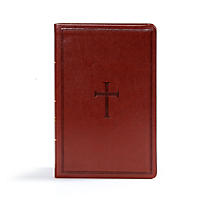
CSB (Holman) - Ultrathin Reference Bible - Brown Leathertouch

The Christian Standard Bible is a new revision of the Holman Christian Standard Bible.  They have made some changes, and it seems to me that many of those changes are toward a more literal translation, which is a good thing. 

Here are some samples:

In Matthew 19:28 the HCSB renders it:
"Jesus said to them, 'I assure you: in the Messianic Age, when the Son of Man sits on His glorious throne…" This new revision has it as, "Jesus said to them, 'Truly I tell you, In the renewal of all things, when the Son of Man sits on His glorious throne…'" - CSB

Not that I'm disputing that the renewal of all things references the Messianic age, it's just that "the renewal of all things" is a more literal rendition of what Christ said, more toward a formal equivalence rather than a dynamic one - which I believe is a safer route.

To some degree the same holds true with the following:

Daniel 9:25:"Know and understand this:  From the issuing of the decree to restore and rebuild Jerusalem until Messiah the Prince will be seven weeks and 62 weeks…" HCSB

"Know and understand this:  From the issuing of the decree to restore and rebuild Jerusalem until an Anointed One, the ruler, will be seven weeks and sixty-two weeks" CSB

1 Peter 3:1-2: "In the same way, wives, submit yourselves to your own  husbands so that, even if some disobey the Christian message, they may be won over without a message by the way their wives live when they observe your pure, reverent lives." HCSB

"In the same way, wives, submit yourselves to your own husbands so that, even if some disobey the word, they may be won over without a word by the way their wives live when they observe your pure, reverent lives."  CSB

The translators also switched "languages" in 1 Corinthians 14 to "tongues", though I still think that Languages was a good translation.

There are also noticeable changes in the way the translators interpret the text, for example, in 1 Corinthians 7, where Paul is explaining that if a husband or a wife has an unbelieving spouse who wants to leave them, that they should let them leave, they then translate his next words as, "Wife, for all you know, you might save your husband.  Husband, for all you know you might save your wife." CSB  Whereas the HCSB said, "For you, wife, how do you know whether you will save your husband?  Or you, husband, how do you know whether you will save your wife?"  - 1 Cor 7:16?   Which is a rather significant change.

There were some things that I did not like about this translation.  For instance, they seem to have caved a little bit more on the gender inclusive language - 1 John 3:17  "If anyone has this worlds goods and sees a fellow believer in need but withholds compassion from him -how does God's love reside in him?" CSB

"If anyone has this world's goods and sees his brother in need but closes his eyes to his need - how can God's love reside in him?"   HCSB  They do note that their goal is to translate the Bible faithfully, they simply change some gender specific language to gender inclusive when the text itself allows for it. I still don't think that that is necessary, but okay.   

And then there is a problem that I had with the HCSB that I still have with this revision.  One of which is that, despite saying in their introduction that their "OT Textual notes show IMPORTANT differences among Hebrew (HB) manuscripts and ancient OT versions, such as the Septuagint…(emphasis mine)", they do not include the LXX variant of Psalm 40:6, Sacrifice and offering thou wouldest not; but a BODY hast thou prepared me: (Brenton- Emphasis added), Whereas the Masoretic text (which only goes back to about 900 A.D. [or CE]), the text the Majority of our Old Testaments are based on, says, Sacrifice and offering thou didst not desire; MINE EARS HAST THOU OPENED: burnt offering and sin offering hast thou not required." (KJV - emphasis added).  The difference is extremely significant as the writer of Hebrews quotation of that verse matches the Septuagint and not our Masoretic text in that it says that God prepared a body for the speaker rather than opened his ears.   And yet they include a manuscript variant of the number of the beast, 616 - which variant is quite suspect as Irenaeus (a person who lived in the earlier days of the church who is thought to have been a follower of Polycarp a follower of the Apostle John) said that this variant was false, and that the older manuscripts did not contain it nor did those who knew the Apostles support it.  If they included this variant of the number of the beast then I do not  understand how they did not give the variant of Psalm 40 which is supported by the writer of Hebrews in the Bible!

One other thing that confused me:  The CSB is presented as having been translated directly from the original languages rather than using an existing translation as its basis. There is a chart on the website for this translation showing many translations and separating them on the basis of whether or not they are translated directly from the ancient languages as opposed to using an existing English translation as the basis.  The CSB is shown to be a translation not based upon an existing translation. But to me this seems to be contradicted by the admission that the CSB is a revision of the HCSB.   That just struck me as rather deceptive.  Perhaps I simply didn't understand the chart….

Otherwise, this is quite a nice translation  Also, this Bible is very nicely bound, with a LeatherTouch cover (it feels very nice).  The text is in two columns with a center column cross reference.  There is also a concordance at the back as well as full color maps.  All in all, very nice.


Many thanks to the folks at B&H publishers for sending me a free review copy of this book (My review did not have to be favorable).

My rating: 5 out of 5 stars
 *****

Among other websites you may purchase this Bible at Christianbook.com and on Amazon.com

Tuesday, January 3, 2017

KJV Journal the Word Bible (Large Print)

The KJV Journal the Word Bible (Large Print) is a Bible designed for those who like to write notes in their Bibles.  The text is laid out in one column on each page and next to the column of text is a ruled margin for writing  (or as is also advertised: for creating art - but I don't necessarily recommend that). 

The paper is very easy to write on with pen and pencil (I like how the pen just glides along the page).  The Bible when opened really does lay quite flat, which also helps in writing neatly.  It would be useful in writing particular exegetical comments down, noting insights from your pastor and perhaps noting other translations of particular verses.  I don't think that there is enough room to write notes on each verse on any given page,  but one normally doesn't write a lot when noting things in a regular Bible, just the things that really capture our attention and that we want to remember to associate with the text.

 I kind of wish that they would have put the writing space at the bottom of the page (as study Bibles do with commentary) instead of next to the Biblical text.  It would help with organization: one could just write a tiny number next to whatever verse a particular note pertains to and place the same number next to the handwritten commentary below for reference sake.  It  wouldn't be quite as distracting as having one's own notes right next to the text that do not necessarily pertain to the verses one is reading at the moment (as one's notes can take several lines down the side of the page and thus seem to encompass several verses). 

But I still think that this is a pretty handy Bible to have if you like taking notes in your Bible already, and you could just do the drawing arrows to the verse method of pointing out which particular verse you are commenting on. Or I suppose the numbers reference method might still work in this format as well.

 The version I have is a hardcover, but there are several other editions as well (including leather), and also other translations.

 My Rating: four out of five stars
**** 


I received a free review copy of this book from The BookLook Bloggers Program (My review did not have to be favorable). 


A couple  (of the many) websites where you may purchase this Bible are Amazon.com and Christianbook.com

Wednesday, October 12, 2016

The Cultural Backgorunds Study Bibl

The Cultural Background Study Bible is a Bible that contains a lot of information about the times in which the various sections were  written.  It has many pictures, maps and diagrams, and of course, commentary.  The Bible is pretty large and heavy, but that is to be expected with so much extra content being added to it. 

I must say that this Bible, or rather the extra content of this Bible, had a lot of unnecessary things, and even absolutely indecent things.  First, the pictures.  I don't remember if I've ever reviewed a Bible that had so many indecent pictures in it. There's the obligatory Adam and Eve (as usual, depicted before the fall of man with conveniently placed leaves), there are ancient artistic depictions of women exposing various body parts, including the lower half of the body,  there are ancient depictions of men being circumcised…and so on.  And get this, there's even a clay depiction of a woman bathing (not very detailed at all, but still…) from around, and I quote, the "eighth-sixth century  BC, a few centuries after David saw Bathsheba"! I’m sorry people (sarcastically said), but this is absolutely absurd.  Why would Christians think that looking at photographs of naked people are wrong but that it's okay to stare at a painting, statue, or etching of a naked person?????  I don't care how "ancient" the depiction is, or even how undetailed, it's still wrong.  Hasn't any one considered that some of the stuff might even be ancient pornography?  Whatever the case,  It's a denial of the fall of mankind, it's a denial of original sin, it makes it seem as though it is okay to not be ashamed to stare at other people's nakedness/shame, as long as it is ancient or artistic, and it also provides possible "stumbling blocks" to other Christians.  My understanding of the Bible is not enhanced by looking at unclothed people. 

Second, some of the commentary actually seems blasphemous. Just look at this commentary on  Isaiah 46:9:  "'I am God, and there is no other. ' The Assyrians saw their god Ashur as being the god from whom all other gods derive…In the Hymn to Aten from New Kingdom Egypt, Aten is hailed as the 'sole God beside whom there is none.'  In an environment where numerous other deities claimed power, Israel's God is not making an absolute statement of uniqueness, though he could, according to Israel's theology, rather, he is saying that the readers know his uniqueness through past experience, and this will be confirmed through future fulfillment of God's plans."  WHAT????????????? God is "not making an absolute statement of uniqueness"?  But what does God say in the VERY NEXT STATEMENT IN THAT VERY SAME VERSE ?  "I AM GOD, AND THERE IS NONE LIKE ME." This is simply shocking.  Let's look at another one:  The commentary on Proverbs 3:19:  "'By wisdom the Lord laid the earth's foundations.'  It is not unprecedented that creation is said to be the product of a deity's wisdom, in the 'Memphite Theology,' the Egyptian god Ptuah is said to produce the world through his heart and tongue, standing for his wisdom and his speech…" Sections in the Bible like this seem to be actually making the case that there WERE/ARE actually other gods like God, without taking into consideration the CONTEXT of the rest of the Bible, and even the evidence of the archeology, that states that other so-called 'gods' are not even gods at all, but rather wood and stone.  Essentially the commentators appear to think it valid to compare God to the attributes that man in his stupidity has ascribed to elaborately carved sticks and stones, and then finding "similar", though imaginary, attributes attributed to those sticks and stones they declare that God is not a unique 'god' and that He is compatible to a rock and a piece of wood.  I hope that they do not mean to do so, but this is STRONGLY implied. 

This is very awkward to say, but I don't like this Bible.  Or rather, I don't like some of the commentary and other additions to this Bible.  I don't know if I've ever said this before, but I'm saying it now:  Don't buy this Bible.  The back of this Bible says, in bold letters: "CONTEXT CHANGES EVERYTHING".  It certainly does.


I received a free review copy of this book from The BookLook Bloggers Program (My review did not have to be favorable). 

Saturday, September 3, 2016

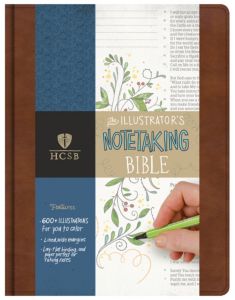
Illustrator's Notetaking Bible

The Illustrator's Notetaking Bible has a nicely bound bible, with a very handy lay-flat design, making it easy to write or color in it.  On the inside each page has only one column of text with large margins on either side.  Some of the margins have lines for writing in, many of them have pictures that one may color in (the Illustrator part). 

I like to doodle sometimes while listening to sermons, sometimes it helps me think and stay focused, so I thought that this was an interesting concept.  But upon examination it was rather disappointing.  In a way, it is reminiscent of the illuminated manuscripts of the past, except that in the illuminated manuscripts I've noticed that the text didn't seem to have as dwarfed by the illustrations as this one appears to me to do on many of the pages (perhaps they did, I just don't remember).  If the text of the Bible itself weren't so small or if it were more…I don't know, 'fancy' I guess, it would seem more fitting and more as if the text and pictures work together rather than compete. 

Some of the pictures were too much like graven images (or were exactly so) as there were some pictures supposed to be depicting Christ.  Besides the graven image thing, it just seems disrespectful to have an illustration that one can color in that is depicting the Lord of the Universe!  And then some of the illustrations in the margins seem odd placed next to certain texts.  For instance, coloring in a beautiful illustration running down the margin of a page depicting flowers and ribbons right next to the text where Jeremiah is thrown into a cistern, and where he tells Zedekiah that he will be handed over to the King of Babylon if he does not surrender to that King?  That just seems rather odd and indifferent to what the text is saying.  What illustration should you use for a spot like that? I have no idea…but probably not pretty flowers.

So, I'm not thrilled with this Bible, I wish that they had done a better job at enhancing the text and that they had not added the pictures of depicting Christ.


Many thanks to the folks at B&H/Lifeway Bloggers for the free review copy of this book! (My review did not have to be favorable)  

My Rating: 1 Out of 5 Stars

Saturday, August 13, 2016

The Murderous History of Bible Translations - by Harry Freedman

I often sense a tendency in myself to take having an English translation of the Old and New Testaments for granted.  But, as Harry Freedman demonstrates in his book, The Murderous History of Bible Translations: Power, Conflict, and the Quest for Meaning, I shouldn't take it for granted and should appreciate all the more the effort and sacrifice that went in to getting the written Word of God into a book that ordinary people could read. 

In this book Freedman does an excellent job at writing, he grasps and keeps one's attention, and it flows nicely.  He takes you through history, beginning with the translation of the Old Testament and then including the New in the focus as well.   Translating God's Word into the common vernacular of any people was often very tumultuous and controversial, and we see this down the passage of time that the author examines, and through many different translators who often took many risks to make the translation. 

Though I really like the book, I feel the need to mention that there were several things that I did not like, for instance, statements like:  ""…even to this day, radical fundamentalism hasn't gone away.  And religious extremism relies upon a revealed, unmediated, literal reading of Scripture, one which rejects the prism of human interpretation."(pg.139)  Perhaps I am misunderstanding what the author is saying, but I think that' religious extremism' is that which focuses upon the "prism of human interpretation" without interpreting the Word of God with a literal/grammatical-historical hermeneutic. To be extreme is to not take the Bible for what it says, to not interpret it literally.  Interpreting the Bible "literally" in my view is to interpret it correctly in context: taking allegory as allegory, historical narrative as narrative, prophecy as prophecy, …etc. But again, perhaps I  misunderstand what he meant by that statement.


This book seemed more or less secular look at the history of Bible translation, but Freedman did a very good job at giving the perspective of the translators (whether Christian or Jewish) whose lives he recounts.  All in all, despite statements that I disagreed with, I really liked the history given, it is very, very interesting and an informative read.  Knowing this history should drive Christians more to reading this Holy Book that people in the past translated and read in secret, suffered and died for, many considered the Words it contains as much more valuable than their lives or comfort in this earth.  Shouldn't we do the same and do God the honor of reading it?

Many thanks to the folks at Bloomsbury Press for sending me a free advance review copy of this book! (My review did not have to be favorable)

This book is slated for release on November 15, 2016

You may preorder it at Amazon and on the Bloomsbury website  (and probably from other sites as well)

Rating: 5 out of 5 stars *****

Friday, May 20, 2016

NKJV Chronological Study Bible

This edition of the Chronological Study Bible NKJV is a nicely bound chronological Bible.  It has a simple, studious looking  'Leathersoft' cover, brown in color with a big dark blue stripe across its center.  This Bible is full of extra content, almost to the point of being distractingly cluttered.  It has charts and 'timepanels', background notes,  full color illustrations (some are very neat looking while others are not very decent), and maps throughout. 

I have some problems with it though, besides some indecent works of art,  some of the notes and commentary seem rather eisegetical.   For instance, some of the notes dealing with wives being submissive to their husbands make it more of a concession to the culture of the time rather than God ordained. They say things like,  "Paul's command 'Wives, submit to your own husbands' (Eph. 5:22) is at least partly related to concern for Christian witness within the surrounding culture, and is quite mild in comparison to the rest of his culture. What is significant is that Paul modified the culture's values, calling on all believers to submit…Wives were to submit 'as to the Lord' (Eph. 522), and husbands were to love their wives 'as Christ also loved the church"(5:25)  and, "…the structure of these traditional codes was adopted in Christian letters,".

 But the reasons given in the New Testament for wives submitting to their husbands was because of the structure that God had set up, not one man had set up.  It's not that the apostles were adopting and then modifying cultural authority structures in the family and that the headship of a husband over a wife and her submission to him were just necessary cultural evils, rather they were explaining how to correctly implement the authority structure set up by God (husbands loving their wives, wives submitting to their husbands and children obeying their parents.  Ironically, the commentators in this Bible are imposing modern cultural family-structure (equality of husbands and wives = no submission required) views on the Scriptures. 

And of course, you can presume, based upon the hermeneutical method used in interpreting the above concepts in the Bible there are other things that are probably erroneously interpreted as well.  One hint of it is in their use of dates, the numbers they use (like 26,000 years ago) hint at an 'old earth' or theistic evolutionist perspective. 

Oh, and I didn't like some of the chronological arrangement.  For instance, they have some prophecies from Isaiah being read after the fall of Jerusalem.  Part of their reasoning is that, "Other prophetic passages speak of times later than the traditional date of composition for the passage itself.  For example, parts of the Book of Isaiah refer to events that took place centuries after the prophet Isaiah lived.  Though Isaiah prophesied in Jerusalem during the 8th century B. C., the passage of Isa 44:28; 45:1 refers by name to Cyrus, a Persian king who lived in the 6th century .  For this reason , some chapters form the Book of Isaiah appear in the time of Cyrus…"  Umm… didn't God have the prophets prophecy LOTS of things that hadn't happened yet?  It would hardly be unthinkable for God to have the prophets give out a particular name of someone in the future.  Besides, right before God starts prophetically addressing Cyrus He states, "I am the Lord, the maker of all things, who stretches out the heavens, who spreads out the earth by myself, who foils the signs of false prophets and makes fools of diviners, who overthrows the learning of the wise and turns  it into nonsense, who carries out the words of his servants and fulfills the predictions of his messengers."

Overall, this Bible is very nice looking inside and out (excepting the indecent pictures), but several of the above mentioned aspects keep me from recommending this Bible highly, though there are several redeeming factors, like the timelines, charts, and even other study notes that aren't so biased.  I had reviewed the NIV version of this Bible a while back but seem to have forgotten about several of the problems that I had with it.

I am grateful to have received a free review copy of this book from the Book Look Blogger program(My review did not have to be favorable)


Friday, April 15, 2016

NKV APPLY THE WORD Study Bible

I am disappointed with many of the 'study' Bibles of our day but the Apply the Word Study Bible is quite refreshing in its commitment to prompting one think to about the text one is studying.  he Bible has many "application notes" and also includes maps,  charts and little character profile boxes throughout.    It really is more of an application type of study Bible, not a linguistic study Bible but the application used seems to be mostly exegetically based. 

I think that the application notes are quite good, none of them really seem forced onto any text they're commenting on, even the ones found throughout the books of the law, and prophets, are quite good and don't seem as though someone was grasping at straws (as some study Bibles seem to do) to find an application of those seemingly tedious parts of Scripture and so they come up with some  eisegetical way to get some personal-meaning out of them.

For example, toward middle of Ezekiel one of the application notes reads:
"…when the show was over, so was the people's interest.  They heard Ezekiel's words but did nothing to put them into action.  They enjoyed the presentation but ignored the message…Their curiosity about Ezekiel's sermons did not change their lives.   When faith becomes more about entertainment than genuine commitment, we become spectators rather than players, concerned more with What is the latest word from God?  Than What am I going to do with what God has said? …Self-deception is the worst thing about a faith that exalts entertainment.  True conversion and true obedience involve not just expanded knowledge about spiritual things or good feelings toward God, but changed purposes, commitments, and actions."

Some of the application notes are quite strikingly insightful, In Luke 18, where the blind man begs Christ to have mercy on him there is a note entitles "Holy Interruptions", part of which reads: "Jesus didn't treat these interruptions like intrusions, He let needy people elbow into His life, even when His closest ffriends tried to block their way.  In fact, one could argue that Jesus did much of His work during moments of interruption.  We often grown annoyed at disruptions, feeling as if life has been put on hold.  When are we missing out on some of life's holiest moments?" Though I have heard of similar concepts/teachings about 'holy interruptions',  I had never noticed their significance in Christ's life before and His handling of them.

There were some problems that I had with it though, for instance, some references that were made to specific times when Christians "enter into the presence of God" which concept really seems to discount His omnipresence and His promise never to leave us or forsake us.    I also don't like that some of the notes call the land of Israel 'Palestine', I thought that the land did not become 'Palestine' until Hadrian's day, not to mention that in our day it’s basic area is the state of Israel.  I didn't understand why they didn't call that present day land area 'Israel'.

And then there were some things that seemed laughably odd to me (though they didn't mean them to be),  three samples of which I'll give here. First:  in the intro to each book of the Bible there are lists of key people in that book and key events..etc.  Among the key people of 1st Chronicles is "Sheerah, an Ephraimite woman who built three cities".  Umm…that just seems odd to me as, though she is mentioned, she hardly seems "key" to the account of book of 1st Chronicles. Second: In a chart comparing Joshua and Paul entitled "Profiles of Leadership" the two men are compared to each other, and in the section "Early indications of leadership potential" one of Paul's early leadership displays was  that he "Aggressively tried to stamp out Christianity"?  That just seemed too odd of an example  in my opinion.  And the last that I'll mention is the notes on Matthew 13 where Christ tells some parables, here is a tiny excerpt from the notes, "Jesus captivated listeners by putting spiritual truths into everyday terms they could understand.…His images and language brought His message to life for ordinary people."  But if the author of those notes would have just read vs. 10-17 of that very chapter they would realize that they are contradicting what Jesus said, when the disciples asked Him why He spoke in parables He said that He spoke in parables so that the people WOULD NOT UNDERSTAND!!  Even the disciples did not understand until Christ explained the parables to them.


 But, excepting all of the above and some other things, I was pleasantly surprised at the format and study content of this study Bible.  I have read too many Christian books and even, if I remember correctly, study Bible notes that seem too, for lack of a better term, "lovey-dovey", too "God is in love with YOU!", too uncomfortably and almost irreverentially romantic.  This study Bible is refreshingly un-overly-sentimental…if that makes any sense.  

I received a free review copy of this book from the BookLook Blogger program (My review did not have to be favorable)

This Bible may be purchased at (among other places) CBD and Amazon.com

Friday, December 4, 2015

ICB translation: The Frost Bible

I must admit, I liked the cover of this Bible (the 'Frost Bible') decorated with snow and sparkles and that was one of the reasons I requested this book in order to review it.  I am not an advocate of choosing a Bible because of its cover, and am generally uncomfortable with Bibles that are aimed towards a specific gender (mainly because of their study notes that may run into danger of eisegesis by trying to direct the thinking into a more egotistical interpretation of Scripture) , but this one, other than its being appealing to girls by its cover (as I am proof of) is otherwise a fairly basic Bible.   

My motives in requesting this Bible were not wholly material in nature, I had never heard of the International Children's Translation before and was very curious about it.   It seems to be a rather literal translation overall.  They explain in the preface about some liberties they took in translation, such as clarifying ancient customs, changing Rhetorical questions to statements, "showing the implied meaning, as in this example:  'No one is equal to our God,' instead of 'Who is equal to our God?'", editing figures of speech, idiomatic expressions ('he rested with his fathers' is changed to, 'he died')…etc.   Some of the writing style reminds me of the Dick and Jane books, short sentences with a lot of periods for punctuation. But it still reads quite well.  Here's a sample from Genesis 42: 1-4:  "Jacob learned that there was grain in Egypt.  So he said to his sons, 'Why are you just sitting here looking at one another?  I have heard that there is grain in Egypt.  Go down there and buy grain for us to eat.  Then we will live and not die.'  So ten of Joseph's brothers went down to buy grain from Egypt.  But Jacob did not send Benjamin, Joseph's brother, with them.  Jacob was afraid that something terrible might happen to Benjamin."

The translation appears to be quite good to me, and very understandable for kids.  One of the passages I always go to in Bibles to help give me an idea of the general literalness of the translation is Romans 9:13, and this translation doesn't try to soften it which is a good sign:  "As the Scripture says, "I loved Jacob, but I hated Esau." 

Here are some other excerpts to help give you more of an idea of how this translation reads: 

Rom 8:28, 30. "We know that in everything God works for the good of those who love him.  They are the people God called, because that was his plan…God planned for them to be like his Son.  And those he planned to be like his Son, he also called.  And those he called, he also made right with him.  And those he made right, he also glorified." 

2 Tim. 3: 14-17:  "But you should continue following the teachings that you learned.  You know that these teachings are true.  And you know you can trust those who taught you.  You have known the Holy Scriptures since you were a child.  The Scriptures are able to make you wise.  And that wisdom leads to salvation through faith in Christ Jesus.  All Scripture is inspired by God and is useful for teaching and for showing people what is wrong in their lives.  It is useful for correcting faults and teaching how to live right.  Using the Scriptures, the person who serves God will be ready and will have everything he needs to do every good work."  

The Bible has some fancy pages (with snowflakes of course) scattered throughout with little tidbits on topics like, "How Do I Pray?" , "How Do I know Jesus Better?" and "Knowing Jesus Better".  For the most part those sections seem okay, though I might have an issue with some of the memory verses they suggest like Jeremiah 29:11 which is usually taken out of context and applied specifically to Christians when in actuality it was a promise to the physical descendants of Jacob, not necessarily to present day Gentile Christians.  I just had to mention that. 

Overall, I thought this translation was pretty good. 

 
The FTC guidelines require me to state that I received this Bible for free from the publisher in exchange for an honest review (my review did not have to be favorable).  Many thanks to the BookLook blogger program.

Amongst other places, this book may be purchased at Amazon